

AC Not Blowing Cold Air? Here's What's Actually Wrong
It's 85 degrees outside, the humidity is climbing, and your air conditioner is running—but the air coming out of the vents feels like a weak ceiling fan. Maybe it's barely cool. Maybe it's room temperature. Either way, your house is getting warmer, and you're getting frustrated.
We've been answering emergency AC calls across Southeast Michigan for over 35 years, and "AC not blowing cold air" is the number one complaint we hear from June through August. The good news? Most of these problems have clear causes—and some you can check yourself before calling us.
This guide walks through the seven most common reasons your AC isn't cooling, what's actually happening inside the system, and when you need a licensed HVAC contractor to step in. No fluff. Just what we've learned from thousands of service calls in Macomb County, Oakland County, and St. Clair County.
How Your AC Actually Cools Air (The Quick Version)
Before we dig into what's wrong, here's what's supposed to happen when your AC is working correctly:
Your air conditioner doesn't "create" cold air. It removes heat from the air inside your home and moves it outside. This happens through a closed-loop refrigerant cycle:
- Indoor evaporator coil: Refrigerant absorbs heat from the air passing over the coil. The blower pushes this now-cooled air through your ductwork.
- Compressor: Pressurizes the refrigerant and pumps it to the outdoor unit.
- Outdoor condenser coil: Releases the absorbed heat into the outside air.
- Expansion valve: Reduces refrigerant pressure so the cycle can repeat.
When your AC isn't blowing cold air, something in this cycle is broken. The refrigerant isn't absorbing heat, the airflow is restricted, or a component has failed. Let's walk through the most common culprits.
7 Reasons Your AC Isn't Blowing Cold Air
1. Low Refrigerant (The Most Common Cause)
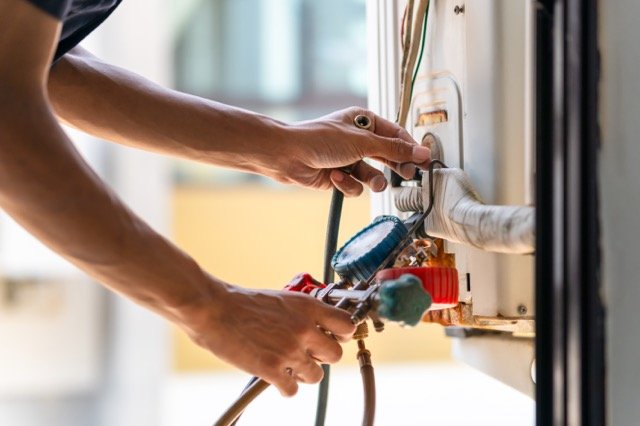
If your AC is running but barely cooling, low refrigerant is the first thing we check. Refrigerant doesn't "run out" like gas in a car—it's a closed system. If the level is low, you have a leak somewhere.
What you'll notice:
- Ice forming on the refrigerant lines or evaporator coil
- Hissing or bubbling sounds near the indoor or outdoor unit
- The AC runs constantly but never reaches the set temperature
- Higher-than-normal electric bills (the system works harder to compensate)
Most systems in Southeast Michigan built before 2010 use R-22 refrigerant (Freon), which was phased out in 2020. If you have an older system with an R-22 leak, recharging it is expensive—often $150+ per pound, and a typical recharge takes 3-5 pounds. Newer systems use R-410A (Puron), which is more affordable and environmentally friendly.
What needs to happen: A NATE-certified technician locates the leak, repairs it, and recharges the system to the manufacturer's specification. This isn't a DIY job—refrigerant handling requires EPA 608 certification.
Michigan Reality Check: We see refrigerant leaks more often in homes with outdoor units sitting directly on the ground or surrounded by overgrown landscaping. Vibration, corrosion, and physical damage from lawn equipment are common causes.
2. Frozen Evaporator Coil
When the evaporator coil freezes, it can't absorb heat. You'll get weak airflow and zero cooling. Sometimes homeowners notice ice on the refrigerant lines running into the furnace or air handler.
What causes it:
- Restricted airflow (dirty filter, blocked return vents, closed registers)
- Low refrigerant (see above)
- Blower motor failure or dirty blower wheel
- Running the AC when outdoor temperatures drop below 60°F
In older Michigan homes—especially 1960s ranches with original ductwork—we often find undersized or poorly designed return air pathways. Not enough air moves across the coil, the temperature drops too low, and condensation freezes.
What needs to happen: Turn off the AC at the thermostat and let the coil thaw (this can take 4-8 hours). Replace the air filter. If it freezes again after restarting, call a technician to diagnose the root cause.
3. Dirty or Clogged Air Filter
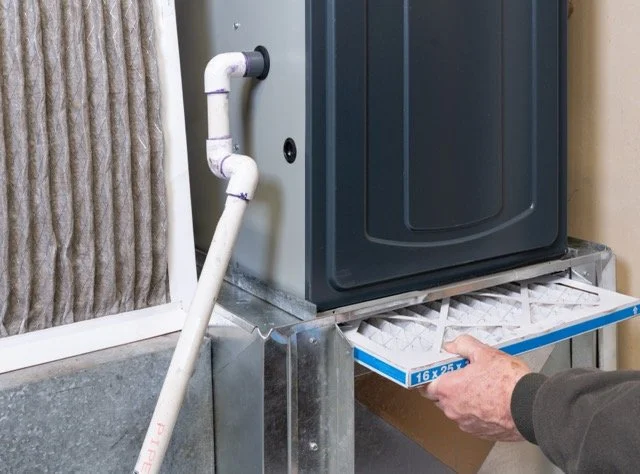
This is the simplest fix, and it's shocking how often it's the problem. A clogged filter chokes airflow, which causes the evaporator coil to freeze (see above) or forces the blower motor to work harder than it should.
How often to replace: Every 1-3 months, depending on your home. Homes with pets, high dust, or poor outdoor air quality (near construction, gravel roads) need monthly changes. If you're using a high-MERV filter (MERV 11-13), check it more frequently—they trap more particles but also restrict airflow faster.
We covered this in detail in our guide on HEPA vs. MERV filters for Michigan homes, but the short version: use a MERV 8-11 filter unless you have specific air quality concerns, and check it monthly.
What needs to happen: Pull out your filter and hold it up to the light. If you can't see light passing through, replace it immediately. Keep a few extras on hand during cooling season.
4. Condenser Unit Problems (Outdoor Unit)
The condenser unit outside your home does the heavy lifting—it releases the heat your AC pulled from inside. If it's not working correctly, the refrigerant cycle breaks down.
Common issues:
- Blocked or dirty condenser coils: Cottonwood seeds, grass clippings, leaves, and dirt coat the coils and block airflow. We see this constantly in Sterling Heights and Clinton Township during late spring.
- Failed capacitor: The capacitor gives the compressor and fan motor the electrical jolt they need to start. When it fails, the outdoor unit hums but doesn't run.
- Compressor failure: The compressor is the heart of the system. If it fails, the AC won't cool at all. This is usually a $1,200-$2,500 repair, and on systems older than 10 years, replacement often makes more sense.
- Fan motor failure: If the fan isn't spinning, heat can't escape the condenser coil.
What needs to happen: Clear debris from around the unit (maintain 2 feet of clearance). Gently spray the condenser coils with a garden hose from the inside out—never use a pressure washer. If the fan isn't spinning or the unit isn't running, call a technician.

5. Thermostat Issues
Sometimes the AC is working fine—the thermostat just isn't telling it what to do.
What to check:
- Mode setting: Make sure it's set to COOL, not just FAN. In FAN mode, the blower runs but the compressor doesn't, so you get room-temperature air.
- Temperature setting: The thermostat needs to be set at least 3-5 degrees below the current room temperature to trigger cooling.
- Calibration: Older thermostats can drift out of calibration. If the thermostat reads 72°F but the room feels like 78°F, it's not calling for cooling when it should.
- Location: Thermostats in direct sunlight, near heat sources (lamps, TVs), or in dead-air corners give false readings.
We've seen thermostats mounted on exterior walls in older Michigan homes—they read colder than the rest of the house in winter and warmer in summer, throwing off the whole system.
What needs to happen: Verify settings. If the thermostat is old (10+ years) or poorly located, consider upgrading to a programmable or smart thermostat. We install and configure these as part of our HVAC services in Metro Detroit.
6. Ductwork Leaks
Your AC might be producing cold air just fine—but if 20-30% of it is leaking into your attic, crawl space, or basement before it reaches the living areas, you'll never feel comfortable.
Ductwork leaks are extremely common in Michigan homes built before 1990. We routinely find:
- Disconnected or poorly sealed duct joints
- Torn or crushed flex duct in attics
- Gaps around return air plenums
- Undersized return ducts that can't move enough air
If you have uneven heating or cooling (some rooms freezing, others hot), ductwork is likely part of the problem.
What needs to happen: A proper duct inspection and sealing job. This isn't a DIY project—it requires access to crawl spaces and attics, specialized mastic sealant or metal tape (never cloth duct tape), and sometimes duct redesign.
7. Undersized or Aging AC Unit
If your AC has always struggled to keep up on the hottest days, it might be undersized for your home. This happens when:
- The original installer didn't perform a Manual J load calculation
- You've added square footage (finished basement, addition) without upgrading the system
- Your home has poor insulation or old windows that let heat pour in
Air conditioners also lose efficiency as they age. A 15-year-old system might have a SEER rating of 10, while modern units hit SEER 16-20. That's a 40-50% efficiency difference. Even if it's "still running," it's working twice as hard and costing you more every month.
Most AC units last 10-15 years in Michigan. If yours is in that range and struggling, replacement is usually the smarter investment than pouring money into repairs. We covered this in depth in our post on what a new central air conditioner actually costs in Michigan.
What needs to happen: A load calculation to determine the correct size, followed by a system replacement with a properly sized unit from Carrier, Lennox, Trane, or another quality manufacturer.
What You Can Check Before Calling a Tech
Before you schedule a service call, run through these four quick checks. They take less than 10 minutes and solve the problem about 30% of the time.
1. Check Your Air Filter
Pull it out and hold it up to the light. If you can't see light passing through, it's restricting airflow and needs immediate replacement. This is the single most common cause of "AC not cooling" calls we get.
2. Verify Thermostat Settings
Make sure it's set to COOL mode, not just FAN. The temperature setting should be at least 3-5 degrees below the current room temperature. If you have a programmable thermostat, check that you're not in an "away" or "eco" mode that's overriding your settings.
3. Check the Circuit Breaker
Go to your electrical panel and verify the breaker for your AC hasn't tripped. If it has, flip it completely off, then back on. If it trips again immediately, don't keep resetting it—call a technician. Repeated trips indicate an electrical problem or compressor failure.
4. Inspect Your Outdoor Unit
Walk outside and look at your condenser unit. Clear away any leaves, grass clippings, or debris within 2 feet of the unit. Make sure the fan is spinning when the system is running. If it's not, or if you hear unusual noises (grinding, squealing, buzzing), shut the system off and call for service.
Safety Note: Never remove the condenser unit's top panel or access panels while the power is on. The capacitor inside stores a dangerous electrical charge even after the power is cut. Leave internal work to licensed technicians.
When to Call a Professional
Some AC problems are DIY-friendly (replacing a filter, clearing debris). Most are not. Here's when to call a reliable HVAC contractor in Metro Detroit:
- Refrigerant work: Diagnosing leaks, repairing lines, and recharging refrigerant requires EPA 608 certification. It's illegal for unlicensed individuals to purchase or handle refrigerant.
- Electrical issues: Capacitor replacement, compressor diagnosis, and wiring problems require specialized tools and knowledge. Mistakes can damage expensive components or create fire hazards.
- Compressor or coil replacement: These are major repairs that involve brazing refrigerant lines, evacuating the system, and recharging to exact specifications.
- Ductwork sealing or redesign: Proper duct sealing requires mastic, metal tape, and access to tight spaces. Poorly done DIY duct work often makes the problem worse.
- System sizing and replacement: Installing a new AC requires a Manual J load calculation, proper refrigerant line installation, electrical work, and startup procedures.
NEXT Heating & Cooling offers same-day emergency service across Macomb County, Oakland County, and St. Clair County. Our NATE-certified technicians show up on time, diagnose the problem honestly, and give you options without pressure. No commission-based sales—just straightforward answers.
Cost Reality: What AC Repairs Actually Run in Southeast Michigan
Let's talk numbers. Michigan homeowners are practical—you want to know what this is going to cost before you pick up the phone.
Common AC Repair Costs (2026 Pricing)
- Refrigerant recharge (R-410A): $200-$400, depending on how much refrigerant is needed
- Refrigerant recharge (R-22, older systems): $400-$800+ due to phaseout pricing
- Capacitor replacement: $150-$300
- Contactor replacement: $150-$250
- Blower motor replacement: $400-$800
- Condenser fan motor replacement: $300-$600
- Compressor replacement: $1,200-$2,500 (often makes more sense to replace the entire outdoor unit)
- Evaporator coil replacement: $800-$1,800
- Full system replacement (2-3 ton unit): $3,500-$7,000, depending on brand, efficiency, and installation complexity
These are real-world prices from our service area—Sterling Heights, Clinton Township, Warren, Troy, and surrounding communities. Your actual cost depends on your system's age, brand, and accessibility.
When Repair Doesn't Make Sense
Here's a rule of thumb we use: If the repair cost is more than 50% of a new system's cost AND your AC is older than 10 years, replacement is usually the smarter investment.
Example: A compressor replacement on a 12-year-old Goodman unit costs $1,800. A new 16 SEER Carrier system costs $4,200 installed. You're spending 43% of the replacement cost to fix a system that's already past its expected lifespan. The new system will be more efficient, more reliable, and come with a 10-year parts warranty.
The Next Care Plan: Preventing Problems Before They Start
Most AC failures happen because of neglect—dirty coils, worn components, low refrigerant that's been leaking for months. Our $5/month HVAC maintenance plan catches these issues early.
You get two visits per year: a spring AC tune-up and a fall furnace tune-up. We clean coils, check refrigerant levels, test capacitors, inspect electrical connections, and measure airflow. Members get priority scheduling, 10% off repairs, and no service call fees.
The math is simple: A $1,500 compressor replacement or a $60/year maintenance plan that prevents it. We've been doing this for 35 years—preventive maintenance works.
AC Not Cooling? We'll Get You Back to Comfortable
NEXT Heating & Cooling has been keeping Southeast Michigan homes comfortable since 1991. Our NATE-certified technicians provide honest diagnostics, fair pricing, and same-day emergency service across Macomb, Oakland, and St. Clair counties.
Schedule Your Service CallFrequently Asked Questions
The most common causes are low refrigerant (from a leak), a frozen evaporator coil (usually from restricted airflow), or a dirty air filter choking the system. Less common: failed compressor, bad capacitor, or thermostat problems. Start by checking your air filter and thermostat settings. If those are fine and the AC still isn't cooling, you likely need a technician to diagnose refrigerant levels or component failures.
Refrigerant doesn't "expire" or wear out—it's a closed-loop system. If your refrigerant level is low, you have a leak somewhere. A properly installed and maintained AC should never need refrigerant added. If a technician tells you it needs a recharge every year or two, you have an unrepaired leak that needs to be fixed, not just refilled.
No. Refrigerant handling requires EPA 608 certification, and it's illegal for unlicensed individuals to purchase or work with refrigerant. More importantly, adding refrigerant without finding and fixing the leak is a waste of money—it'll just leak out again. Proper refrigerant service involves leak detection, repair, system evacuation, and precise recharging based on manufacturer specs. This requires specialized equipment and training.
It depends on the age of the system and the cost of the repair. Our rule of thumb: If the repair costs more than 50% of a new system AND your AC is older than 10 years, replacement usually makes more sense. Example: A $1,800 compressor repair on a 12-year-old system vs. a $4,200 new system. You're spending 43% of replacement cost on a unit that's already past its expected lifespan. A new system will be more efficient, more reliable, and come with a warranty.
Every 1-3 months during cooling season, depending on your home. Homes with pets, high dust, or poor outdoor air quality need monthly changes. If you're using a high-MERV filter (MERV 11-13), check it more frequently—they trap more particles but also restrict airflow faster. The best practice: check it monthly and replace it when you can't see light passing through it.
A frozen evaporator coil is almost always caused by restricted airflow or low refrigerant. When not enough warm air passes over the coil, the temperature drops below freezing and condensation turns to ice. Common causes: dirty air filter, blocked return vents, closed registers, dirty blower wheel, or low refrigerant from a leak. Turn off the AC and let it thaw (4-8 hours), replace the filter, and restart. If it freezes again, call a technician.
It depends on the cause. Simple fixes like a new air filter cost $15-$30. Refrigerant recharge runs $200-$600. Capacitor replacement is $150-$300. Compressor replacement is $1,200-$2,500. Full system replacement is $3,500-$7,000. The only way to know for sure is to have a licensed technician diagnose the problem. We provide upfront pricing before any work begins—no surprises.