

Furnace Short Cycling? Why It Keeps Turning On & Off
By NEXT Heating & Cooling | March 2, 2026 | 8 min read
You hear the furnace kick on. The blower starts. Warm air begins flowing through the vents. Then, two or three minutes later — click — it shuts off. The house is still cold. Five minutes pass, and the cycle starts again. On, off, on, off. Your furnace keeps turning on and off every few minutes, and your heating bill is climbing while your comfort is dropping.
This is called short cycling, and it is one of the most common furnace problems we diagnose at NEXT Heating & Cooling during Michigan winters. It is frustrating, inefficient, and if left unchecked, it can shorten the life of your furnace by years. But here is the good news: most causes of short cycling are fixable — and some you can even troubleshoot yourself before calling a technician.
In this guide, we will walk through exactly what short cycling is, the seven most common causes we see in Southeast Michigan homes, what it is doing to your equipment, and when you need professional heating and cooling services in Metro Detroit to fix it.
What Is Short Cycling?
Short cycling is when your furnace runs for less than its normal heating cycle — typically shutting off after just 2-5 minutes instead of completing a full 10-15 minute cycle. A properly functioning furnace should:
Turn on when the thermostat calls for heat
Run for approximately 10-15 minutes to bring the home up to temperature
Shut off once the thermostat is satisfied
Stay off for a reasonable period (usually 10-20 minutes or more, depending on outdoor temperature and insulation)
When a furnace short cycles, it is starting and stopping far more frequently than it should. You might notice the blower motor turning on, a brief burst of warm air, and then everything shuts down before the house reaches the set temperature. This rapid on-off pattern is the hallmark of short cycling.
In Michigan homes — especially older ranches in Sterling Heights or Clinton Township with original ductwork and minimal insulation — short cycling often gets worse during polar vortex events when the furnace is already working overtime. The constant starting and stopping puts enormous stress on the heat exchanger, blower motor, and ignition system.
Why Your Furnace Keeps Turning On and Off
After 35 years of diagnosing furnaces across Macomb, Oakland, and St. Clair counties, we have seen short cycling caused by everything from a $15 air filter to a $4,000 oversized furnace. Here are the seven most common culprits, in order of how often we find them.
1. Dirty or Clogged Air Filter
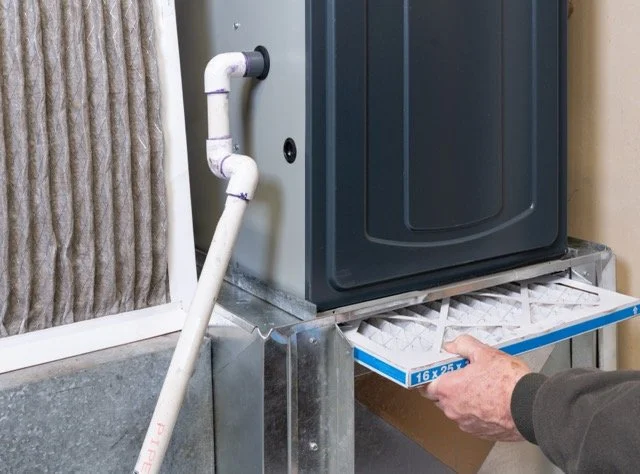
This is the number one cause of short cycling, and it is the easiest to fix. When your furnace filter gets clogged with dust, pet hair, and debris, it restricts airflow across the heat exchanger. The heat exchanger gets too hot, the limit switch trips to prevent damage, and the furnace shuts down. A few minutes later, it cools off and tries again. Repeat.
A dirty filter can reduce airflow by 50% or more. In a Michigan winter, where your furnace is running daily, a standard 1-inch pleated filter should be replaced every 30-60 days. If you have pets, a dusty home, or you are running the blower continuously, replace it monthly.
What to do: Check your filter right now. If you cannot see light through it, replace it. This is a $15 fix that solves short cycling 40% of the time.
2. Oversized Furnace
This is the most expensive cause of short cycling, and unfortunately, it is common in homes where the previous contractor did not perform a proper load calculation. An oversized furnace produces too much heat too quickly. It satisfies the thermostat in just a few minutes, shuts off, and then the house cools down again before the ductwork and walls have absorbed enough heat. The cycle repeats endlessly.
We see this frequently in homes where the furnace was replaced without updating the ductwork. For example, a 1970s ranch in Warren might have had a 60,000 BTU furnace originally, but when it was replaced in 2010, the contractor installed a 100,000 BTU unit "just to be safe." The result: short cycling, uneven temperatures, and wasted energy.
What to do: If your furnace is less than 10 years old and has always short cycled, it may be oversized. A reliable HVAC contractor in Metro Detroit can perform a Manual J load calculation to determine the correct size for your home.
3. Thermostat Issues
A malfunctioning thermostat can send erratic signals to the furnace, causing it to turn on and off unpredictably. Common thermostat problems include:
Incorrect placement (near a heat source like a lamp, sunny window, or kitchen)
Loose wiring or corroded connections
Outdated mercury-switch thermostats that have lost calibration
Programmable thermostats with dying batteries
Thermostat set to "ON" instead of "AUTO" for the fan, causing continuous blower operation and confusing heat cycles
What to do: Check your thermostat location and settings. Make sure the fan is set to AUTO, not ON. Replace batteries if it is battery-powered. If the thermostat is in a bad location (like on an exterior wall in direct sunlight), it may need to be relocated.
4. Flame Sensor Failure
The flame sensor is a safety device that confirms the burners are lit before allowing gas to flow. Over time — usually after 10+ years — the sensor rod gets coated with carbon buildup or corrosion. When it cannot detect the flame properly, it shuts the furnace down after just a few seconds. The furnace tries to restart, the sensor fails again, and the cycle continues.
This is especially common in older Carrier, Lennox, and Bryant furnaces we service in Shelby Township and Rochester Hills. The flame sensor is a small metal rod positioned in the burner assembly, and it costs about $20 to replace — but it requires a technician to access, clean, or replace it safely.
What to do: If your furnace lights, runs for 30-90 seconds, and then shuts off with the blower continuing to run briefly, the flame sensor is the likely culprit. This is a job for a professional.
5. Blocked or Closed Supply Vents
When too many supply vents in your home are closed — often because homeowners are trying to "zone" their heating without a zoned system — the furnace cannot move enough air through the ductwork. Pressure builds up, airflow drops, the heat exchanger overheats, and the limit switch shuts everything down.
We see this often in two-story homes in Troy or Bloomfield Hills where homeowners close upstairs vents in winter to "save money." It does not work. It just causes short cycling and increases wear on the blower motor.
What to do: Open all supply vents in your home. Even if you do not use a room regularly, keep the vent at least 50% open. Your furnace needs to move the volume of air it was designed for.
6. Ductwork Problems
Leaky, undersized, or poorly designed ductwork can cause short cycling in two ways. First, if return air ducts are leaking or blocked, the furnace cannot pull in enough air to cool the heat exchanger. Second, if supply ducts are too small or kinked, air cannot escape fast enough, causing pressure buildup and overheating.
In older Michigan homes — especially 1960s ranches with original flex duct in crawlspaces — we often find ducts that have collapsed, disconnected, or were never properly sized for the furnace. This is particularly common in homes where a high-efficiency furnace was installed without upgrading the ductwork to match.
What to do: Inspect visible ductwork in your basement for disconnected joints, crushed sections, or visible gaps. Professional duct sealing and sizing is part of our furnace installation and repair services.
7. Failing Limit Switch
The limit switch is a safety device that monitors the temperature of the heat exchanger. If the heat exchanger gets too hot (usually above 200°F), the limit switch shuts off the burners to prevent a cracked heat exchanger or fire. A failing limit switch can become overly sensitive or stick in the "off" position, causing the furnace to shut down prematurely even when temperatures are safe.
Limit switches typically fail after 15-20 years of service, and replacement requires a licensed technician. We see this most often in Trane, Rheem, and older Goodman furnaces that are nearing the end of their lifespan.
What to do: If you have ruled out airflow issues and your furnace is over 15 years old, the limit switch may need testing or replacement. This requires diagnostic tools and HVAC knowledge — not a DIY job.
How Short Cycling Damages Your Furnace
Short cycling is not just annoying — it is actively destroying your furnace and costing you money. Here is what happens when a furnace short cycles over weeks and months:
1. Increased Energy Bills: Every time your furnace starts up, it uses a surge of energy to ignite the burners and spin up the blower motor. A furnace that cycles 30 times per hour instead of 3-4 times per hour is wasting 30-50% more energy. Homeowners in Royal Oak and Grosse Pointe Farms often see their gas bills spike by $100-$200 per month during short cycling episodes.
2. Premature Component Failure: The igniter, blower motor, and gas valve are designed for a specific number of start cycles over their lifespan. Short cycling can burn through these components in half the time. A blower motor that should last 15 years might fail in 7-8 years. An igniter rated for 100,000 cycles might crack after 50,000.
3. Heat Exchanger Stress: The heat exchanger undergoes thermal expansion and contraction every time the furnace cycles. Constant short cycling accelerates metal fatigue, leading to cracks. A cracked heat exchanger is a safety hazard (carbon monoxide risk) and typically means furnace replacement, not repair. Repair costs for a cracked heat exchanger often exceed $1,500-$4,000 — at which point replacement makes more sense.
4. Reduced Comfort: Short cycling means your furnace never runs long enough to distribute heat evenly throughout your home. You will have cold spots, drafts, and temperature swings of 3-5 degrees between rooms. This is especially noticeable in larger homes or homes with poor insulation.
Real Cost Example: A homeowner in Clinton Township ignored short cycling for two winters. The constant cycling caused the heat exchanger to crack, the blower motor to fail, and the igniter to burn out. Total repair estimate: $3,200. Furnace age: 14 years. Our recommendation: replace the furnace with a properly sized unit and address the underlying ductwork issues. Total investment: $4,800 for a new Lennox furnace with a 10-year parts warranty and proper load calculation.
What You Can Check Before Calling a Tech
Not every short cycling problem requires a service call. Here are the things you can safely check yourself before calling a professional:
Check and Replace the Air Filter
Turn off your furnace at the thermostat. Locate the filter (usually in a slot near the blower or in a return air grille). Pull it out and hold it up to a light source. If you cannot see light through it, replace it immediately. Make sure the arrow on the filter frame points toward the furnace (in the direction of airflow).
Verify All Vents Are Open
Walk through your home and make sure every supply vent (the vents that blow warm air) is at least 50% open. Do not close vents to "save energy" — it does not work and causes more problems than it solves.
Check Thermostat Settings
Make sure your thermostat is set to HEAT mode, not AUTO or COOL. Verify the fan setting is on AUTO, not ON. If your thermostat uses batteries, replace them. If it is a programmable thermostat, check that the schedule is correct and not causing the furnace to cycle on and off at odd times.
Inspect Visible Ductwork
If you have exposed ductwork in your basement or crawlspace, look for disconnected joints, crushed sections, or large gaps. If you find obvious damage, that is a clear sign you need professional duct repair.
Listen to the Furnace Cycle
Stand near your furnace and listen to a full cycle. Does it ignite, run for 2-3 minutes, and shut off? Does the blower keep running after the burners shut off? Does it make any unusual noises (clicking, rumbling, screeching)? These clues help a technician diagnose the problem faster.
If you have checked all of these and the furnace is still short cycling, it is time to call in a professional. At that point, you are likely dealing with a flame sensor, limit switch, oversized furnace, or ductwork issue that requires diagnostic equipment and HVAC expertise.
When to Call a Professional
Some short cycling problems are beyond DIY troubleshooting. Call a licensed HVAC contractor immediately if:
The furnace lights, runs for 30-90 seconds, and shuts off repeatedly. This is almost always a flame sensor or ignition issue.
You smell gas or burning odors. Shut off the furnace and call immediately. This could indicate a cracked heat exchanger or gas leak.
The furnace is over 15 years old and has always short cycled. You may have an oversized furnace that was improperly installed. A load calculation and replacement may be the only long-term solution.
You have replaced the filter, opened all vents, and checked the thermostat, but short cycling continues. The problem is internal to the furnace or in the ductwork.
Your energy bills have spiked 30% or more without explanation. Short cycling is likely wasting hundreds of dollars per winter.
At NEXT Heating & Cooling, our NATE-certified technicians diagnose short cycling using a systematic approach: airflow measurement, temperature differential testing, flame sensor inspection, and ductwork evaluation. We do not upsell unnecessary equipment. If your furnace can be repaired, we will tell you. If replacement makes more financial sense, we will explain why and give you options.
How NEXT Heating & Cooling Diagnoses Short Cycling
When you call us for a short cycling furnace in Southeast Michigan, here is exactly what happens:
Step 1: Diagnostic Visit
We send a NATE-certified technician to your home, usually within 24 hours (same-day for emergencies). We do not charge a service call fee if you are a Next Care Plan member.
Step 2: Visual Inspection
We check the obvious culprits first: air filter, thermostat settings, vent positions, visible ductwork. If we find a simple fix (like a clogged filter), we will tell you immediately.
Step 3: Airflow and Temperature Testing
Using a digital manometer and temperature probes, we measure airflow across the heat exchanger and temperature rise through the furnace. This tells us if the furnace is getting enough air and whether the heat exchanger is overheating.
Step 4: Component Testing
We test the flame sensor, limit switch, gas valve, and ignition system using multimeters and amp clamps. We check for proper voltage, resistance, and current draw. If a component is failing, we will show you the readings and explain what it means.
Step 5: Ductwork Evaluation
If airflow is restricted, we inspect the ductwork for leaks, undersizing, or blockages. We measure static pressure to determine if the duct system is properly sized for the furnace.
Step 6: Honest Recommendations
We give you options, not sales pitches. If a $150 repair solves the problem, we will tell you. If your furnace is 18 years old, oversized, and on its last legs, we will explain why replacement makes more sense than pouring money into repairs. You decide. We do not work on commission, so our techs have no incentive to upsell.
We have been serving Macomb, Oakland, and St. Clair counties for over three decades under Premier Builder Inc. We know Michigan winters. We know the furnaces that hold up in polar vortex events and the ones that do not. We know which brands (Carrier, Lennox, Trane, Rheem, Bryant) offer the best value for Southeast Michigan homeowners. And we know that most short cycling problems can be fixed for a few hundred dollars if caught early.
Ready to Get Started?
NEXT Heating & Cooling has been keeping Michigan homes comfortable for over 35 years. Get honest diagnostics and fair pricing from NATE-certified technicians who show up on time.
Frequently Asked Questions
How long should a furnace run before shutting off?
+
A properly functioning furnace should run for 10-15 minutes per cycle during normal operation. In extremely cold weather (below 10°F), cycles may extend to 15-20 minutes as the furnace works harder to maintain temperature. If your furnace is shutting off after just 2-5 minutes, it is short cycling and needs diagnosis. Cycles shorter than 7-8 minutes indicate a problem with airflow, thermostat placement, or an oversized furnace.
Can a dirty filter really cause short cycling?
+
Yes — and it is the most common cause we see. A clogged filter restricts airflow across the heat exchanger, causing it to overheat. When the heat exchanger reaches unsafe temperatures (typically 200°F or higher), the limit switch shuts the furnace down as a safety measure. Once it cools, the furnace tries again, creating a rapid on-off cycle. Replacing a $15 filter solves short cycling in about 40% of the cases we diagnose in Southeast Michigan homes.
How much does it cost to fix a furnace that keeps turning on and off?
+
Repair costs depend entirely on the cause. A dirty filter costs $15-$30 to replace yourself. A flame sensor cleaning or replacement typically runs $150-$250 including labor. A failing limit switch costs $200-$350 to replace. Thermostat replacement ranges from $150-$400 depending on the model. Ductwork repairs can range from $300-$1,500 depending on severity. If the furnace is oversized and causing chronic short cycling, replacement is often the only long-term solution, ranging from $3,500-$7,000 depending on size and efficiency. At NEXT Heating & Cooling, we always give you repair vs. replacement options with honest cost breakdowns.
Is short cycling an emergency?
+
Short cycling is not an immediate emergency in most cases, but it should not be ignored. If your furnace is still producing some heat and your home is staying above 55°F, you can schedule a diagnostic visit within 24-48 hours. However, if you smell gas, notice a burning odor, or your furnace is cycling on and off every 30-60 seconds without producing heat, shut it off immediately and call for emergency service. Short cycling that continues for weeks or months will damage your furnace and increase the risk of heat exchanger failure, which can lead to carbon monoxide leaks.
Will a programmable thermostat cause short cycling?
+
A programmable thermostat itself will not cause short cycling, but incorrect settings or placement can. If the thermostat is located near a heat source (like a lamp, sunny window, or kitchen), it will read artificially high temperatures and shut the furnace off prematurely. If the fan is set to ON instead of AUTO, the blower will run continuously, which can confuse the heating cycle. Dead batteries in battery-powered thermostats can also cause erratic behavior. Make sure your thermostat is mounted on an interior wall away from heat sources, set to AUTO fan mode, and has fresh batteries if applicable.
Can I prevent short cycling with regular maintenance?
+
Absolutely. Most short cycling problems develop gradually due to neglected maintenance. Regular filter changes (every 30-60 days during heating season), annual furnace tune-ups, and ductwork inspections catch problems before they cause short cycling. Our $5/month Next Care Plan includes two annual visits (fall furnace tune-up and spring AC tune-up) where we clean flame sensors, test limit switches, measure airflow, and inspect all components that commonly cause short cycling. Preventive maintenance costs far less than emergency repairs and extends furnace lifespan by 5-7 years on average.
What brands of furnaces are most reliable in Michigan winters?
+
After 35 years of servicing furnaces across Southeast Michigan, we have seen which brands hold up best in polar vortex conditions and lake-effect cold. Carrier, Lennox, and Trane consistently deliver 15-20 year lifespans with proper maintenance. Bryant (owned by Carrier) and Rheem offer excellent value in the mid-tier range. Goodman and Amana are budget-friendly options that perform well if sized correctly and maintained annually. The most important factor is not the brand — it is proper sizing (Manual J load calculation) and professional installation. An oversized Lennox will short cycle just as badly as an oversized Goodman. We are authorized dealers for all major brands and help you choose based on your home's specific needs, not our profit margin.