

Duct Cleaning Macomb County Michigan: What Actually Works
NEXT Heating & Cooling
•
March 2, 2026
•
12 min read
Here's what I tell homeowners in Sterling Heights, Clinton Township, and across Macomb County when they ask about duct cleaning: most of the time, you don't need it. And when you do need it, it's not going to solve the problems the guy on the phone promised it would.
That's not a popular opinion in an industry where "$99 whole house duct cleaning" mailers show up in every mailbox every spring. But after 35 years of crawling through Michigan basements and attics with NEXT Heating & Cooling, I've seen what actually improves indoor air quality — and what's just noise.
This isn't an anti-duct-cleaning piece. When it's done right, for the right reasons, by a licensed contractor who understands HVAC systems, duct cleaning has legitimate value. The problem is that most homeowners get sold duct cleaning when what they really need is a new furnace filter, a functioning damper, or an actual conversation about why their house is dusty.
Let's walk through what duct cleaning actually does, when it makes sense for Michigan homes, and how to avoid the scams that have given this service a bad reputation in Macomb County and beyond.
What Duct Cleaning Actually Does (And Doesn't Do)
Duct cleaning is the mechanical removal of dust, debris, and contaminants from the supply and return ducts of your forced-air HVAC system. A legitimate service uses a high-powered vacuum system (called a negative air machine) connected to your ductwork, combined with rotary brushes or compressed air tools that dislodge material from the duct walls.
The vacuum creates negative pressure throughout the duct system — typically 1,500 to 3,000 cubic feet per minute (CFM) — so that loosened debris is pulled into a collection unit instead of blowing into your living space. The brushes physically scrub the interior surfaces of the ducts. When done properly, this removes layers of accumulated dust, construction debris, pet dander, and sometimes mold growth from the sheet metal or flex duct.
Here's what duct cleaning does not do:
It doesn't improve airflow if your ducts are properly sized. Dust accumulation on duct walls is measured in fractions of an inch. It doesn't restrict airflow in a meaningful way unless you have a catastrophic blockage (which is rare and usually obvious).
It doesn't reduce your energy bills. The EPA and Department of Energy have both stated that duct cleaning has not been proven to reduce energy consumption. Airflow restriction comes from undersized ducts, crushed flex duct, closed dampers, and dirty filters — not from a thin layer of dust on the duct walls.
It doesn't eliminate dust in your home. Household dust comes from skin cells, pet dander, carpet fibers, outdoor air infiltration, and activities like cooking and cleaning. Your ducts distribute air; they don't create dust. If your house is dusty, the problem is usually filtration, air sealing, or a return air imbalance — not dirty ducts.
It doesn't fix mold problems. If you have mold in your ducts, you have a moisture problem. Cleaning the mold without fixing the moisture source (a leaking AC coil, condensation from poor insulation, or a basement humidity issue) means the mold will come back. Duct cleaning treats a symptom, not the cause.
This is where the disconnect happens. Homeowners in Macomb County call because they're dealing with allergies, dust, or high energy bills. A duct cleaning company shows up, shows them a photo of dirty ducts (which almost all ducts are after 10+ years), and implies that cleaning will solve these problems. It usually doesn't.
When Duct Cleaning Is Actually Necessary in Michigan Homes
There are specific situations where duct cleaning makes sense. These are the scenarios where we recommend it to homeowners as part of our heating and cooling services in Metro Detroit:
After Major Renovation or Construction
If you've had a kitchen remodel, basement finish, or room addition, your ducts are full of drywall dust, sawdust, and construction debris. Even with plastic sheeting and air scrubbers, fine particulate gets into the duct system. This is one of the few times where duct cleaning delivers visible, measurable results. You'll see clouds of white dust come out of the collection unit.
We see this constantly in older homes in Clinton Township and Warren where homeowners are updating 1960s-era ranches. The ductwork in these homes was often installed with minimal sealing, so construction dust migrates into every branch line.
Verified Mold Growth Inside Ducts
Not suspected mold. Not "it smells musty." Verified mold growth that you can see on the interior duct surfaces or that has been confirmed by a lab test. This typically happens in a few specific situations:
Condensation from an undersized or poorly insulated AC system has created standing water in the ducts
A basement flood or plumbing leak saturated flex duct or duct board
Humidifier overflow or steam from a basement bathroom has created chronic moisture in the return duct
If you're dealing with mold in your ducts, duct cleaning is part of the solution — but only if you also fix the moisture problem. Otherwise you're wasting money on a temporary fix.
Rodent or Insect Infestation
Mice, squirrels, and occasionally birds get into ductwork through gaps in the foundation, attic penetrations, or disconnected duct sections. They leave behind droppings, nesting material, and sometimes carcasses. This is a legitimate health hazard and requires professional cleaning with proper containment and disposal.
We see this more often in older homes in Shelby Township and Macomb where ductwork runs through crawl spaces or unfinished attics. If you hear scratching in the walls or smell something foul when the furnace runs, call a licensed HVAC contractor — not a duct cleaning company that showed up with a coupon.
Excessive Pet Hair and Dander (In Specific Cases)
If you have multiple shedding pets and you've never cleaned your ducts in 15+ years, there may be enough accumulated hair and dander in the return ducts to warrant cleaning — especially if someone in the household has severe allergies or asthma. But this is a quality of life decision, not a necessity. Upgrading your filtration (more on this below) will do more for your air quality than a one-time duct cleaning.
When You're Replacing a Furnace or AC in an Older Home
If we're installing a new high-efficiency furnace or AC unit in a home that's 20+ years old and the ducts have never been cleaned, we'll sometimes recommend duct cleaning as part of the installation. This ensures that decades of accumulated dust and debris don't immediately coat the new equipment's blower wheel, evaporator coil, and heat exchanger. It's preventive maintenance that protects your investment.
This is especially relevant in Southeast Michigan where many homes still have original 1970s or 1980s ductwork. When we're doing a furnace replacement in Sterling Heights, we'll inspect the ducts and give you an honest assessment of whether cleaning is worth it.
Bottom line: If you can't point to a specific event (construction, water damage, infestation) or visible contamination, you probably don't need duct cleaning. And if someone is selling it to you as an energy-saving or allergy-cure service, they're overselling.
The Duct Cleaning Process: What to Expect
A legitimate, NADCA-certified duct cleaning service follows a specific process. If the company you're considering doesn't do these things, walk away.
Pre-Cleaning Inspection
The technician should inspect your entire duct system before starting work. This means accessing the supply and return plenums, checking for disconnected ducts, looking for mold or moisture issues, and identifying any problem areas. They should show you what they're finding and explain whether cleaning is necessary.
If someone shows up, quotes you a price over the phone without seeing your system, and starts cleaning immediately — that's not a professional service.
Access Point Creation
To clean ducts properly, the technician needs to create access points in the trunk lines and branch ducts. This usually means cutting small holes (typically 8-12 inches) in the sheet metal ductwork at strategic locations. These holes are later sealed with metal patches and mastic.
Some companies try to clean ducts through the registers alone. This is inadequate. You can't clean a 40-foot trunk line by sticking a brush through a 10x6 floor register.
Negative Air Machine Setup
A commercial-grade negative air machine (also called a HEPA vacuum truck or portable collection unit) is connected to the main trunk line. This machine creates negative pressure throughout the entire duct system so that dislodged debris is pulled into the collection unit instead of blowing into your home.
The machine should be rated for at least 1,500 CFM and equipped with HEPA filtration. If the company shows up with a shop vac and a leaf blower, that's not duct cleaning — that's theater.
Mechanical Agitation
The technician uses rotary brushes, compressed air whips, or contact vacuuming tools to physically dislodge dust and debris from the duct walls. This is done section by section, working from the furthest branches back toward the main trunk line.
Proper agitation takes time. A thorough duct cleaning for a 1,500-square-foot home typically takes 4-6 hours. If someone quotes you 90 minutes, they're not cleaning your ducts — they're running a brush through them and calling it done.
Component Cleaning
A complete service includes cleaning the furnace blower, evaporator coil (if accessible), return air plenum, and supply plenum. These components accumulate as much or more dust than the ducts themselves. Skipping them defeats the purpose of cleaning the ducts.
Sanitization (Optional and Often Unnecessary)
Some companies push antimicrobial fogging or duct sealant coatings as add-ons. The EPA has stated that the health benefits of these treatments are unproven and that they should only be used after the underlying problem (moisture, contamination) has been addressed. In most cases, these are upsells you don't need.
Red Flags: Duct Cleaning Scams Common in Macomb County
The duct cleaning industry has a reputation problem because of a small number of companies that use high-pressure sales tactics and deceptive pricing. Here's what to watch for:
The "$99 Whole House" Bait-and-Switch
You see the mailer: "$99 whole house duct cleaning — all vents, all ducts." The company shows up, does a cursory inspection, and then tells you that your ducts are "the worst they've ever seen" and that the $99 price only covers "basic cleaning." The real price? $800 to $1,200 with mandatory add-ons for mold treatment, sanitization, and dryer vent cleaning.
This is the most common scam in Southeast Michigan. If the advertised price seems too good to be true, it is. Legitimate duct cleaning costs $400-$800 for an average home, depending on system size and accessibility.
High-Pressure Mold Scare Tactics
The technician swabs your ducts, shows you a petri dish with some discoloration, and tells you that you have "toxic black mold" that requires immediate treatment for $1,500. Mold is common in Michigan basements and ductwork, but most species are not dangerous, and visual identification is not sufficient for diagnosis.
If someone is using mold as a scare tactic to sell you a service, ask them to provide lab results from an accredited testing facility. They won't.
Unlicensed Operators
In Michigan, anyone working on HVAC systems is required to hold a mechanical contractor license or work under the supervision of a licensed contractor. Duct cleaning falls under this requirement because it involves accessing and modifying ductwork.
If the company can't provide a Michigan mechanical contractor license number, they're operating illegally. This matters because unlicensed operators have no accountability, no insurance, and no incentive to do the work correctly. When we see poorly done duct cleaning jobs in Macomb County homes, it's almost always from an unlicensed company that disappeared after cashing the check.
Refusal to Provide References or Proof of Insurance
A legitimate HVAC contractor will provide references, proof of liability insurance, and documentation of NADCA certification (if they claim to have it). If someone hesitates or changes the subject when you ask, that's a red flag.
Aggressive Add-On Sales
Duct sealing, UV light installation, whole-house humidifiers, and air purifiers are all legitimate products — but they should be recommended based on your system's needs, not pushed as mandatory add-ons to a duct cleaning service. If the technician is spending more time selling than cleaning, you're dealing with a salesperson, not a technician.
Protect yourself: Get multiple quotes, verify licensing, and ask for a detailed written estimate before any work begins. A reputable contractor will walk you through what they're going to do and why — not pressure you into a same-day decision.
What Matters More Than Duct Cleaning: Air Quality Fundamentals
If you're concerned about indoor air quality, dust, or allergies, here's what actually makes a difference — and most of it costs less than duct cleaning.
Upgrade Your Filtration
The single most effective thing you can do for air quality is upgrade from a cheap fiberglass filter (MERV 1-4) to a high-efficiency pleated filter (MERV 8-13). A MERV 11 filter captures 65-80% of particles between 1 and 3 microns — the size range that includes most allergens, mold spores, and fine dust.
For homes with severe allergies or asthma, we recommend a whole-house HEPA filtration system or a media filter cabinet. These systems filter out 99.97% of particles down to 0.3 microns and require filter changes only once or twice a year.
This is a conversation we have constantly with homeowners enrolled in our $5/month HVAC maintenance plan. Most people are running their furnace with a $3 filter from the hardware store and wondering why their house is dusty. Upgrading filtration costs $50-$150 per year and delivers measurable results.
Balance Your Return Air
Many Michigan homes — especially older ranches and colonials — have inadequate return air. This creates negative pressure in the house, which pulls unfiltered air through gaps in the building envelope (around windows, doors, and rim joists). That unfiltered air brings dust, pollen, and outdoor pollutants with it.
Adding return air grilles, installing transfer grilles between rooms, or upgrading to a properly sized return duct system solves this problem. It's not glamorous, but it's one of the most effective air quality improvements you can make.
Seal and Insulate Your Ducts
Leaky ductwork is a bigger problem than dirty ductwork. If 20-30% of your conditioned air is leaking into the attic, crawl space, or basement, you're wasting energy and creating pressure imbalances that pull dust into your living space.
Sealing ducts with mastic (not duct tape, which fails) and insulating ducts in unconditioned spaces improves comfort, reduces energy costs, and minimizes dust infiltration. This is part of the diagnostic process when we do AC installations in Shelby Township or furnace replacements in Sterling Heights.
Control Humidity
Michigan basements are notoriously humid, especially in summer. High humidity promotes mold growth in ductwork, creates musty odors, and makes your home feel uncomfortable even when the temperature is fine.
A whole-house dehumidifier integrated with your HVAC system keeps basement humidity below 50%, which inhibits mold and dust mite growth. This is a more effective long-term solution than periodic duct cleaning.
Change Your Filter Regularly
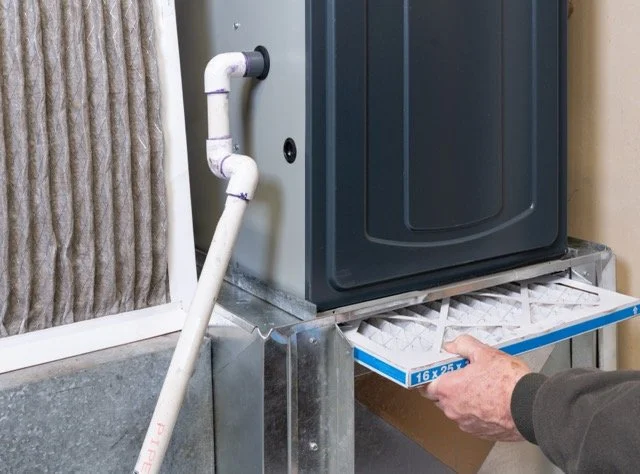
This sounds basic, but it's the most commonly neglected maintenance task. A clogged filter restricts airflow, forces your blower motor to work harder, and allows dust to bypass the filter and accumulate on the blower wheel and heat exchanger.
Check your filter monthly. Replace it when it's visibly dirty — not when the calendar says it's time. Homes with pets, high occupancy, or nearby construction may need monthly changes. Homes with minimal dust and good air sealing may go three months between changes.
Cost Reality: What Duct Cleaning Should Cost in Southeast Michigan
Let's talk numbers. Legitimate duct cleaning in Macomb County, Oakland County, and St. Clair County typically costs:
$400-$600 for a small home (1,000-1,500 sq ft) with a simple duct layout and easy access
$600-$800 for a medium home (1,500-2,500 sq ft) with standard ductwork
$800-$1,200 for a large home (2,500+ sq ft) or a home with complex ductwork, multiple zones, or difficult access
What Affects Cost
Several factors influence the final price:
System size: More ducts, more vents, more time.
Duct accessibility: Ducts in a finished basement or tight crawl space take longer to access and clean.
Duct material: Sheet metal ducts are easier to clean than flex duct or duct board.
Contamination level: Heavy contamination (construction debris, mold, rodent droppings) requires more time and specialized equipment.
Additional services: Cleaning the furnace blower, evaporator coil, or dryer vent adds to the cost but may be worth it if those components are heavily soiled.
When It's Worth the Cost
Duct cleaning is worth the investment if:
You've just completed major construction or renovation
You have verified mold growth and you've fixed the moisture problem
You've had a rodent or insect infestation
You're installing new HVAC equipment in an older home with original ductwork
You have severe allergies and you've exhausted other air quality solutions
Duct cleaning is not worth the cost if:
You're doing it because a coupon showed up in your mailbox
Someone told you it will lower your energy bills (it won't)
You're hoping it will eliminate dust (it won't — filtration and air sealing will)
You're being pressured into it by a door-to-door salesperson
What You Should Get for Your Money
A professional duct cleaning service should include:
Pre-cleaning inspection with documentation of problem areas
Cleaning of all supply and return ducts, not just the main trunk lines
Cleaning of the furnace blower, return plenum, and supply plenum
Use of a HEPA-rated negative air machine
Proper sealing of all access points with metal patches and mastic
Post-cleaning inspection to verify results
Written documentation of work performed
If the company isn't providing these things, you're not getting full value.
Ready to Get Started?
NEXT Heating & Cooling has been keeping Michigan homes comfortable for over 35 years. Get honest diagnostics and fair pricing from NATE-certified technicians who show up on time. We'll tell you what you need — and what you don't.
Frequently Asked Questions About Duct Cleaning in Macomb County
How often should I have my ducts cleaned in Michigan?
+
There's no universal timeline. Most homes don't need duct cleaning more than once every 10-15 years, if at all. The National Air Duct Cleaners Association (NADCA) recommends cleaning "as needed," not on a fixed schedule. Focus on regular filter changes, annual HVAC maintenance, and addressing specific problems (construction, water damage, infestation) as they arise. If your system is running well and your home isn't excessively dusty, you probably don't need duct cleaning.
Will duct cleaning help with my allergies?
+
It depends. If your allergies are triggered by dust, pet dander, or mold that has accumulated in your ducts, cleaning may provide some relief. But for most people, upgrading to a high-efficiency filter (MERV 11-13) or installing a whole-house air purifier delivers better results at lower cost. Duct cleaning is a one-time service; filtration is ongoing protection. If you're dealing with severe allergies, talk to a licensed HVAC contractor about a comprehensive air quality strategy, not just duct cleaning.
Can I clean my own ducts to save money?
+
Not effectively. DIY duct cleaning with a shop vac and a brush won't create the negative pressure needed to capture dislodged debris, and you'll likely end up blowing dust into your living space. Professional equipment (negative air machines, rotary brushes, HEPA filtration) costs tens of thousands of dollars. You can clean your registers and the first few feet of accessible ductwork, but deep cleaning requires specialized tools and training. If cost is a concern, focus on what you can do yourself: change filters regularly, vacuum registers, and seal visible duct leaks with mastic.
How do I know if my ducts actually need cleaning?
+
Look for specific indicators: visible mold growth inside ducts or on registers, excessive dust blowing out of vents when the system starts, evidence of rodent or insect infestation, or recent construction that generated significant dust. If you can't point to a specific problem, you probably don't need cleaning. The best way to know for sure is to have a licensed HVAC contractor inspect your system during a maintenance visit. They can remove a register, look inside the ductwork with a flashlight or camera, and give you an honest assessment.
What's the difference between duct cleaning and duct sealing?
+
Duct cleaning removes dust and debris from inside the ducts. Duct sealing closes gaps and leaks in the ductwork to prevent conditioned air from escaping into unconditioned spaces (attics, crawl spaces, basements). Sealing is done with mastic or metal-backed tape at joints, seams, and connections. For most Michigan homes, duct sealing delivers more measurable benefits than duct cleaning: lower energy bills, better comfort, and reduced dust infiltration. If you're choosing between the two, sealing is usually the better investment.
Are duct cleaning companies required to be licensed in Michigan?
+
Yes. Anyone working on HVAC systems in Michigan must hold a mechanical contractor license or work under a licensed contractor's supervision. This includes duct cleaning because it involves accessing and modifying ductwork. Before hiring a duct cleaning company, verify their license through the Michigan Department of Licensing and Regulatory Affairs (LARA). Unlicensed operators have no accountability, no insurance, and no recourse if something goes wrong. At NEXT Heating & Cooling, we're a licensed and insured HVAC contractor with 35+ years of experience serving Southeast Michigan.
Will duct cleaning reduce my heating and cooling costs?
+
No. The EPA and Department of Energy have both stated that duct cleaning has not been proven to reduce energy consumption. Dust accumulation on duct walls doesn't restrict airflow enough to impact efficiency. What does affect your energy costs: leaky ductwork, undersized or oversized equipment, dirty filters, poor insulation, and lack of regular maintenance. If you want to lower your heating and cooling bills, focus on sealing duct leaks, upgrading insulation, and enrolling in a preventive maintenance plan like our Next Care Plan.