

AC Not Cooling House? 7 Causes & How to Fix Them
NEXT Heating & Cooling
•
March 2, 2026
•
12 min read

It's 87 degrees outside. Your air conditioner is running—you can hear it humming away—but your house feels like a sauna. You walk over to the vent and barely feel any cool air. Sound familiar?
We've been servicing air conditioners across Southeast Michigan for over 35 years, and "AC not cooling house" is one of the most common calls we get every June. The good news? Most of the time, it's something fixable. The better news? Some fixes you can handle yourself before calling a technician.
This guide walks you through the seven most common reasons your AC is running but not cooling your home—from simple filter problems to more serious compressor failures. We'll tell you which issues you can troubleshoot on your own, which ones need a professional, and what to expect cost-wise if you're facing a repair. No upselling. No vague answers. Just straight talk from NATE-certified HVAC technicians who've diagnosed thousands of no-cool calls in Michigan homes.
1. Dirty or Clogged Air Filter
Let's start with the most common culprit—and the easiest fix. A dirty air filter causes roughly 80% of the "AC not cooling" service calls we run in Sterling Heights, Troy, and Clinton Township. When your filter gets clogged with dust, pet hair, and Michigan pollen, it restricts airflow across your evaporator coil. Less airflow means less heat removal from your home. Eventually, the restricted airflow can cause the evaporator coil to freeze over completely, shutting down all cooling.
Here's what happens mechanically: Your AC system depends on a steady flow of warm air passing over the cold evaporator coil. That warm air transfers its heat to the refrigerant inside the coil, which then carries the heat outside. When a dirty filter blocks that airflow, the coil gets too cold, moisture in the air freezes on contact, and you end up with a block of ice where your cooling coil should be.
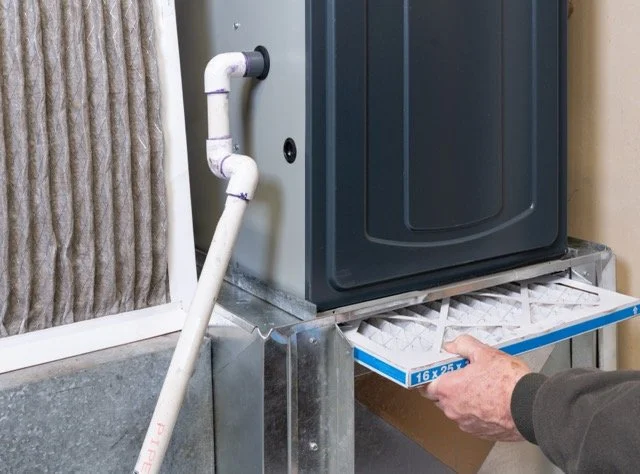
DIY Fix: Turn off your AC at the thermostat. Locate your air filter—usually in the return air grille (often in a hallway or near your furnace) or inside the furnace cabinet itself. Pull it out and hold it up to a light. If you can't see light through it, it's clogged. Replace it with a new filter of the same size. Standard filters should be changed every 30-90 days depending on pets, occupancy, and dust levels. If you have pets or allergies, change it monthly.
Most Michigan homes use 1-inch pleated filters rated MERV 8 to MERV 11. Don't go higher than MERV 13 unless your system is specifically designed for it—high-efficiency filters can restrict airflow on older systems. Brands like Carrier, Lennox, and Trane all make quality aftermarket filters available at hardware stores, but generic filters work fine as long as the size matches.
2. Refrigerant Leak
If your AC is blowing air but it's barely cool—or not cool at all—you might have a refrigerant leak. Refrigerant is the chemical that absorbs heat from inside your home and releases it outside. Without enough refrigerant, your system can't transfer heat effectively, and your house stays warm no matter how long the AC runs.
Common signs of a refrigerant leak include:
Ice buildup on the copper refrigerant lines running to your outdoor unit
Hissing or bubbling sounds near the indoor or outdoor unit
AC runs constantly but never reaches the set temperature
Higher-than-normal electric bills (system working harder for less cooling)
Oily residue or staining on refrigerant lines
Here's what you need to know: Refrigerant doesn't "run out" like gas in a car. AC systems are sealed. If your refrigerant is low, there's a leak somewhere—in the evaporator coil, condenser coil, or refrigerant lines. Simply adding more refrigerant (often called "topping it off") is a temporary fix that doesn't solve the underlying problem. The leak will continue, and you'll be paying for more refrigerant again next year.
Refrigerant work requires EPA 608 certification. It's not a DIY repair. Older systems use R-22 refrigerant (Freon), which is no longer manufactured in the U.S. as of 2020. If you have an R-22 system with a major leak, you're often better off replacing the entire system rather than paying for expensive reclaimed refrigerant. Newer systems use R-410A (Puron) or R-32, which are more affordable and environmentally friendly.
Professional Repair Required: If you suspect a refrigerant leak, call a licensed HVAC contractor. Our technicians use electronic leak detectors and UV dye to locate leaks, then repair the leak and recharge the system to the manufacturer's specified pressure. Expect to pay $300-$1,500 depending on leak location and refrigerant type.
3. Frozen Evaporator Coil
Walk over to your furnace or air handler (the indoor unit) and look at the copper refrigerant lines. Do you see ice? If so, your evaporator coil is frozen. This is one of the most dramatic-looking AC problems—and one of the most misunderstood.
A frozen evaporator coil is usually a symptom, not the root cause. The coil freezes when something disrupts the balance of airflow and refrigerant pressure. Common causes include:
Dirty air filter (restricted airflow—see #1 above)
Dirty evaporator coil (years of dust buildup blocking airflow)
Low refrigerant due to a leak (causes coil temperature to drop too low)
Blower motor failure or weak blower (not moving enough air)
Blocked return air vents (furniture, rugs, or closed doors restricting airflow)
Running AC when outdoor temperature is below 60°F (system not designed for low ambient temps)
When the coil freezes, it can't absorb heat from your home. You'll feel little to no airflow from your vents, and the AC will run continuously without cooling. In severe cases, the ice can build up so much that it blocks the condensate drain, causing water to overflow and damage your ceiling or floors.
What to Do: Turn off your AC immediately at the thermostat. Turn the fan setting to ON (not AUTO) to help thaw the coil faster. It can take 4-8 hours for a badly frozen coil to thaw completely. Do not try to chip or scrape the ice off—you'll damage the delicate aluminum fins on the coil. Once thawed, check your air filter. If it's clean and the coil freezes again, call a technician—you likely have a refrigerant leak or blower motor issue.
We see frozen coils frequently in older Michigan homes with undersized ductwork or return air grilles. If your system freezes every summer, the underlying issue needs to be addressed—whether that's a duct modification, coil cleaning, or refrigerant repair.
4. Dirty Condenser Coils (Outdoor Unit)
Your outdoor condenser unit has one job: release the heat your AC pulled from inside your house. It does this through a condenser coil—a network of aluminum fins and copper tubing wrapped around the unit. When that coil gets caked with dirt, grass clippings, cottonwood seeds (a Michigan summer staple), or pollen, it can't release heat efficiently. The result? Your AC runs but doesn't cool effectively.
Michigan summers are tough on outdoor units. Between cottonwood trees dropping their fluffy seeds in June and lawn mowers kicking up grass clippings all season, condenser coils get filthy fast. Add in the humidity we get from the Great Lakes, and you've got a perfect recipe for reduced efficiency.
Signs your condenser coils are dirty:
Visible dirt, debris, or plant matter on the coil fins
AC runs longer than normal to cool the house
Outdoor unit is hot to the touch or radiating excessive heat
Higher electric bills without a change in usage
DIY Maintenance: Turn off power to the outdoor unit at the disconnect box (usually mounted on the house near the unit). Use a garden hose with a spray nozzle to gently rinse the coil from the inside out—spray from inside the unit outward to push debris out, not deeper into the fins. Do NOT use a pressure washer; the high pressure will bend the delicate aluminum fins and make the problem worse. Clear away grass, weeds, and shrubs within 2 feet of the unit for proper airflow.
If the coils are heavily caked or bent, professional cleaning is worth it. Our HVAC services in Metro Detroit include condenser coil cleaning using specialized coil cleaners and fin combs to straighten bent fins. We also check refrigerant pressures, electrical connections, and capacitor health during the same visit—catching small problems before they become expensive failures.
5. Failed Compressor or Capacitor
The compressor is the heart of your AC system. It's the component that pressurizes refrigerant and pumps it through the system. When the compressor fails, your AC can't move refrigerant, which means it can't move heat. You'll hear the outdoor fan running, but the compressor itself stays silent. No cooling happens.
Compressor failure is one of the most expensive AC repairs—often $1,200 to $3,500 depending on the unit size and refrigerant type. On systems older than 10-12 years, a failed compressor usually means it's time to replace the entire outdoor unit rather than sink money into a major repair on aging equipment.
More common than compressor failure is capacitor failure. The capacitor is a small cylindrical component that gives the compressor and fan motor the electrical "boost" they need to start. Capacitors wear out over time, especially in hot climates (like a Michigan summer where the outdoor unit sits in direct sun). When a capacitor fails, you'll hear a humming sound from the outdoor unit—the motor is trying to start but can't.
Signs of a failed capacitor:
Outdoor unit hums but doesn't start
AC trips the circuit breaker repeatedly
Outdoor fan spins slowly or not at all
You have to manually "kick start" the unit to get it running
Professional Repair Required: Capacitors store high voltage even when the unit is off. Do not attempt to test or replace a capacitor yourself—it can deliver a dangerous shock. A capacitor replacement typically costs $150-$400 including the service call. It's a quick repair (30-60 minutes) and will have your AC running again the same day.
If you're in Shelby Township, Chesterfield, or Warren and your AC is making unusual sounds or won't start, we offer same-day service for most repairs. Our technicians carry common capacitors, contactors, and fan motors on their trucks to minimize downtime.
6. Thermostat Problems
Sometimes the problem isn't your AC at all—it's the thermostat. A malfunctioning or misconfigured thermostat can make it seem like your AC isn't cooling when the real issue is communication between the thermostat and the system.
Common thermostat issues we see:
Wrong mode: Thermostat set to HEAT instead of COOL, or set to OFF
Fan setting on ON: When the fan is set to ON (not AUTO), it runs continuously even when the AC isn't cooling. You'll feel air movement, but it won't be cold air. Set it to AUTO so the fan only runs during cooling cycles.
Dead batteries: Battery-powered thermostats (even some "smart" ones) can lose their settings when batteries die
Poor location: Thermostat installed in direct sunlight, near a heat source, or in a drafty area gives false temperature readings
Loose wiring: Wires connecting the thermostat to your HVAC system can come loose over time, especially in older homes
Software glitches: Smart thermostats (Nest, Ecobee, Honeywell Home) occasionally need a reboot or firmware update
Quick Troubleshooting: Set your thermostat to COOL, lower the temperature setting 5 degrees below the current room temperature, and set the fan to AUTO. Wait 5 minutes and check if cold air is coming from the vents. If you have a smart thermostat, try rebooting it (remove from the wall plate for 30 seconds, then reattach). Replace batteries if applicable.
We've responded to service calls where the homeowner thought their AC was broken, only to find the thermostat was set to heat or the batteries were dead. It happens more than you'd think—especially after a power outage when settings get reset.
If your thermostat is more than 15 years old, upgrading to a programmable or smart thermostat can improve comfort and save energy. Modern thermostats from Carrier, Lennox, Ecobee, and Honeywell offer better temperature control, scheduling, and remote access. We install and configure thermostats as part of our residential HVAC services in Southeast Michigan.
7. Undersized AC Unit for Your Home
This one's frustrating because it's not a failure—it's a design problem. If your AC runs all day, never reaches the set temperature, and struggles on hot, humid Michigan days, your unit might be undersized for your home.
AC sizing is based on load calculation—a detailed analysis that considers your home's square footage, insulation, window area, ductwork, ceiling height, and local climate. It's measured in tons (not weight—cooling capacity). A typical Michigan home needs about 1 ton of cooling per 600-800 square feet, but that's a rough estimate. Proper sizing requires a Manual J load calculation.
We see undersized AC units most often in these scenarios:
Home additions or finished basements added after the original AC was installed
Contractor installed the cheapest/smallest unit to win a bid
Previous owner did a DIY install without proper load calculation
Home has poor insulation or leaky ductwork (increasing the actual cooling load)
An undersized unit will run constantly on 85°F+ days, struggle to remove humidity, and wear out faster due to continuous operation. You'll also see higher electric bills because the system never shuts off.
On the flip side, an oversized unit is also a problem. It cools too quickly, short-cycles (turns on and off frequently), and doesn't run long enough to remove humidity. Your house feels cold but clammy. Bigger is not always better in HVAC.
The Fix: If your AC is undersized, the only real solution is replacement with a properly sized unit. Before replacing, address any insulation, air sealing, or ductwork issues—fixing those problems might reduce your cooling load enough that a correctly sized unit performs well. A reputable contractor will perform a load calculation before recommending a replacement size. If they suggest a size based only on square footage, find a different contractor.
When we install a new AC system—whether it's a Carrier, Lennox, Trane, Rheem, Bryant, or Goodman unit—we always start with a Manual J load calculation. It's the only way to ensure the system matches your home's actual needs. We've been doing this for 35 years across Macomb, Oakland, and St. Clair counties, and we've seen what happens when sizing is done wrong. It's not a mistake we make.
When to Call a Professional HVAC Technician
Some AC problems are DIY-friendly. Others require a licensed technician with specialized tools, refrigerant certification, and diagnostic experience. Here's when to call for professional help:
Refrigerant leaks: Requires EPA certification, leak detection equipment, and proper refrigerant handling
Electrical issues: Capacitors, contactors, and compressor wiring involve high voltage
Compressor failure: Major repair or replacement decision—needs professional diagnosis
Frozen coil that won't thaw or keeps refreezing: Indicates a deeper airflow or refrigerant issue
Strange noises: Grinding, squealing, or banging sounds can indicate failing motors or loose components
Water leaks: Condensate drain clogs or overflow can cause water damage
System won't turn on at all: Could be electrical, thermostat, or safety switch issue
What to expect during a service call: A qualified HVAC technician will start with diagnostics—checking refrigerant pressures, electrical connections, airflow, and thermostat operation. They'll explain what they find in plain language, show you the problem if possible, and give you repair options with upfront pricing. No surprises. No pressure to replace equipment that can be repaired.
At NEXT Heating & Cooling, our service calls follow a standard process: arrive on time, diagnose the issue thoroughly, explain the problem and your options, and complete the repair the same day whenever possible. We don't work on commission, so you're getting honest recommendations—not upselling. That's been our approach since we started serving Southeast Michigan families over three decades ago.
Service call and diagnostic fees in Metro Detroit typically run $89-$150. Repair costs vary widely depending on the issue:
Capacitor replacement: $150-$400
Contactor replacement: $150-$300
Condensate drain cleaning: $100-$200
Refrigerant leak repair and recharge: $300-$1,500
Blower motor replacement: $400-$800
Compressor replacement: $1,200-$3,500
Full AC system replacement: $3,500-$7,500 (depends on size, brand, and efficiency)
If you're facing a major repair on a system that's 12+ years old, we'll give you the cost-benefit analysis: repair now and plan for replacement in the next few years, or replace now and avoid another breakdown mid-summer. The decision is always yours.
How to Prevent AC Cooling Problems
Most AC failures are preventable with regular maintenance. Here's what you can do to keep your system running efficiently and avoid mid-summer breakdowns:
Homeowner Maintenance (Monthly/Seasonal)
Change your air filter every 30-90 days (monthly if you have pets or allergies)
Keep the outdoor unit clear—trim grass, weeds, and shrubs back at least 2 feet
Rinse the condenser coils with a garden hose once or twice per season
Check the condensate drain line for clogs (usually a PVC pipe near the indoor unit)
Make sure supply vents and return grilles aren't blocked by furniture or rugs
Set your thermostat to AUTO, not ON to prevent unnecessary fan operation
Professional Maintenance (Annual)
Even with diligent homeowner maintenance, your AC needs professional attention once a year. A thorough tune-up catches small problems before they become expensive failures. Our spring AC tune-ups include:
Check and record refrigerant pressures (superheat and subcooling)
Inspect and tighten electrical connections
Test capacitor and contactor condition
Clean condenser coils and evaporator coils
Check condensate drain operation
Measure airflow and temperature split
Lubricate motors (if applicable)
Test thermostat calibration and operation
Inspect ductwork for leaks or disconnections
The best time for AC maintenance is April or May—before the summer rush. By June, HVAC contractors are slammed with emergency repair calls. Scheduling your tune-up in spring means you get convenient appointment times and catch problems before the first 90-degree day.
We offer the NEXT Care Plan for $5/month ($60/year). It includes two annual visits—one in spring for AC tune-up, one in fall for furnace tune-up. You also get priority scheduling, 10% off repairs, and no service call fees. It's the most cost-effective way to maintain your HVAC system and avoid expensive breakdowns. Most furnace repairs run $1,500-$4,000. AC compressor replacements cost $1,200-$3,500. Catching a failing capacitor during a $60 tune-up instead of paying $400 for an emergency repair in July? That's preventative maintenance paying for itself.
Ready to Get Your AC Cooling Again?
NEXT Heating & Cooling has been keeping Michigan homes comfortable for over 35 years. Our NATE-certified technicians provide honest diagnostics, fair pricing, and same-day service for most repairs. No upselling. No surprises. Just reliable HVAC service you can count on.
Frequently Asked Questions
Why is my AC running but not cooling my house?
+
The most common causes are a dirty air filter (restricts airflow), low refrigerant due to a leak, a frozen evaporator coil, dirty condenser coils on the outdoor unit, a failed capacitor or compressor, thermostat problems, or an undersized AC unit for your home. Start by checking your air filter—if it's clogged, replace it and see if cooling improves. If the filter is clean and the problem persists, call a licensed HVAC technician to diagnose the issue.
How do I know if my AC is low on refrigerant?
+
Signs of low refrigerant include ice buildup on the copper refrigerant lines or indoor coil, hissing or bubbling sounds near the indoor or outdoor unit, the AC running constantly without reaching the set temperature, and higher-than-normal electric bills. If you suspect low refrigerant, call a licensed HVAC contractor—refrigerant work requires EPA certification and specialized equipment. Low refrigerant always means there's a leak that needs to be repaired, not just recharged.
Can I fix a frozen AC coil myself?
+
You can thaw a frozen coil by turning off your AC at the thermostat and setting the fan to ON (not AUTO) to circulate air and speed up thawing. It can take 4-8 hours for a badly frozen coil to thaw completely. Do not try to chip or scrape the ice off—you'll damage the coil. Once thawed, check your air filter. If it's dirty, replace it. If the coil freezes again after the filter is changed, you likely have a refrigerant leak or blower motor issue that requires professional repair.
How often should I change my AC air filter?
+
Standard 1-inch pleated filters should be changed every 30-90 days depending on your household. Change it monthly if you have pets, allergies, or high dust levels. Change it every 60-90 days if you have no pets and low occupancy. Check your filter monthly—if you can't see light through it when you hold it up, it's time to replace it. A clogged filter is the #1 cause of AC cooling problems and can lead to frozen coils and system damage.
What does an AC tune-up include?
+
A professional AC tune-up includes checking refrigerant pressures, inspecting and tightening electrical connections, testing the capacitor and contactor, cleaning condenser and evaporator coils, checking the condensate drain, measuring airflow and temperature split, lubricating motors if needed, testing thermostat operation, and inspecting ductwork for leaks. A thorough tune-up takes 60-90 minutes and catches small problems before they become expensive failures. We recommend annual AC maintenance in April or May before the summer heat arrives.
How much does it cost to fix an AC that's not cooling?
+
Repair costs vary widely depending on the problem. Simple fixes like a capacitor replacement cost $150-$400. Refrigerant leak repair and recharge runs $300-$1,500. Blower motor replacement costs $400-$800. Compressor replacement is $1,200-$3,500. Full AC system replacement ranges from $3,500-$7,500 depending on size and efficiency. A diagnostic service call typically costs $89-$150 in Metro Detroit. A reputable contractor will diagnose the issue, explain your options, and provide upfront pricing before starting any work.
When should I replace my AC instead of repairing it?
+
Consider replacement if your AC is 12+ years old and facing a major repair (compressor, coil, or multiple component failures), if repair costs exceed 50% of replacement cost, if your system uses R-22 refrigerant and has a refrigerant leak, if your energy bills have increased significantly due to declining efficiency, or if your system requires frequent repairs. Modern AC units are 30-50% more efficient than systems from the early 2000s, so replacement often pays for itself through lower energy bills over time. A qualified contractor will give you an honest cost-benefit analysis to help you decide.