

New Furnace Installation Troy MI: What to Expect in 2026
Most Troy homeowners don't know what actually happens during a furnace installation. They know the old unit comes out and a new one goes in, but the details — the load calculations, the ductwork inspection, the code compliance checks, the venting requirements for high-efficiency models — remain a mystery until installation day.
That's a problem. Because when you understand what a professional furnace installation involves, you can spot the shortcuts some contractors take. You know what questions to ask. And you understand why a proper install costs what it does.
We've been installing furnaces in Troy and across Oakland County for over 35 years. We've worked in everything from 1960s ranches with original ductwork to new construction with complex zoning systems. And we've seen what happens when installations get rushed — undersized equipment that can't keep up during polar vortex events, improperly vented high-efficiency furnaces that fail within three years, and ductwork connections that leak 30% of your heated air into the crawlspace.
This guide walks you through the real process, from the in-home assessment to the final system test. You'll learn what NATE-certified technicians actually do during installation, what equipment makes sense for Michigan winters, and what a quality install should cost in 2026.
Before the Install — What Happens During Your In-Home Assessment
A proper furnace installation starts before any equipment gets ordered. The in-home assessment determines what size furnace your house actually needs, whether your existing ductwork can handle the new unit, and what modifications might be required for code compliance.
Manual J Load Calculation — Why It Matters for Michigan Winters
The Manual J load calculation is the industry-standard method for determining your home's heating and cooling needs. It accounts for square footage, insulation levels, window types, air infiltration, and local climate data. For Troy homes, that means factoring in our design temperature of -6°F — the coldest temperature we can reasonably expect during a typical winter.
Most older Troy homes have R-30 attic insulation and double-pane windows. A 1,800-square-foot ranch with those specs typically needs a furnace in the 60,000-80,000 BTU range. But that number changes if you've added insulation, replaced windows, or if your home has an open floor plan that affects airflow.
We see contractors skip this step constantly. They look at the nameplate on your old furnace and order the same size — or worse, they go bigger "just to be safe." That's how you end up with a 100,000 BTU furnace in a house that only needs 70,000 BTU. The oversized unit short-cycles, never reaches peak efficiency, and wears out faster.
Existing Ductwork Inspection
Your ductwork has to match your new furnace. If you're upgrading from an 80% AFUE furnace to a 96% AFUE model, the airflow requirements change. High-efficiency furnaces run longer cycles at lower temperatures, which means they need properly sized and sealed ductwork to distribute heat effectively.
During the assessment, we inspect your duct system for leaks, crushed sections, disconnected runs, and undersized returns. In Troy's older homes — especially those built in the 1960s and 1970s — we often find ductwork that's been modified over the years by different contractors. Returns get blocked when homeowners finish basements. Supply ducts get crimped when additions are built. These issues have to be addressed before the new furnace goes in.
Electrical Panel Capacity Check
Modern high-efficiency furnaces require dedicated electrical circuits. Most need 15-20 amps at 120 volts. If your home has an older electrical panel or if the existing circuit is shared with other equipment, we may need to run a new dedicated line.
This is particularly common in Troy homes built before 1980. The original electrical service was sized for the appliances of that era. Adding a new furnace, central AC, and modern electronics can push those panels to their limits. We check for available breaker slots and verify that your panel can handle the additional load.
Venting Requirements for High-Efficiency Furnaces
If you're upgrading to a 90%+ AFUE condensing furnace, the venting system changes completely. These units exhaust through PVC pipe instead of traditional metal flue pipe. The exhaust is cool enough to vent through a sidewall rather than up through the roof.
But that means we need a clear path to an exterior wall, proper slope for condensate drainage, and adequate clearance from windows, doors, and air intake vents. Michigan mechanical code requires specific clearances — typically 4 feet below windows, 1 foot to the side, and 12 inches above grade. We verify these clearances during the assessment to avoid surprises on installation day.
Choosing the Right Furnace for Troy Homes
Troy homeowners have access to the same furnace brands we install across Southeast Michigan — Carrier, Lennox, Trane, Bryant, Rheem, Goodman, Amana, York, and RUUD. The question isn't which brand is "best." The question is which combination of efficiency, features, and budget makes sense for your specific home and usage patterns.
AFUE Ratings Explained — Michigan Minimum vs. Recommended
AFUE (Annual Fuel Utilization Efficiency) measures how much of your natural gas gets converted to heat. An 80% AFUE furnace turns 80 cents of every dollar into heat; the other 20 cents goes up the flue. A 96% AFUE furnace converts 96 cents of every dollar.
Michigan's minimum AFUE requirement is 80% for new furnaces. But that's a floor, not a recommendation. For homes in Troy where natural gas is the primary heating fuel and winters are long, we typically recommend 95-96% AFUE models. The efficiency gain pays for itself through lower gas bills, usually within 7-10 years.
The math: A typical Troy home uses about 800 therms of natural gas per heating season. At current rates (roughly $1.20/therm), that's $960 per year. Upgrading from 80% to 96% AFUE saves about 17% on heating costs — roughly $163 annually. Over the 15-20 year lifespan of the furnace, that's $2,445-$3,260 in savings.
Single-Stage vs. Two-Stage vs. Modulating
Single-stage furnaces run at full capacity whenever they're on. Two-stage models have a low-fire setting (typically 60-70% capacity) for mild weather and a high-fire setting for cold snaps. Modulating furnaces adjust output in 1% increments from about 40% to 100%.
For Troy's climate, two-stage furnaces offer the best balance of comfort and cost. They run on low fire most of the season, which means longer cycles, better temperature control, and quieter operation. High fire kicks in when outdoor temps drop below 20°F — which happens regularly in January and February.
Modulating furnaces provide the ultimate in comfort and efficiency, but they cost $1,500-$2,500 more than comparable two-stage models. They make sense for larger homes (2,500+ square feet), homes with zoning systems, or homeowners who prioritize even temperatures and minimal noise.
Brand Comparison: What Works Best for Michigan Conditions
We've installed thousands of furnaces from every major manufacturer. Here's what we've learned about how different brands perform in Michigan winters:
Carrier and Bryant (same parent company, similar designs): Reliable cold-weather performance. Their Infinity and Evolution series modulating furnaces handle subzero temps well. Heat exchangers are aluminized steel with strong warranties. These are premium-tier furnaces with pricing to match.
Lennox: Known for high-efficiency models (up to 98.7% AFUE). Their SLP98V variable-capacity furnace is one of the quietest on the market. Good choice for homeowners who prioritize efficiency and comfort over upfront cost.
Trane: Built like tanks. Heavy-gauge steel cabinets, robust heat exchangers. Not the highest efficiency ratings, but excellent durability. Their XV95 two-stage furnace is a solid mid-to-upper tier choice for Troy homes.
Rheem and RUUD (same manufacturer, different branding): Strong value proposition. Their 96% AFUE two-stage models compete well against premium brands at lower prices. We've had good experience with their Prestige series in Southeast Michigan.
Goodman and Amana (budget-friendly options): Basic but functional. Good choice for rental properties, budget-conscious homeowners, or situations where the furnace won't see heavy use. Shorter warranties, simpler features, but they get the job done.
You can read our detailed comparison of Carrier vs. Trane vs. Lennox furnaces for more specifics on how these brands stack up.
Sizing: Why Bigger Isn't Better
The biggest mistake homeowners make is thinking a larger furnace provides more comfort. It doesn't. An oversized furnace short-cycles — it heats the air near the thermostat quickly, shuts off before the heat distributes evenly, then cycles back on a few minutes later.
This constant on-off cycling creates hot and cold spots, increases wear on components, and prevents the furnace from reaching its rated efficiency. High-efficiency furnaces need to run long enough to reach condensing mode, where they extract maximum heat from the exhaust gases. Short cycles prevent that from happening.
Proper sizing based on Manual J calculations ensures your furnace runs long, steady cycles that distribute heat evenly and maximize efficiency. For most Troy homes, that means a furnace sized to handle design day conditions (when it's -6°F outside) without excessive overcapacity.
Installation Day — What Our NATE-Certified Techs Actually Do
A professional furnace installation typically takes 6-8 hours for a straightforward replacement. More complex jobs — those requiring ductwork modifications, electrical upgrades, or venting system changes — can take a full day or longer.
Here's the step-by-step process our licensed technicians follow:
Step 1: Remove the Old Furnace
We start by shutting off gas and electrical power to the existing furnace. The gas line gets disconnected and capped. Electrical wiring is removed from the junction box. Ductwork connections are separated.
The old furnace is then removed from its platform or concrete pad. In Troy basements with tight staircases or low clearances, this sometimes requires disassembling the unit. We protect flooring and walls during removal and haul away the old equipment.
Step 2: Position and Level the New Unit
The new furnace goes onto a reinforced platform (usually a concrete pad or steel stand) that keeps it elevated off the basement floor. This protects the unit from potential flooding and allows for proper condensate drainage.
Leveling is critical. If the furnace isn't level, condensate won't drain properly. In high-efficiency models, that condensate has to flow by gravity to a floor drain or condensate pump. Even a slight tilt can cause drainage problems.
Step 3: Connect Ductwork
Supply and return ducts get connected to the new furnace using sheet metal screws and mastic sealant. We don't use duct tape — it degrades over time. Mastic creates an airtight seal that lasts the life of the system.
If ductwork modifications are needed (adding returns, resizing supply runs, sealing leaks), we handle those now. Proper duct sealing can improve system efficiency by 20-30% in older homes.
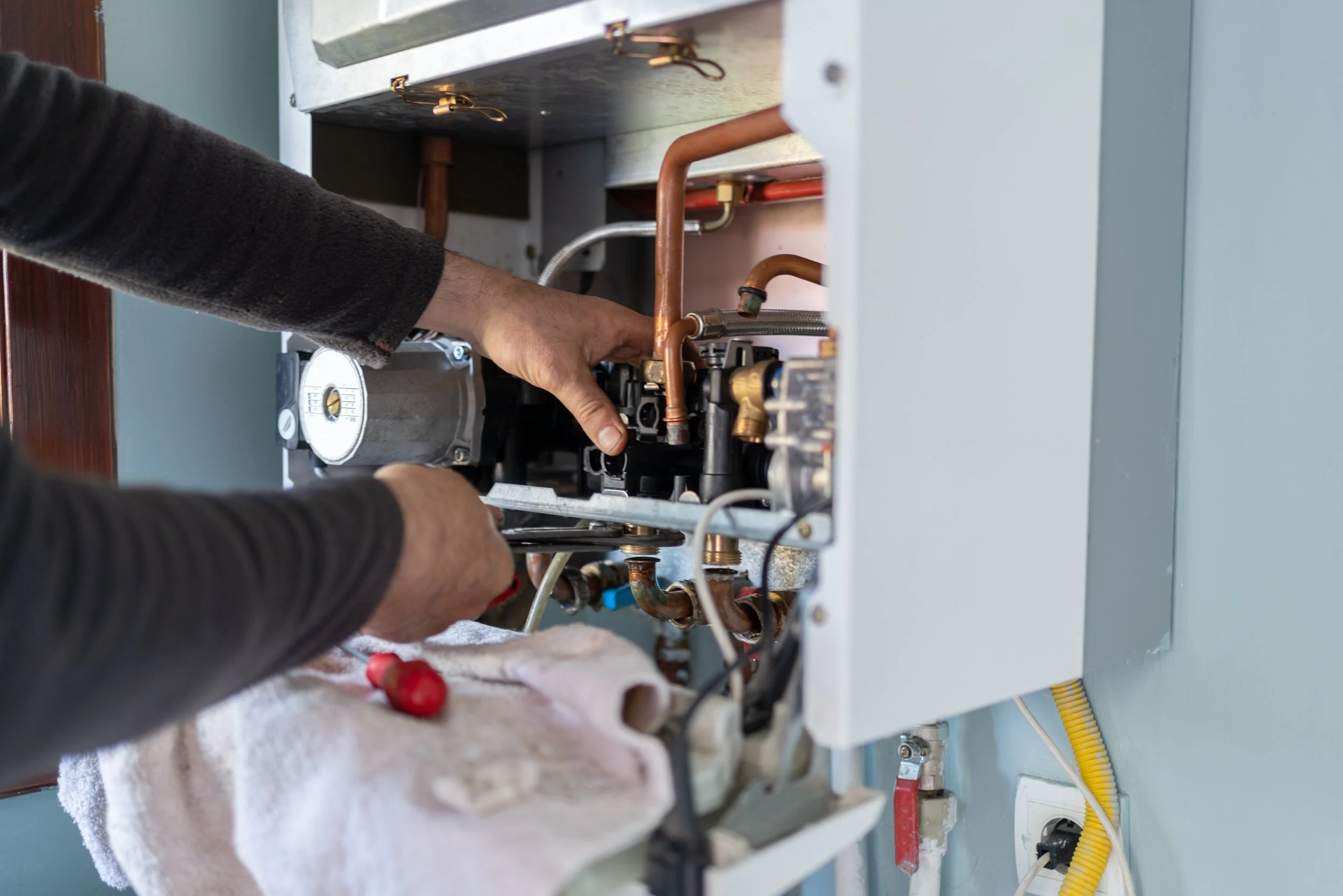
Step 4: Install Venting System
For 80% AFUE furnaces, we connect to the existing metal flue. For high-efficiency condensing furnaces (90%+ AFUE), we install PVC venting through an exterior wall.
Michigan code requires specific clearances for PVC vent terminations. We install the intake and exhaust pipes with proper slope (1/4 inch per foot minimum) to ensure condensate drains back to the furnace. Vent pipes must be supported every 3 feet and sealed at all joints to prevent exhaust leaks.
Step 5: Connect Gas Line and Electrical
The gas line gets reconnected using black iron pipe (never flexible connector for permanent installations). We size the pipe according to the furnace's BTU input and the length of the run. A pressure test verifies there are no leaks.
Electrical wiring connects to a dedicated circuit. We verify voltage, check the disconnect switch, and ensure all connections are tight and properly grounded.
Step 6: Install Thermostat and Controls
If you're upgrading to a programmable or smart thermostat, we mount it at the proper height (52-60 inches from the floor) on an interior wall away from direct sunlight, drafts, and heat sources.
Wiring runs from the thermostat to the furnace control board. We program the thermostat according to your preferences and explain how to use the different features.
Step 7: Test and Verify Operation
This is where the professional install separates itself from the quick-and-dirty jobs. We don't just fire up the furnace and walk away. We monitor the system through multiple complete heating cycles, checking:
- Gas pressure: Inlet and manifold pressure must match manufacturer specs
- Temperature rise: The difference between return and supply air temperature should fall within the range listed on the furnace data plate (typically 40-70°F)
- Airflow: We verify CFM (cubic feet per minute) using a flow hood or calculate it based on temperature rise
- Combustion analysis: We test for carbon monoxide, oxygen levels, and combustion efficiency using a calibrated analyzer
- Safety controls: We verify that limit switches, rollout switches, and flame sensors operate correctly
- Condensate drainage: On high-efficiency furnaces, we confirm that condensate drains properly and that the trap is filled
We don't leave until the system is running correctly and you understand how to operate it.
Code Compliance and Permit Requirements
Michigan requires permits for furnace installations. The permit process ensures that installations meet state mechanical codes and that a qualified inspector verifies the work.
In Troy and Oakland County, permit fees typically run $50-$150 depending on the scope of work. The inspection covers gas line connections, venting, electrical, and combustion safety. Reputable contractors pull permits automatically and schedule the inspection as part of the installation process.
What a New Furnace Actually Costs in Troy (2026 Reality)
Furnace installation costs have three main components: equipment, labor, and permits/materials. Here's what you can expect to pay in Troy and Oakland County in 2026.
Equipment Cost Ranges by Efficiency Tier
Budget Tier (80% AFUE, single-stage): $1,200-$2,000
Brands: Goodman, Amana, York, base-model Rheem
Good for: Rental properties, tight budgets, mild climates (not ideal for Michigan winters)
Mid Tier (95-96% AFUE, two-stage): $2,500-$4,000
Brands: Rheem Prestige, Bryant Preferred, Carrier Comfort, Trane XR95
Good for: Most Troy homeowners — best balance of efficiency, comfort, and cost
Premium Tier (96-98% AFUE, modulating): $4,500-$6,500
Brands: Carrier Infinity, Bryant Evolution, Lennox SLP98V, Trane S9V2
Good for: Larger homes, homeowners prioritizing comfort and efficiency, homes with zoning systems
Labor and Installation Factors
Labor costs for a straightforward furnace replacement (same location, similar size, existing ductwork compatible) typically run $1,500-$2,500 in Southeast Michigan. This includes:
- Removal and disposal of old furnace
- Installation of new furnace
- Gas line connection and leak test
- Electrical connection
- Ductwork connection and sealing
- Thermostat installation
- Startup and testing
- Permit and inspection
Labor costs increase when the job requires:
- Ductwork modifications: Add $500-$2,000 depending on scope
- New venting system for high-efficiency furnace: Add $400-$800
- Electrical panel upgrade or new circuit: Add $300-$1,200
- Condensate pump installation: Add $200-$400
- Gas line upgrade: Add $300-$800
- Difficult access (tight basements, multiple stories): Add $200-$500
Total Investment: What Most Troy Homeowners Pay
For a typical Troy home (1,500-2,000 square feet, straightforward installation), total costs break down like this:
Basic replacement (80% AFUE, single-stage): $3,500-$4,500
Standard upgrade (95-96% AFUE, two-stage): $5,000-$6,500
Premium installation (96-98% AFUE, modulating): $7,000-$8,500
These ranges assume no major ductwork modifications or electrical upgrades. If your home needs significant additional work, costs can exceed $10,000.
For detailed cost breakdowns specific to Troy, check our guide on furnace replacement costs in Troy, Michigan.
Financing and Rebate Options: Most manufacturers offer financing through their dealer networks. Terms vary, but 0% interest for 12-24 months is common during promotional periods. DTE Energy occasionally offers rebates for high-efficiency furnace installations — check their website for current programs. The federal energy tax credit (25C) may apply to qualifying high-efficiency equipment; consult your tax advisor for details.
After Installation — What You Need to Know
First Startup and System Testing
Your technician should walk you through the first startup and explain what you're hearing and seeing. New furnaces often have a slight "burning off" smell during the first few cycles — this is normal as manufacturing oils burn off the heat exchanger. The smell should dissipate within a few hours.
You'll receive documentation that includes the equipment model and serial numbers, warranty information, and a record of the combustion analysis and airflow measurements. Keep this in a safe place — you'll need it for warranty claims and future service.
Thermostat Programming for Efficiency
Programmable and smart thermostats can reduce heating costs by 10-15% when used correctly. The key is creating a schedule that matches your actual occupancy patterns.
For Troy homeowners who work traditional hours, a typical efficient schedule looks like this:
- Weekday wake (6:00 AM): 68°F
- Weekday away (8:00 AM): 62°F
- Weekday return (5:00 PM): 68°F
- Weekday sleep (10:00 PM): 65°F
Setbacks of 6-8 degrees save energy without sacrificing comfort. Avoid larger setbacks — your furnace will work harder to recover, potentially negating the savings.
Warranty Registration
Most furnace manufacturers require warranty registration within 60-90 days of installation. Failure to register can reduce your warranty from 10 years to just 5 years on the heat exchanger.
Registration is typically done online through the manufacturer's website. You'll need the model number, serial number, and installation date. Your contractor should provide this information, but verify that registration happens — don't assume they'll do it for you.
Maintenance Schedule
New furnaces need annual maintenance just like older units. The first tune-up should happen before the next heating season — typically in September or October for Michigan homes.
Our Next Care Plan includes two annual visits (fall furnace tune-up and spring AC tune-up) for just $5/month. The fall visit includes filter replacement, combustion analysis, safety inspection, and cleaning. Regular maintenance prevents the kind of breakdowns that lead to expensive emergency service calls during January cold snaps.
Annual maintenance also keeps your warranty valid. Most manufacturers require proof of annual professional service to honor warranty claims on heat exchanger failures.
Common Installation Mistakes We Fix for Troy Homeowners
We get called to diagnose and fix installation problems regularly. Here are the most common issues we see:
Undersized Units That Can't Handle Polar Vortex Temps
Some contractors use rules of thumb instead of load calculations — "400 square feet per ton" or similar shortcuts. This works in moderate climates but fails in Michigan winters.
We've seen 1,800-square-foot Troy homes with 60,000 BTU furnaces that struggle when outdoor temps drop below zero. The furnace runs continuously but can't maintain 68°F inside. The problem isn't the furnace quality — it's the sizing. The home needed 75,000-80,000 BTU based on insulation levels and air infiltration.
Improper Venting on High-Efficiency Furnaces
High-efficiency condensing furnaces require specific venting materials and installation methods. We regularly see installations where contractors used incorrect pipe materials, inadequate slope for condensate drainage, or improper clearances from windows and air intakes.
The most common mistake: insufficient slope on the vent pipes. PVC venting must slope at least 1/4 inch per foot back toward the furnace so condensate drains properly. When pipes are level or slope the wrong direction, condensate pools in the pipes and eventually backs up into the furnace, causing the unit to shut down on safety.
Skipped Load Calculations
This is the root cause of most sizing problems. Contractors who skip Manual J calculations are guessing at what size furnace you need. Sometimes they guess right. Often they don't.
The consequences: oversized furnaces that short-cycle and never reach rated efficiency, or undersized furnaces that can't maintain comfort during cold weather. Both problems cost you money and shorten equipment life.
Mismatched Ductwork
Your ductwork has to match your furnace's airflow requirements. High-efficiency furnaces move more air at lower temperatures than older models. If your ductwork is undersized or has significant leakage, the new furnace won't perform as designed.
We see this frequently in Troy homes where contractors install a new high-efficiency furnace but don't address ductwork issues. The result: uneven heating, reduced efficiency, and increased noise. The furnace is working harder than it should because it's fighting against restrictive or leaky ducts.
If you're experiencing issues after a recent installation, our guide on furnaces not blowing hot air covers common post-installation problems and solutions.
When to Call a Pro vs. DIY Maintenance
What Homeowners Can Safely Do
There are a few maintenance tasks Troy homeowners can handle without professional help:
Filter changes: Replace your furnace filter every 1-3 months depending on the type. Standard 1-inch fiberglass filters need monthly replacement. Pleated filters last 2-3 months. High-efficiency 4-inch media filters can go 6-12 months. Check the filter monthly and replace when it looks dirty.
Thermostat adjustments: Programming your thermostat, changing batteries, and adjusting temperature settings are all safe DIY tasks. If your thermostat isn't responding or shows error codes, that's when you call a professional.
Keeping vents clear: Make sure supply and return vents aren't blocked by furniture, curtains, or storage. Blocked vents reduce airflow and force your furnace to work harder.
Visual inspections: You can look for obvious problems — unusual noises, visible damage, water pooling around the furnace, or error codes on the display. But diagnosing and fixing those problems requires professional tools and training.
What Requires a Licensed Technician
Michigan law requires licensed contractors to perform certain HVAC work. These tasks are illegal for homeowners to do themselves and dangerous even for experienced DIYers:
Gas line work: Anything involving natural gas lines — connections, leak testing, pressure adjustments — requires a licensed mechanical contractor. Gas leaks can cause explosions and carbon monoxide poisoning. This isn't a place to save money with DIY work.
Electrical work: Furnace electrical systems operate at 120V or 240V. Incorrect wiring can cause fires, damage equipment, or electrocute someone. Licensed electricians or HVAC techs should handle all electrical connections.
Combustion system service: Cleaning burners, adjusting gas pressure, testing combustion efficiency, and servicing flame sensors require specialized tools and training. Incorrect adjustments can create carbon monoxide hazards.
Heat exchanger inspection: Cracked heat exchangers allow combustion gases (including carbon monoxide) to mix with your home's air. Visual inspection requires removing panels and knowing what to look for. This is a critical safety check that professionals do during annual tune-ups.
Signs Your New Furnace Needs Service
Even new furnaces can develop problems. Call a professional if you notice:
- Unusual noises (banging, screeching, rumbling)
- Weak airflow from vents
- Furnace cycles on and off frequently (short-cycling)
- Yellow or flickering burner flame (should be steady blue)
- Error codes on the display
- Burning smell that persists beyond the first few hours
- Visible rust or corrosion on the unit
- Water pooling around the furnace base
Most of these issues are covered under warranty if the furnace is new. But warranty coverage requires professional diagnosis and repair — DIY attempts can void the warranty.
Ready to Schedule Your Furnace Installation in Troy?
NEXT Heating & Cooling has been serving Troy and Oakland County for over 35 years. Our NATE-certified technicians perform proper load calculations, pull permits, and install furnaces according to Michigan mechanical code. No shortcuts. No upselling. Just honest diagnostics and quality work.
Get Your Free EstimateFrequently Asked Questions About Furnace Installation in Troy, MI
A straightforward furnace replacement typically takes 6-8 hours. This includes removing the old unit, installing the new furnace, connecting gas and electrical lines, attaching ductwork, installing venting, and testing the system. More complex installations requiring ductwork modifications, electrical upgrades, or extensive venting work can take a full day or longer. Our technicians provide accurate time estimates during the in-home assessment.
Furnace size depends on your home's Manual J load calculation, which accounts for square footage, insulation levels, window types, air infiltration, and Michigan's design temperature. Most 1,500-2,000 square foot Troy homes need furnaces in the 60,000-80,000 BTU range. Older homes with less insulation may need larger units; newer well-insulated homes may need smaller ones. We never recommend sizing based on your old furnace — proper load calculations ensure you get the right size for your specific home.
For Troy and Southeast Michigan, we typically recommend 95-96% AFUE furnaces. The efficiency gain pays for itself through lower gas bills over the 15-20 year lifespan of the furnace. A typical Troy home saves $150-$200 annually on heating costs by upgrading from 80% to 96% AFUE. That's $2,250-$4,000 in savings over the furnace's lifetime. High-efficiency models also provide better comfort with longer, more consistent heating cycles.
Yes. Michigan requires permits for furnace installations to ensure work meets state mechanical codes. In Troy and Oakland County, permit fees typically run $50-$150. The permit process includes an inspection that verifies proper gas line connections, venting, electrical work, and combustion safety. Reputable contractors pull permits automatically and include the cost in their installation quote. Avoid contractors who suggest skipping the permit — unpermitted work can create safety hazards and problems when you sell your home.
Total installed cost for a new furnace in Troy ranges from $3,500 to $8,500 depending on efficiency level and installation complexity. Budget 80% AFUE units run $3,500-$4,500 installed. Mid-tier 95-96% AFUE two-stage furnaces cost $5,000-$6,500. Premium modulating furnaces run $7,000-$8,500. These ranges assume straightforward installations without major ductwork modifications or electrical upgrades. Complex jobs requiring significant additional work can exceed $10,000.
We install all major furnace brands including Carrier, Lennox, Trane, Rheem, Bryant, Goodman, Amana, York, and RUUD. We don't push one brand over others — we recommend equipment based on your specific needs, budget, and home requirements. For most Troy homeowners, we suggest mid-to-upper tier models from Carrier, Bryant, Rheem, or Trane in the 95-96% AFUE range. These provide excellent reliability and efficiency for Michigan winters at reasonable prices.
Annual professional maintenance is essential for all furnaces, including new ones. Schedule your first tune-up before the next heating season (September or October in Michigan). Annual service includes filter replacement, combustion analysis, safety inspection, burner cleaning, and testing all controls. Regular maintenance prevents breakdowns, keeps your warranty valid, and ensures the furnace operates at rated efficiency. Our Next Care Plan provides two annual visits (fall furnace tune-up and spring AC tune-up) for just $5/month.