

AC Condenser Unit Replacement Cost in Southeast Michigan

When your AC condenser unit fails on a 90-degree July day in Sterling Heights, you need answers fast — and you need to know what you're actually going to pay before a truck shows up in your driveway.
After 35 years of heating and cooling services in Metro Detroit, we've replaced thousands of condenser units across Macomb, Oakland, and St. Clair counties. We know what homeowners pay in 2026, what drives the cost up or down, and when replacement makes more sense than repair.
This guide breaks down the real ac condenser unit replacement cost for Southeast Michigan homeowners — brand by brand, size by size, with the kind of detail you won't find in a generic national article. No sales pitch. Just the numbers and the reasoning behind them.
What Is an AC Condenser Unit (And Why It Matters)
Before we talk cost, let's make sure we're talking about the same thing. Your AC condenser unit is the big metal box sitting outside your house — the one that hums and blows hot air out the top when your air conditioning is running.
Inside that box, you've got four major components:
- Compressor: The heart of the system. It pressurizes refrigerant and pumps it through the cooling cycle. This is the most expensive single part in your AC system.
- Condenser coil: A serpentine copper tube wrapped in aluminum fins. It releases heat from the refrigerant into the outdoor air.
- Condenser fan motor and blade: Pulls air across the coil to dissipate heat. When this fails, you'll hear grinding or the fan won't spin at all.
- Control board and capacitors: The electrical brain that manages compressor startup, fan speed, and communication with your indoor air handler.
When any of these components fail — especially the compressor — you're often looking at a repair bill that's 50% to 70% of what a brand-new condenser unit would cost. That's when the replacement conversation starts.
Michigan-Specific Reality: Our climate is brutal on outdoor AC equipment. Winter temperature swings from -10°F during a polar vortex to 40°F thaws in February cause expansion and contraction stress. Summer humidity and pollen clog coils faster than in drier climates. And if your condenser sat through 15 Michigan winters, it's lived a harder life than the same unit would in Arizona.
What You'll Actually Pay to Replace an AC Condenser in Michigan (2026)
Here's the range you'll see for a complete ac condenser unit replacement in Southeast Michigan in 2026, installed by a licensed and insured HVAC contractor like NEXT Heating & Cooling:
Total installed cost: $2,200 to $6,500
That wide range depends on three main factors:
- Brand tier: Budget brands (Goodman, Amana) vs. premium brands (Carrier, Lennox, Trane)
- Tonnage (size): A 2-ton unit for a small ranch vs. a 5-ton unit for a 3,000-square-foot colonial
- SEER rating: A basic 14 SEER unit vs. a high-efficiency 18 SEER or 20 SEER model
Let's break down what goes into that number:
Equipment Cost
The condenser unit itself — just the metal box with compressor, coil, fan, and controls — runs $1,400 to $4,800 at contractor cost, depending on brand and efficiency. Homeowners don't see this number directly because contractors bundle it with labor, but it's 60% to 70% of your total bill.
Labor Cost
Professional installation in Southeast Michigan typically runs $600 to $1,200. This includes:
- Disconnecting and removing the old condenser unit
- Installing the new unit on a concrete pad or composite base
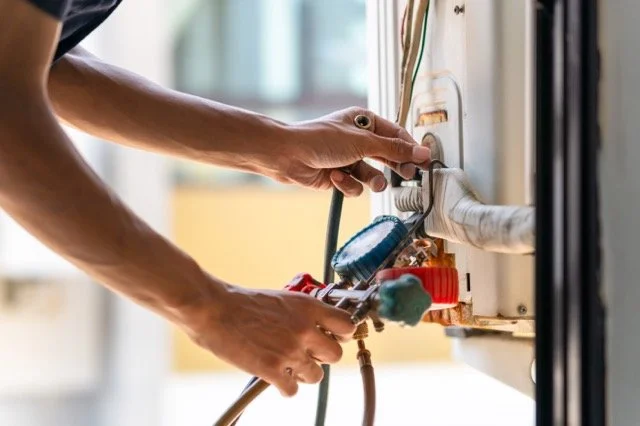
- Connecting refrigerant lines (and pressure-testing for leaks)
- Running electrical connections and verifying voltage
- Vacuuming the system to remove moisture
- Charging the system with the correct refrigerant type and amount
- Testing airflow, temperature drop, and system performance
If you're in Troy, Rochester Hills, or Bloomfield Hills and the condenser is on a second-story roof or tucked in a tight side yard, expect labor to run closer to the high end. Ground-level installs with easy access in Warren or Clinton Township tend to come in lower.
Additional Costs
- Permit fees: $50 to $150 (required in most Michigan municipalities for HVAC work)
- Disposal fee: $50 to $100 to haul away the old unit and reclaim refrigerant (EPA-required)
- Electrical upgrades: $200 to $800 if your breaker panel needs a dedicated circuit or upgraded wiring
- Concrete pad replacement: $150 to $300 if the old pad is cracked or sinking
Brand-by-Brand Condenser Replacement Costs
Not all AC brands are created equal — and the price difference reflects real engineering, warranty coverage, and long-term reliability. Here's what you'll pay for the most common brands we install in Southeast Michigan, based on a standard 3-ton, 16 SEER condenser unit (the most popular size for a 1,500 to 1,800 square-foot home).
Budget Tier: $2,200 to $3,800 Installed
Goodman: $2,200 to $3,200
Goodman is the workhorse of budget HVAC. Owned by Daikin (a premium Japanese manufacturer), Goodman units are built in Texas and designed for value. You get a 10-year parts warranty, solid performance, and straightforward construction. We install a lot of these in rental properties and for homeowners who need reliable cooling without premium features. They're louder than higher-end units and don't have the advanced humidity control or variable-speed options, but they cool effectively.
Amana: $2,400 to $3,400
Also owned by Daikin, Amana sits just above Goodman in the lineup. You get the same core reliability with slightly better sound dampening and a lifetime compressor warranty (as long as you own the home and register the unit). That warranty is the main reason to choose Amana over Goodman — if the compressor fails in year 12, you're covered for the part.
York: $2,600 to $3,800
York (owned by Johnson Controls) has been around since 1874. Their budget-tier condensers are solid mid-market performers. You'll see these in a lot of older Michigan homes because York has strong distributor presence in the region. Parts availability is excellent, and warranty coverage is standard (10 years parts).
Mid-Tier: $3,200 to $4,800 Installed
Bryant: $3,200 to $4,500
Bryant is Carrier's sister brand — same parent company (Carrier Global), same engineering, slightly lower price. You get Carrier's build quality and efficiency technology without the Carrier badge premium. We recommend Bryant when homeowners want premium performance but are budget-conscious. The Evolution series offers variable-speed compressors and excellent humidity control for Michigan's sticky summers.
Rheem: $3,400 to $4,600
Rheem is a strong American brand with manufacturing in Fort Smith, Arkansas. Their EcoNet smart technology integrates well with modern thermostats, and their scroll compressors are known for quiet operation. Rheem's mid-tier Prestige series hits a sweet spot for Southeast Michigan homeowners — efficient, reliable, and well-supported by local parts suppliers.
RUUD: $3,300 to $4,500
RUUD is Rheem's commercial-grade sibling. Same parent company, but RUUD units are built for durability over aesthetics. If you're a property manager in Sterling Heights with multi-unit buildings, RUUD is a go-to. Tough, repairable, and built to handle high-use environments.
Premium Tier: $3,800 to $6,500 Installed
Carrier: $4,200 to $6,200
Carrier invented modern air conditioning in 1902, and they still lead in innovation. The Infinity series offers variable-speed compressors, two-stage cooling, and Greenspeed intelligence that adjusts output based on humidity and temperature. These units are whisper-quiet (as low as 56 decibels — quieter than a normal conversation) and incredibly efficient. If you're in Grosse Pointe Farms or Bloomfield Hills and want the best, this is it.
Lennox: $4,000 to $6,000
Lennox competes head-to-head with Carrier in the premium space. Their Signature series offers SEER ratings up to 26 (the highest in the industry) and SunSource solar-ready technology. Lennox units excel in humidity control — a big deal in Michigan, where summer dew points hit 70°F and your house feels clammy even when the AC is running. We see a lot of Lennox in Lake Orion and Rochester Hills.
Trane: $4,200 to $6,500
Trane's slogan is "It's Hard to Stop a Trane," and there's truth to it. These units are built like tanks — heavy-gauge steel cabinets, spine-fin coils that resist corrosion, and compressors tested to 100,000 startup cycles. Trane's XV20i variable-speed condenser is one of the most efficient and reliable units we install. If you plan to stay in your home for 20+ years, Trane is worth the investment.
What We Actually Install: At NEXT Heating & Cooling, we're manufacturer-agnostic. We carry Carrier, Lennox, Trane, Rheem, Bryant, Goodman, Amana, York, and RUUD because different homes need different solutions. We'll never upsell you to a premium brand if a mid-tier unit meets your needs. Our NATE-certified technicians will size the system correctly, explain your options, and let you decide.
When Repair Makes More Sense Than Replacement
Not every condenser failure means you need a new unit. Sometimes repair is the smarter financial move. Here's how we help homeowners make that call:
The 50% Rule
If the repair cost is more than 50% of what a new condenser would cost, replacement usually makes more sense — especially if the unit is over 10 years old. Example: Your compressor fails. A new compressor plus labor runs $1,800. A new condenser unit installed costs $3,200. That's 56% of replacement cost. If your unit is 12 years old, replace it. If it's 6 years old and still under warranty, repair it.
Age Matters
AC condensers in Michigan typically last 12 to 18 years, depending on maintenance and usage. Here's our rule of thumb:
- Under 8 years: Repair unless it's a catastrophic failure (lightning strike, flood damage)
- 8 to 12 years: Gray area — depends on repair cost and efficiency of current unit
- Over 12 years: Lean toward replacement, especially if the unit is 14 SEER or lower
- Over 15 years: Replace. You're on borrowed time, and parts availability becomes an issue.
Refrigerant Type Is Critical
If your condenser uses R-22 refrigerant (common in units installed before 2010), replacement is almost always the right call. R-22 was phased out by the EPA in 2020, and remaining stockpiles are expensive — $100 to $150 per pound. A typical recharge takes 6 to 10 pounds. You're looking at $600 to $1,500 just for refrigerant, and you'll likely need more in a few years as the system ages.
Modern condensers use R-410A refrigerant (Puron), which is cheaper, more efficient, and environmentally friendlier. If you're still running R-22, it's time to upgrade.
Warranty Status
If your condenser is still under manufacturer warranty (typically 10 years on parts), repair becomes much more attractive. You'll only pay for labor, not the $800 to $2,000 compressor. But here's the catch: You need proof of professional installation and proof of annual maintenance. Most manufacturers void the warranty if you can't provide service records. That's where our $5/month HVAC maintenance plan pays for itself — we keep those records for you, and you get priority scheduling when something breaks.
What Drives the Cost Up (Or Down) in Southeast Michigan
Two homeowners in Clinton Township can get quotes for the same brand and tonnage and see a $1,000 difference. Here's why:
SEER Rating Impact
SEER (Seasonal Energy Efficiency Ratio) measures how efficiently your AC converts electricity into cooling. Higher SEER = lower electric bills, but higher upfront cost.
- 14-15 SEER: Minimum efficiency for new units. Budget-friendly upfront, but you'll pay more in summer electric bills.
- 16-17 SEER: Sweet spot for Michigan. Noticeable efficiency improvement without premium pricing.
- 18-20 SEER: High efficiency. Makes sense if you run AC heavily (June through September) or have high electric rates.
- 20+ SEER: Top-tier. Pays back over 10-15 years in energy savings, but upfront cost is steep.
In Southeast Michigan, where we use AC for 3 to 4 months a year (not year-round like the South), the payback period for ultra-high-efficiency units is longer. We typically recommend 16 SEER as the best value unless you have specific comfort needs (like severe allergies or humidity sensitivity).
Tonnage (Size) Matters
AC tonnage refers to cooling capacity, not weight. One ton of cooling = 12,000 BTUs per hour. Here's what most Michigan homes need:
- 2 tons (24,000 BTU): 1,000 to 1,400 sq ft (small ranch, condo)
- 2.5 tons (30,000 BTU): 1,400 to 1,700 sq ft
- 3 tons (36,000 BTU): 1,700 to 2,100 sq ft (most common size)
- 3.5 tons (42,000 BTU): 2,100 to 2,400 sq ft
- 4 tons (48,000 BTU): 2,400 to 2,800 sq ft
- 5 tons (60,000 BTU): 2,800+ sq ft (large colonial, two-story with high ceilings)
Bigger isn't always better. An oversized unit short-cycles (turns on and off rapidly), which wastes energy and fails to dehumidify properly. An undersized unit runs constantly and never catches up on hot days. Proper sizing requires a Manual J load calculation — something our NATE-certified technicians do for every installation.
Installation Complexity
Some installs are straightforward. Some aren't. Factors that increase labor cost:
- Roof-mounted condenser: Requires crane or rooftop access. Add $400 to $800.
- Tight side yard or fenced area: Equipment has to be carried through the house. Add $200 to $400.
- Electrical panel upgrade: Older homes in Royal Oak or Grosse Pointe might have 100-amp service that needs upgrading to 200-amp. Add $800 to $2,000.
- Refrigerant line replacement: If existing lines are corroded or kinked, new copper lines run $300 to $600.
- Ductwork modifications: If your indoor air handler doesn't match the new condenser's airflow requirements, duct sizing might need adjustment. Add $400 to $1,200.
Time of Year
HVAC contractors are slammed in June, July, and August. That's when your condenser is most likely to fail, and that's when demand (and pricing) peaks. If you can schedule replacement in April, May, September, or October, you'll often see 10% to 15% lower pricing and faster scheduling. We call it "shoulder season," and it's the best time to upgrade.
Signs Your Condenser Unit Is Failing
Most condenser failures don't happen overnight. Here are the warning signs we see during service calls in Macomb and Oakland counties:
1. Compressor Won't Start or Short-Cycles
You hear a click or hum, but the compressor never kicks on. Or it runs for 30 seconds, shuts off, then tries to start again. This usually means a failed start capacitor (cheap fix, $150 to $300) or a dying compressor (expensive, $1,200 to $2,500). If your unit is over 10 years old and the compressor is failing, replace the whole condenser.
2. Loud Grinding, Squealing, or Rattling
Compressors should hum quietly. If you hear metal-on-metal grinding, the compressor bearings are shot. Squealing usually means the condenser fan motor is failing. Rattling can be loose fan blades or debris in the unit. None of these are DIY fixes — shut the system off and call a tech before you cause more damage.
3. Ice Buildup on Refrigerant Lines
If you see frost or ice on the copper lines running from your condenser to your house, something's wrong. Common causes: low refrigerant (leak), dirty evaporator coil (inside your house), or failing expansion valve. This is a diagnostic call — could be a $200 fix or a $2,000 problem. Related: AC unit frozen with ice on coils? Here's what's wrong.
4. Breaker Trips Repeatedly
If your AC breaker trips once, reset it. If it trips again, don't keep resetting it — you've got an electrical problem. Could be a short in the compressor, a failing capacitor, or undersized wiring. This is a safety issue. Call a licensed contractor immediately.
5. Unit Is Over 15 Years Old
Even if it's still running, a 15-year-old condenser in Michigan has lived a full life. Efficiency has dropped (you're paying more to cool less), refrigerant is likely R-22 (expensive and obsolete), and parts availability is declining. Start budgeting for replacement before it fails on the hottest day of summer.
When to Call for Emergency Service: If your condenser fails during a heat wave and you have young children, elderly family members, or health conditions affected by heat, don't wait. NEXT Heating & Cooling offers 24/7 emergency HVAC service across Southeast Michigan. We'll get your system running or provide temporary cooling options while we source a replacement unit.
How to Get the Best Value on Condenser Replacement
You're going to spend $2,200 to $6,500 on this project. Here's how to make sure you get the best value — not the lowest price, but the best combination of quality, reliability, and fair cost.
1. Get Multiple Quotes with the Same Specs
Don't just ask for "a new AC." Specify the SEER rating, tonnage, and brand tier you're comparing. Example: "I want quotes for a 3-ton, 16 SEER condenser from Carrier, Rheem, and Bryant." That way you're comparing apples to apples, not a budget Goodman quote against a premium Trane quote.
2. Ask About Labor Warranty vs. Equipment Warranty
Manufacturers cover equipment (10 years on parts, sometimes lifetime on compressor). But who covers labor if something fails in year 3? Some contractors offer 1-year labor warranties. Others offer 5 or 10 years. That difference matters if you have a $600 service call down the road. At NEXT Heating & Cooling, we back our installations with a 1-year labor warranty and offer extended coverage through our Next Care Plan.
3. Consider Off-Season Scheduling
If your condenser is limping along but still working, schedule replacement in April or September. You'll avoid the June rush, get better pricing, and have more time to research options. Bonus: Manufacturers often run spring and fall promotions with rebates or extended warranties.
4. Don't Skip the Load Calculation
A proper Manual J load calculation accounts for your home's square footage, insulation, window types, ductwork, and orientation. It takes 30 to 60 minutes. If a contractor quotes you over the phone without seeing your house, they're guessing. Undersized or oversized equipment costs you money every month in wasted energy.
5. Invest in Preventive Maintenance
A new condenser should last 15+ years — but only if you maintain it. Annual tune-ups (spring for AC, fall for furnace) catch small problems before they become expensive failures. Our Next Care Plan costs $5/month and includes two annual visits, priority scheduling, 10% repair discounts, and no service call fees. Over the life of your condenser, that's $900 in membership fees vs. $1,500 to $4,000 in avoided repair costs. It pays for itself.
6. Check Contractor Credentials
Michigan requires HVAC contractors to hold a mechanical contractor license. Ask to see it. Also ask about:
- NATE certification: North American Technician Excellence is the gold standard for HVAC techs. It's not required by law, but it proves competence.
- BBB rating: Check the Better Business Bureau for complaints and resolution history.
- Insurance: Liability and workers' comp. If a tech gets hurt on your property and the company isn't insured, you could be liable.
- Manufacturer authorization: Brands like Carrier and Lennox only authorize contractors who meet training and service standards.
NEXT Heating & Cooling holds a Michigan Mechanical Contractor License, BBB A+ accreditation, NATE certification, and manufacturer partnerships with every major brand. We've been doing this for 35 years under Premier Builder Inc., and we're not going anywhere.

Need a Condenser Replacement Quote?
NEXT Heating & Cooling has been keeping Southeast Michigan homes comfortable for over 35 years. We'll size your system correctly, explain your options honestly, and install it right the first time. No pressure. No upselling. Just straight answers from NATE-certified technicians who show up on time.
Get Your Free EstimateFrequently Asked Questions About AC Condenser Replacement
A straightforward condenser replacement takes 4 to 6 hours for a professional crew. That includes disconnecting the old unit, installing the new one, pressure-testing refrigerant lines, vacuuming the system, charging it with refrigerant, and testing performance. If we need to replace the concrete pad, run new electrical, or modify ductwork, add another 2 to 4 hours. Most jobs are completed in a single day.
You can replace just the condenser if your indoor air handler or evaporator coil is in good condition and uses compatible refrigerant (R-410A). However, manufacturers design systems to work as matched pairs — same brand, same generation, same SEER rating. Mismatched systems can lose 10% to 15% efficiency and may void warranties. If your indoor unit is over 10 years old, it's often smarter to replace both at once. You'll get better efficiency, full warranty coverage, and avoid another major expense in 3 to 5 years.
The condenser is the entire outdoor unit — the metal cabinet, coil, fan, compressor, and controls. The compressor is the heart inside that cabinet — it's the component that pressurizes refrigerant and pumps it through the cooling cycle. When people say "my compressor died," they usually mean the compressor inside the condenser unit failed. Replacing just the compressor costs $1,200 to $2,500. Replacing the whole condenser unit costs $2,200 to $6,500. If your unit is over 10 years old, replacing the whole condenser makes more sense than just swapping the compressor.
It depends on how much you use your AC and how long you plan to stay in your home. In Southeast Michigan, we run AC for about 3 to 4 months a year (June through September). Upgrading from 14 SEER to 16 SEER costs about $400 to $800 more upfront and saves roughly $80 to $150 per year on electric bills. That's a 5 to 10 year payback. Upgrading to 18 SEER or higher costs $1,200 to $2,000 more and saves $150 to $250 per year — a 7 to 12 year payback. If you're staying in your home long-term and value comfort (better humidity control, quieter operation), higher SEER is worth it. If you're selling in 3 to 5 years, stick with 16 SEER.
Yes. Most Michigan municipalities require a mechanical permit for HVAC equipment replacement. The permit ensures the work meets state building codes and is inspected for safety. Licensed contractors pull the permit as part of the installation — it's included in your quote (typically $50 to $150). If a contractor offers to skip the permit to save money, walk away. Unpermitted work can void your homeowner's insurance, complicate home sales, and leave you liable if something goes wrong.
Licensed contractors are required by EPA regulations to recover refrigerant from old units before disposal. We use certified recovery equipment to remove and reclaim the refrigerant, then haul the unit to a recycling facility where copper, aluminum, and steel are separated and recycled. You'll see a disposal fee ($50 to $100) on your invoice — that covers refrigerant recovery, hauling, and proper recycling. Never let a contractor "throw it in the truck" without recovering refrigerant. That's illegal and harms the environment.
Technically, you can buy a condenser unit online and install it yourself. Practically, you shouldn't. Here's why: (1) You need an EPA 608 certification to legally purchase and handle refrigerant. (2) You need specialized tools — vacuum pump, manifold gauges, refrigerant scale, leak detectors — that cost $1,000+. (3) Improper installation voids manufacturer warranties. (4) Mistakes (wrong refrigerant charge, improper electrical connections, refrigerant leaks) can damage the system or create safety hazards. (5) You won't get a permit or inspection, which can cause problems when you sell your home. Save yourself the headache and hire a licensed contractor. The labor cost ($600 to $1,200) is worth the peace of mind.