

AC Installation Cost Troy MI: 2026 Real Pricing Guide

If you're a Troy homeowner researching AC installation costs, you've probably found wildly different numbers online — anywhere from $3,000 to $12,000 or more. That's frustrating when you're trying to budget for something as essential as staying comfortable through Michigan's humid summers.
Here's what you actually need to know: most central air conditioning installations in Troy, Michigan cost between $4,800 and $9,500 in 2026, depending on your home size, the equipment you choose, and the condition of your existing ductwork. That's the real range we see across Oakland County after 35+ years of furnace and AC installation services throughout Southeast Michigan.
But here's the thing — that range is only useful if you understand what drives those costs and what you're actually paying for. At NEXT Heating & Cooling, we've installed hundreds of AC systems in Troy homes, from 1960s ranches on Coolidge Highway to newer builds in the Northfield Hills subdivision. We know exactly where the money goes and which expenses are worth it versus which ones are just contractor markup.
This guide breaks down the real costs, the hidden expenses most contractors won't mention upfront, and how to get the best value — not just the cheapest price — when you're ready to replace your AC system.
What You'll Actually Pay for AC Installation in Troy
Let's start with the breakdown. When you hire a reliable HVAC contractor in Metro Detroit for a complete central AC installation, you're paying for three main components:
Equipment Costs (40-50% of Total)
The AC unit itself — both the outdoor condenser and indoor evaporator coil — makes up the largest chunk of your investment. Here's what different efficiency tiers cost in 2026:
- Budget tier (13-14 SEER): $1,800 - $3,200 for the equipment. Brands like Goodman, York, and RUUD fall here. These meet minimum federal efficiency standards and work fine for most Troy homes.
- Mid-tier (15-16 SEER): $2,800 - $4,500. This is where you'll find Carrier, Bryant, and Rheem mid-range models. Better warranties, quieter operation, and improved humidity control for Michigan's muggy summers.
- Premium tier (17-20 SEER): $4,200 - $7,000. Lennox, Trane, and Carrier's top-end systems. Variable-speed compressors, advanced humidity management, and the best energy efficiency. Worth it if you're staying in your Troy home long-term.
We work with all these manufacturers at NEXT Heating & Cooling, and the honest truth is this: a properly sized and installed 14 SEER Goodman will keep you more comfortable than an incorrectly sized 18 SEER Lennox. Equipment quality matters, but installation quality matters more.
Labor and Installation (30-40% of Total)
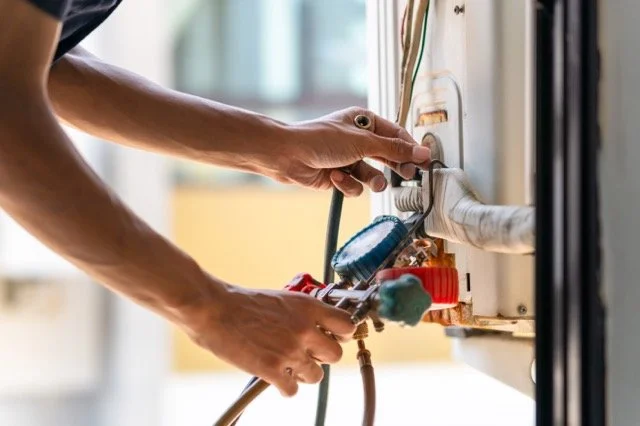
Professional installation in Troy typically runs $1,800 to $3,500, depending on complexity. This includes:
- Removing your old system and properly disposing of refrigerant (EPA regulations require licensed technicians)
- Installing the new outdoor condenser on a level pad
- Mounting the indoor evaporator coil in your furnace plenum
- Running or replacing refrigerant line sets
- Electrical connections and disconnect box installation
- Vacuum testing the refrigerant lines (critical — shortcuts here cause premature failure)
- Charging the system with the correct amount of refrigerant
- Testing airflow and verifying proper operation
Labor costs are higher in Oakland County than in some other parts of Michigan because of permit requirements and the cost of doing business. But this is also where you see the biggest difference between a NATE-certified HVAC technician and someone who just wants to get in and out fast.
Permits and Inspections (5-10% of Total)
Oakland County requires mechanical permits for AC installations, which typically cost $150 to $300 depending on the municipality. Troy's building department is thorough — they want to see proper electrical disconnects, correct refrigerant line sizing, and code-compliant installations.
Some contractors skip permits to save money or time. Don't work with them. If something goes wrong and your homeowner's insurance finds out the work wasn't permitted, you could have a claim denied. It's not worth the risk.
What Drives AC Installation Costs in Southeast Michigan
Now that you know the baseline numbers, here's what makes one installation cost $5,000 and another cost $9,000 — even for similar-sized homes in Troy.
Home Size and Load Calculation Requirements
Your AC system needs to be sized correctly for your home's cooling load, which depends on square footage, insulation quality, window count and orientation, ceiling height, and more. This is called a Manual J load calculation, and it's the foundation of a proper installation.
Here's the problem: many contractors skip this step and just guess based on square footage. They'll say "you need a 3-ton unit for a 1,500 square foot home" without actually measuring anything. That's how you end up with an oversized system that short-cycles, doesn't dehumidify properly, and breaks down early.
At NEXT, we perform a Manual J calculation on every installation. It takes an extra hour, but it's the difference between a system that runs efficiently for 15+ years and one that causes problems from day one.
Troy-specific consideration: Many Troy homes built in the 1960s and 70s have minimal attic insulation and single-pane windows. These homes need more cooling capacity than newer builds of the same square footage. A proper load calculation accounts for this — guesswork doesn't.
Existing Ductwork Condition
If your ductwork is in good shape — properly sized, sealed, and insulated — installation is straightforward. But if you're in one of Troy's older ranches with original ductwork from the 1960s, you might have problems:
- Undersized ducts: Old ductwork was often designed for heating only, not cooling. Modern high-efficiency AC systems need adequate airflow or they'll freeze up.
- Leaky connections: We regularly find 20-30% of cooled air leaking into attics and crawl spaces in older Troy homes. That's money you're literally throwing away.
- Poor layout: Some rooms get blasted with cold air while others barely cool down. This usually means the duct system wasn't designed with proper airflow balance.
Ductwork repairs or modifications can add $800 to $3,500 to your installation cost, but they're often necessary for the system to work correctly. We'll always let you know what's required versus what's recommended — no pressure, just honest information.
SEER Rating and Efficiency Tier Selection
SEER (Seasonal Energy Efficiency Ratio) measures how efficiently your AC converts electricity into cooling. Higher SEER means lower operating costs, but also higher upfront costs.
For Troy homeowners, here's what makes sense:
- If you're planning to move within 5 years: A 14-15 SEER system is probably your best value. You won't recoup the cost of premium efficiency in energy savings before you sell.
- If you're staying 10+ years: Consider 16-18 SEER. Michigan summers are getting hotter and more humid, and the energy savings add up over time. Plus, higher-SEER systems usually have better dehumidification, which matters in our climate.
- If you want the best comfort regardless of cost: Variable-speed systems (18-20 SEER) run almost continuously at low speeds, providing the most consistent temperatures and humidity control. They're also the quietest.
We've written more about this in our Carrier vs. Trane vs. Lennox comparison — the same principles apply to AC systems.
Brand Selection: Does It Really Matter?
Yes and no. The major brands — Carrier, Lennox, Trane, Rheem, Bryant, Goodman, Amana, York, RUUD — all make reliable equipment when installed correctly. The differences come down to:
- Warranty coverage: Premium brands typically offer 10-year parts warranties versus 5-year on budget models. Labor warranties depend on your contractor.
- Noise levels: Higher-end units use better sound insulation and quieter compressor technology. This matters if your condenser sits outside a bedroom window.
- Advanced features: Variable-speed compressors, smart thermostats, and humidity controls are usually only available on mid-tier and premium systems.
- Parts availability: Popular brands like Carrier and Trane have better parts availability in Southeast Michigan, which means faster repairs if something breaks.
Bottom line: buy the best equipment you can reasonably afford, but don't break the bank. A well-installed mid-tier system will outperform a poorly installed premium system every time.
Hidden Costs Troy Homeowners Need to Know About
Here's where honest contractors separate themselves from the ones who lowball estimates to win jobs, then hit you with "unexpected" charges later. These are real costs that often come up during AC installations in Troy:
Electrical Panel Upgrades
Modern AC systems draw significant power, especially high-efficiency models with variable-speed fans. If your home still has a 100-amp electrical panel (common in older Troy neighborhoods), you might need an upgrade to 200 amps. Cost: $1,500 to $3,000.
Even if your panel has enough capacity, you might need a new dedicated circuit for the AC system. A licensed electrician will charge $300 to $600 for this work. Make sure your HVAC contractor coordinates with an electrician — electrical work requires a separate permit in Troy.
Thermostat Upgrades
If you're upgrading from a basic system to a variable-speed or two-stage AC, your old thermostat probably won't work correctly. You'll need a compatible thermostat, which ranges from:
- Basic programmable: $150 - $250 installed
- Wi-Fi enabled (Honeywell, Ecobee, etc.): $300 - $450 installed
- Manufacturer-specific smart thermostat: $400 - $600 installed
Smart thermostats are worth it if you're gone during the day or want to control your system remotely. They can reduce cooling costs by 10-15% through better scheduling and automatic adjustments.
Refrigerant Line Set Replacement
If your existing refrigerant lines are in good condition and the right size for your new system, they can be reused. But if they're damaged, undersized, or you're moving the outdoor unit to a different location, you'll need new line sets.
Cost varies by distance: $400 to $1,200 depending on how far the outdoor unit sits from your furnace. Longer runs mean more refrigerant, more copper tubing, and more labor.
Ductwork Modifications and Sealing
We mentioned this earlier, but it's worth repeating because it's so common in Troy's older homes. If your ductwork needs work, expect to pay:
- Professional duct sealing: $500 - $1,200 (sealing all accessible connections with mastic, not just tape)
- Duct insulation: $400 - $900 (critical for ducts running through unconditioned attics)
- Adding return air ducts: $800 - $2,000 (many older homes have inadequate return air, which kills efficiency)
- Complete duct replacement: $3,000 - $7,000 (sometimes necessary in homes with severely deteriorated ductwork)
A good contractor will inspect your ductwork before giving you a final quote and explain exactly what's needed versus what's optional.
AC Installation Cost by Home Size: Troy Examples
Here's what we typically see for complete AC installations in different types of Troy homes, based on hundreds of installations we've done across Oakland County:
1,200-1,500 Square Feet (Common Troy Ranches)
These are the brick ranches you'll find throughout Troy's older neighborhoods — single-story, 3-bedroom, 1-2 bath homes built in the 1960s and 70s. Most need a 2.5 to 3-ton system.
- Budget installation (14 SEER Goodman or York): $4,800 - $6,200
- Mid-tier installation (16 SEER Carrier or Rheem): $5,800 - $7,500
- Premium installation (18 SEER Lennox or Trane): $7,200 - $9,000
These prices assume existing ductwork is in decent shape and only needs minor sealing. Add $800-$1,500 if you need ductwork repairs, which is common in homes this age.
1,800-2,200 Square Feet (Two-Story Colonials)
Two-story colonials are popular throughout Troy, especially in neighborhoods built in the 1980s and 90s. Most need a 3 to 3.5-ton system, sometimes 4-ton if there's poor insulation or lots of west-facing windows.
- Budget installation (14 SEER): $5,500 - $7,200
- Mid-tier installation (16 SEER): $6,800 - $8,500
- Premium installation (18 SEER variable-speed): $8,500 - $10,500
Two-story homes often have hot upstairs bedrooms in summer because of poor duct design. If that's your situation, budget an extra $1,000-$2,000 for duct modifications to balance airflow properly.
2,500-3,500 Square Feet (Newer Troy Builds)
Larger homes, especially newer construction in Troy's premium subdivisions, typically need 4 to 5-ton systems. Some of these homes benefit from zoned systems with multiple thermostats.
- Single-zone, mid-tier (16 SEER): $8,200 - $10,500
- Single-zone, premium (18 SEER variable-speed): $10,000 - $13,000
- Two-zone system (separate upstairs/downstairs control): $12,000 - $18,000
Zoned systems cost more upfront but provide better comfort and efficiency in larger homes. Each zone gets its own thermostat and dampers control airflow to different areas.
How to Get the Best Value (Not the Cheapest Price)
We've installed AC systems behind contractors who came in with the lowest bid, and we've seen what happens when homeowners choose price over quality. Here's how to avoid those mistakes:
Why the Lowest Bid Often Means Problems
If one contractor quotes $4,500 and everyone else is at $6,500-$7,000, there's a reason. Usually it's one of these:
- Undersized equipment: They're installing a 2-ton system when you need 3 tons. It'll run constantly, never cool properly, and break down early from overwork.
- Skipping the permit: Saves them $200-$300 and the hassle of dealing with inspections, but puts you at risk.
- Using old refrigerant lines: Even when they should be replaced. This saves labor but often causes problems within a year or two.
- No load calculation: They're guessing at system size instead of doing the math.
- Cutting corners on installation: Improper refrigerant charge, poor ductwork connections, skipping vacuum testing — all things that cause premature failure.
The cheapest bid almost always costs you more in the long run through higher energy bills, frequent repairs, and early replacement.
What to Look for in Contractor Estimates
A good estimate should include:
- Specific equipment model numbers — not just "3-ton Carrier system" but the actual model with SEER rating
- Written confirmation of Manual J load calculation — ask to see it
- Detailed scope of work — what's included, what's not, and any potential additional costs
- Permit costs — listed separately so you know they're pulling permits
- Warranty information — both manufacturer warranty and contractor labor warranty
- Timeline — when they can start and how long installation will take
- Payment terms — be wary of contractors who want full payment upfront
At NEXT, we provide detailed written estimates that break down exactly what you're paying for. No surprises, no pressure, just clear information so you can make an informed decision.
Questions to Ask Before Signing
Before you commit to any contractor, ask these questions:
- "Are you licensed and insured in Michigan?" — Ask to see their Michigan Mechanical Contractor License. Not all HVAC companies have one, and they're legally required to.
- "Will you pull permits for this work?" — The answer should be yes, always.
- "Do you perform Manual J load calculations?" — If they say it's not necessary or they can "eyeball it," walk away.
- "What's included in your labor warranty?" — Equipment warranties are from the manufacturer, but labor warranties come from the contractor. Look for at least 1-2 years.
- "What happens if you find problems during installation?" — You want to know their policy on unexpected costs before work starts.
- "Are your technicians NATE-certified?" — NATE (North American Technician Excellence) is the industry's leading certification. It's not required, but it demonstrates competence.
- "Can you provide local references?" — Specifically ask for references from Troy or nearby Oakland County cities.
These questions separate professional contractors from the ones who are just trying to make a quick buck.
The Importance of Manual J Load Calculations
We keep mentioning this because it's that important. A Manual J calculation determines the exact cooling capacity your home needs based on:
- Square footage and room-by-room layout
- Insulation levels in walls, attic, and floors
- Window count, size, and orientation (south and west windows add more heat)
- Air infiltration (how leaky your home is)
- Number of occupants and heat-generating appliances
- Local climate data (Michigan's temperature and humidity patterns)
This calculation tells us whether you need a 2.5-ton, 3-ton, or 3.5-ton system. Get it wrong and you'll have comfort problems no amount of thermostat adjusting can fix.
The old rule of thumb — "400-600 square feet per ton of cooling" — doesn't account for any of these variables. It's lazy and often wrong, especially in Michigan where home construction varies so much by decade.
When Troy Homeowners Should Replace vs. Repair
Not every AC problem requires a full replacement. Here's how to know when it's time to invest in a new system versus repairing what you have:
Age of Existing System (The 10-15 Year Rule)
Most AC systems last 12-15 years in Michigan with proper maintenance. If your system is:
- Less than 8 years old: Repair almost always makes sense unless you have a catastrophic failure (like a cracked compressor, which is rare).
- 8-12 years old: It depends on the repair cost and how well the system has been maintained. Use the 50% rule: if the repair costs more than 50% of a new system, replace it.
- 12+ years old: Lean toward replacement, especially if you're facing a major repair. You'll likely need a new system within a few years anyway.
Our $5/month HVAC maintenance plan helps catch problems early when they're still small and affordable to fix. Regular maintenance can extend your system's life by 3-5 years.
R-22 Refrigerant Phase-Out Implications
If your AC system uses R-22 refrigerant (also called Freon), you need to know this: R-22 production ended in 2020 due to environmental regulations. The refrigerant is still available, but it's expensive and getting more so every year.
If you have an R-22 system with a refrigerant leak, you're looking at:
- Recharge costs: $100-$150 per pound of R-22 (up from $30-$40 a decade ago), and a typical recharge needs 3-8 pounds
- Leak repair costs: $500-$2,000 depending on location
- Future availability concerns: R-22 will only get more expensive as supply dwindles
For most Troy homeowners with R-22 systems that need significant repairs, replacement makes more financial sense. New systems use R-410A refrigerant (or newer alternatives), which is widely available and affordable.
Important: You cannot just "convert" an R-22 system to R-410A. The refrigerants operate at different pressures and require different components. Anyone telling you otherwise doesn't know what they're talking about.
Repair Cost vs. Replacement Cost Analysis
Here's a practical way to think about repair versus replace decisions:
Repair makes sense when:
- Your system is less than 10 years old
- The repair costs less than $1,000
- You've kept up with regular maintenance
- The rest of the system is in good condition
Replacement makes sense when:
- Your system is 12+ years old
- The repair costs more than $2,000
- You've had multiple repairs in the past 2-3 years
- Your energy bills have been climbing
- Your system uses R-22 refrigerant
- You're experiencing comfort problems (hot spots, humidity issues)
We won't push you toward replacement if repair makes sense. Our technicians are salaried, not commission-based, so they have no incentive to upsell you. We'll give you the information and let you decide.
Energy Savings Calculation for Michigan Climate
Upgrading from an old 10 SEER system to a new 16 SEER system can cut your cooling costs by 35-40%. For a typical Troy home that spends $600-$800 per year on air conditioning, that's $210-$320 in annual savings.
At that rate, the energy savings alone will pay for a significant portion of your new system over 10-15 years. Add in the avoided repair costs on an aging system, and replacement often makes financial sense even when the old system is still limping along.
Higher-SEER systems also provide better dehumidification, which matters in Michigan's humid summers. Many Troy homeowners are surprised how much more comfortable they feel with a new system even though the thermostat is set at the same temperature.
Ready to Get a Real Estimate for Your Troy Home?
NEXT Heating & Cooling has been keeping Michigan homes comfortable for over 35 years. Our NATE-certified technicians perform Manual J load calculations on every installation, pull proper permits, and give you honest recommendations without pressure. We're the same family-owned company that built NEXT Exteriors — same values, same commitment to doing things right.
Schedule Your Free EstimateFrequently Asked Questions About AC Installation Costs in Troy
Complete AC replacement in Troy typically costs between $4,800 and $9,500 depending on your home size, equipment choice, and installation complexity. A 1,500 sq ft ranch with a mid-tier 16 SEER system usually runs $5,800-$7,500 installed. Larger homes or premium equipment will cost more. This includes equipment, labor, permits, and proper disposal of your old system.
Yes, a properly sized 14 SEER system will keep your Troy home comfortable through Michigan summers. The federal minimum is 13 SEER (14 SEER in northern states starting 2023), so 14 SEER meets efficiency standards. However, 16 SEER systems provide better humidity control and lower operating costs, which many Troy homeowners appreciate during our increasingly humid summers. The upgrade typically costs $1,000-$1,500 more but pays back over time through energy savings.
Not necessarily, but it often makes sense. If your furnace is 12+ years old, replacing both together saves money on labor (the installer is already there), ensures the systems are properly matched for efficiency, and gives you matching warranties. However, if your furnace is newer and working well, you can replace just the AC. The indoor evaporator coil will be matched to your new AC system and installed in your existing furnace plenum.
Most AC installations take 6-10 hours for a straightforward replacement with existing ductwork in good condition. If we need to modify ductwork, run new electrical, or handle other complications, it might extend to 1.5-2 days. We'll give you a clear timeline before we start. Troy's building department typically inspects within 1-2 business days of completion.
Most 2,000 sq ft homes in Troy need a 3 to 3.5-ton AC system, but the only way to know for sure is through a Manual J load calculation. Square footage is just one factor — insulation quality, window count and orientation, ceiling height, and home layout all affect cooling requirements. A 2,000 sq ft ranch with poor insulation might need a 4-ton system, while a well-insulated two-story might only need 3 tons. Don't trust contractors who size systems based on square footage alone.
Legally, no. Michigan requires licensed contractors for HVAC installations, and Troy requires permits that homeowners cannot pull for HVAC work. More importantly, AC installation requires specialized tools (vacuum pumps, refrigerant gauges, leak detectors), knowledge of refrigerant handling (EPA certification required), and electrical expertise. Improper installation voids your warranty, can damage expensive equipment, and creates safety hazards. The money you save upfront will cost you many times over in repairs and efficiency losses.
Spring (April-May) or fall (September-October) are ideal. Contractors are less busy than during summer's peak cooling season, so you'll have more scheduling flexibility and potentially better pricing. You also won't be without AC during a heat wave. That said, don't wait if your system dies in July — we offer 24/7 emergency service for situations like that. Just know that planned replacements during shoulder seasons are easier for everyone.
If you're ready to get an honest, detailed estimate for AC installation in your Troy home, contact NEXT Heating & Cooling. We'll perform a proper load calculation, inspect your existing ductwork, and give you options at different price points with no pressure to choose the most expensive one. We've been doing this for 35+ years across Southeast Michigan, and we're not changing our approach now.
For more information about our services, visit our full range of heating and cooling services or learn about our company and credentials.