

AC Making Loud Noise What It Means | NEXT Heating & Cooling
It's June in Sterling Heights. You flip the thermostat to cool for the first time this season, and instead of the familiar hum you've heard for years, your air conditioner starts making a sound like someone threw a wrench into a washing machine.
We've been answering AC noise calls across Macomb County, Oakland County, and St. Clair County for over 35 years, and here's what most homeowners don't realize: that noise isn't random. It's your air conditioner telling you exactly what's wrong—if you know how to listen.
An AC making loud noise what it means depends entirely on the type of sound, where it's coming from, and when it happens. A banging noise at startup points to one problem. A high-pitched screech that stops after ten seconds points to something completely different. And some noises—like hissing during operation—mean you need to shut the system down immediately and call a licensed HVAC contractor before the problem gets expensive.
This guide walks through the most common AC noises we diagnose in Southeast Michigan homes, what each one means mechanically, and when you can fix it yourself versus when you need professional help. We'll also cover the cost reality of common AC repairs in 2026, because Michigan homeowners deserve honest numbers before they pick up the phone.
What Different AC Noises Actually Mean
When we get a service call about a noisy air conditioner, the first question we ask is: what kind of noise? Each sound points to a specific mechanical failure. Here's what we've learned diagnosing thousands of AC units across Metro Detroit.
Banging or Clanking (Outdoor Unit)
A loud banging or clanking noise from your outdoor condenser unit usually means something inside the unit has come loose or broken. The most common culprits:
- Loose fan blade: The condenser fan blade can loosen from its motor shaft, especially after years of Michigan temperature swings. When it spins, it hits the fan housing or coil guard.
- Broken compressor mounts: The compressor sits on rubber isolation mounts designed to absorb vibration. When these wear out, the compressor bangs against the unit's metal base.
- Debris in the fan assembly: Sticks, leaves, or even small stones can get pulled into the condenser fan. We've pulled out everything from mulch to children's toys.
If you hear banging, shut the system off immediately. A loose fan blade can crack the coil or damage the compressor if it breaks free. This isn't a DIY repair—the fan assembly requires specific tools and refrigerant handling knowledge.
Screeching or Squealing (Indoor or Outdoor)
A high-pitched screech that starts when the AC kicks on usually points to a worn belt or bad motor bearing. Here's where the noise is coming from:
- Blower motor bearing (indoor air handler): The blower motor that circulates air through your ducts has bearings that wear out over time. When they dry out, they screech. This sound often starts briefly at startup, then goes away as the motor warms up.
- Condenser fan motor bearing (outdoor unit): Same issue, different location. The outdoor fan motor can develop bearing wear, especially in units over 10 years old.
- Belt-driven blower (older systems): Some older AC systems use a belt to drive the blower fan, similar to a car engine. When the belt wears or slips, it screeches. Most modern systems use direct-drive motors and don't have belts.
A screeching motor bearing won't fix itself. The bearing will eventually seize, burning out the motor completely. Replacing a motor bearing costs $200-$400. Replacing the entire motor after it burns out costs $500-$900. We see this progression every summer in Troy and Rochester Hills—homeowners wait too long, and a $300 repair becomes a $700 repair.
Hissing or Bubbling
Hissing during AC operation almost always means a refrigerant leak. This is the noise that requires immediate shutdown. Here's why:
Your air conditioner uses refrigerant (R-410A in most modern systems, R-22 in older units) to absorb heat from your home and release it outside. The refrigerant circulates through copper lines under high pressure. When a line develops a leak—from vibration, corrosion, or poor installation—refrigerant escapes with a hissing sound.
Running an AC with low refrigerant damages the compressor. The compressor is designed to compress gas, not air. When refrigerant levels drop, the compressor works harder, overheats, and eventually fails. A refrigerant leak repair costs $300-$600. A compressor replacement costs $1,800-$3,500.
Important: If you hear hissing and see ice forming on the copper lines near your outdoor unit, shut the system off immediately. Ice formation means refrigerant is already low. Call a licensed technician—refrigerant handling requires EPA 608 certification and specialized equipment.
Clicking (Startup or Shutdown)
Some clicking is normal—the thermostat relay clicks when it signals the AC to start. But continuous clicking or rapid clicking during operation points to electrical problems:
- Failing capacitor: The start capacitor gives the compressor and fan motors the electrical jolt they need to start. When it fails, you'll hear rapid clicking as the contactor tries repeatedly to start the motor.
- Bad contactor relay: The contactor is an electrical switch that controls power to the compressor and fan. When the contacts wear out or pit, they click repeatedly without making a solid connection.
- Thermostat wiring issue: Loose or corroded thermostat wiring can cause intermittent clicking as the connection makes and breaks.
Electrical problems shouldn't be ignored. A failing capacitor will eventually prevent the AC from starting at all. A bad contactor can arc and create a fire hazard. Both repairs are straightforward for a licensed technician but dangerous for homeowners without electrical training.
Buzzing or Humming
A loud buzzing from the outdoor unit, especially if the fan isn't spinning, usually means the compressor is trying to start but can't. Common causes:
- Failed start capacitor: Same component that causes clicking, but in this case, it's providing some power—just not enough to start the motor.
- Frozen compressor: If the compressor has been sitting unused all winter and spring (common in Michigan), the oil can thicken and the compressor can seize.
- Electrical short: A short in the compressor windings or contactor can cause buzzing without motor operation.
If the outdoor unit is buzzing but nothing is spinning, shut it off at the breaker. Continued buzzing means the motor is drawing current but not moving—it's overheating and can burn out in minutes.
Michigan-Specific AC Noise Triggers
After 35 years serving Southeast Michigan, we've noticed that certain AC noise problems show up more frequently here than in other parts of the country. Michigan's climate creates specific mechanical stresses.
Temperature Swings and Metal Expansion
Michigan spring weather can swing 40 degrees in a single day. Your outdoor condenser unit is made of steel, copper, and aluminum—metals that expand and contract at different rates. Over years of freeze-thaw cycles, mounting bolts loosen, fan blades shift slightly on their shafts, and panels develop gaps.
The result: noises that weren't there last season suddenly appear when you fire up the AC in May. A loose panel rattles. A shifted fan blade scrapes the housing. These aren't catastrophic failures, but they get worse if ignored.
Humidity and Condenser Coil Corrosion
Southeast Michigan summers are humid—often 70-80% relative humidity in July and August. That moisture accelerates corrosion on aluminum condenser coils, especially in units near sprinkler systems or under roof drip lines.
Corroded coils develop pinhole leaks, which cause the hissing we talked about earlier. We see this most often in units 12-15 years old in Bloomfield Hills, Grosse Pointe Farms, and other areas with mature landscaping and irrigation systems.
Debris from Lake-Effect Storms
Lake-effect weather doesn't just bring snow in winter. Spring and summer storms in Macomb and St. Clair counties can drop impressive amounts of leaves, seeds, and small branches. Cottonwood seeds are particularly bad—they get sucked into condenser units and coat the fan motor, causing it to overheat and make noise.
We recommend checking your outdoor unit after every major storm. Pull off the top grille (power off first) and clear out any debris around the fan. This five-minute check prevents most debris-related noise problems.
Winter Shutdown and Compressor Oil Migration
In Michigan, most AC units sit unused from October through April—six months of dormancy. During this time, compressor oil can migrate out of the compressor and into the refrigerant lines. When you start the AC for the first time in spring, the compressor runs briefly without adequate lubrication, causing a grinding or groaning noise.
This is why we recommend spring AC startups as part of our Next Care Plan. Our technicians check compressor oil levels, test capacitors that have been sitting idle, and catch these issues before they cause damage.
When to Call a Technician vs. DIY Fixes
Some AC noise problems you can handle yourself. Others require licensed technicians with specialized tools and EPA certification. Here's how to know the difference.
Safe DIY Fixes
You can safely handle these issues without professional help:
- Debris removal: Shut off power at the breaker, remove the top grille from your outdoor unit, and clear out leaves, sticks, or cottonwood seeds. This fixes most rattling and some buzzing noises.
- Panel tightening: Use a nut driver or socket wrench to tighten loose panels on the outdoor unit. Rattling panels are annoying but not dangerous.
- Filter replacement: A clogged filter can cause the blower motor to work harder and make more noise. Replace your filter every 1-3 months depending on usage.
- Thermostat battery: If you hear clicking from the thermostat itself, try replacing the batteries. Low batteries can cause erratic behavior.
When to Call a Licensed Technician
These problems require professional diagnosis and repair:
- Any hissing noise: Refrigerant handling requires EPA 608 certification. Attempting refrigerant repairs without certification is illegal and dangerous.
- Electrical issues: Capacitors store high voltage even when the unit is off. Contactor repairs involve working with 240-volt circuits. One mistake can be fatal.
- Motor bearing replacement: Blower motor and condenser fan motor repairs require disassembly of sealed components. Improper reassembly can create new leaks or damage the motor.
- Compressor problems: Compressor diagnosis requires pressure gauges, refrigerant recovery equipment, and vacuum pumps. This is specialist work.
- Ductwork issues: If the noise is coming from your ductwork (banging when the AC starts, whistling during operation), you may have undersized ducts or disconnected sections. This requires ductwork expertise.
Warranty consideration: If your AC is still under manufacturer warranty, DIY repairs may void that warranty. Most manufacturers require licensed technician installation and service to maintain warranty coverage. Check your paperwork before attempting repairs.
Our HVAC services in Metro Detroit include diagnostic calls where we identify the problem, explain your options, and give you a written estimate before any work begins. No pressure, no commission-based upselling—just honest diagnostics from NATE-certified technicians.
What AC Repairs Actually Cost in Southeast Michigan
Michigan homeowners deserve real numbers before they call for service. Here's what common AC noise repairs actually cost in 2026, based on our service calls across Macomb, Oakland, and St. Clair counties.
Capacitor Replacement: $200-$350
Start capacitors and run capacitors are the most common AC electrical components to fail. The part itself costs $15-$40. The rest of the cost covers the service call, diagnostic time, and labor. Most capacitor replacements take 20-30 minutes once diagnosed.
Capacitors fail more frequently in units over 8 years old. We replace dozens every June in Warren, Sterling Heights, and Clinton Township as homeowners fire up their AC for the first time.
Contactor Replacement: $150-$300
The contactor relay is another common electrical failure point. The part costs $25-$60. Replacement is straightforward but requires working with high-voltage circuits. Expect 30-45 minutes of labor.
Fan Motor Replacement: $400-$900
Blower motors (indoor) and condenser fan motors (outdoor) eventually wear out. The motor itself costs $200-$500 depending on horsepower and manufacturer. Labor adds another $200-$400 depending on accessibility.
Carrier, Lennox, and Trane motors tend to cost more than Goodman or Rheem, but they also tend to last longer. We see original Carrier motors still running after 20 years in some Royal Oak homes.
Refrigerant Leak Repair: $300-$800
Small leaks in accessible copper lines can be repaired with brazing. The repair itself costs $150-$300. Refrigerant recharge adds another $150-$500 depending on how much refrigerant was lost and which type your system uses.
R-410A (Puron) costs less than the older R-22 (Freon), which is being phased out. If you have an old system still using R-22, expect higher refrigerant costs—supply is limited and prices keep climbing.
Compressor Replacement: $1,800-$3,500
The compressor is the heart of your AC system and the most expensive component. Compressor replacement includes the part ($800-$1,800), refrigerant recovery and recharge ($300-$500), labor ($500-$900), and often a new filter-drier and expansion valve.
Here's the cost reality Michigan homeowners need to hear: if your AC is over 12 years old and the compressor fails, replacement often makes more sense than repair. A new compressor might cost $2,500, but a complete new AC system costs $3,500-$6,000 and comes with a 10-year parts warranty and significantly better efficiency.
We walk homeowners through this math on every major repair call. Sometimes repair makes sense. Sometimes it doesn't. We'll give you both options with honest numbers and let you decide. That's part of changing contractor culture—no pressure, just information.
Complete AC Replacement: $3,500-$7,500
For context, a complete central air conditioner replacement in Southeast Michigan runs $3,500-$7,500 installed, depending on system size (tonnage), efficiency rating (SEER), and brand. A basic 14 SEER Goodman or Rheem system for a 1,500 sq ft ranch costs $3,500-$4,500. A high-efficiency 18 SEER Carrier or Lennox system for a 2,500 sq ft colonial costs $6,000-$7,500.
We cover AC replacement costs in detail in our guide to central air conditioner cost in Michigan.
How NATE-Certified Techs Diagnose AC Noise
When you call NEXT Heating & Cooling about a noisy air conditioner, here's what actually happens during the diagnostic process. Understanding this helps you know what to expect and what questions to ask any contractor you're considering.
Step 1: Noise Identification and Location
Our technician will ask you to run the system and listen to the noise with you. We're identifying:
- What type of noise (banging, screeching, hissing, clicking, buzzing)
- Where it's coming from (outdoor unit, indoor air handler, ductwork)
- When it occurs (startup, continuous operation, shutdown)
- How long it's been happening and whether it's getting worse
This initial assessment narrows down potential causes before we start testing components.
Step 2: Visual Inspection
We inspect both the outdoor condenser and indoor air handler, looking for:
- Loose or damaged fan blades
- Debris in the condenser unit
- Corroded or damaged coils
- Loose panels or mounting hardware
- Signs of refrigerant leakage (oil stains on copper lines)
- Burned or damaged electrical components
Many noise problems are visible once you know what to look for. A loose fan blade, for example, shows obvious wobble when you spin it by hand (with power off).
Step 3: Electrical Testing
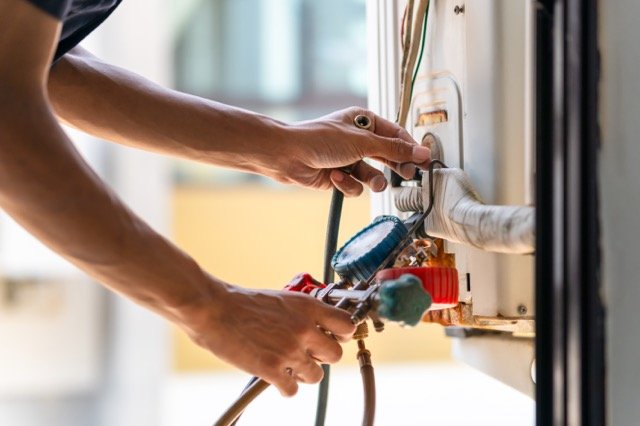
For clicking, buzzing, or humming noises, we test electrical components using a multimeter:
- Capacitor testing: We measure microfarads to determine if the capacitor is within spec. Capacitors lose capacity over time. A 40 µF capacitor that tests at 28 µF is failing.
- Contactor testing: We check for proper voltage across the contactor and inspect the contact points for pitting or burning.
- Motor testing: We measure amp draw on blower motors and condenser fan motors. High amp draw indicates bearing wear or winding problems.
Step 4: Refrigerant System Testing
If we suspect a refrigerant leak (hissing noise, ice formation, poor cooling), we connect pressure gauges to measure refrigerant levels. Normal operating pressures for R-410A are roughly 115-125 PSI on the low side and 250-300 PSI on the high side when ambient temperature is 75-80°F. Low pressures confirm a leak.
We then use electronic leak detectors or UV dye to locate the leak source. Common leak points include:
- Brazed joints on copper line sets
- Schrader valve cores (service ports)
- Condenser coil (corrosion from weather exposure)
- Evaporator coil (corrosion from condensate)
Step 5: Written Estimate and Options
Once we've identified the problem, we provide a written estimate that includes:
- Exact diagnosis (what's broken and why)
- Repair cost with parts and labor breakdown
- Expected lifespan of the repair
- Whether other components are likely to fail soon
- Replacement cost comparison if the unit is old
We don't pressure you to decide immediately. If you want to get a second opinion, we understand. If you want to think about it overnight, that's fine. Our goal is to give you the information you need to make the right decision for your home and budget.
Preventing AC Noise Problems Before They Start
Most AC noise problems develop gradually. A bearing starts to wear. A capacitor loses capacity. A mounting bolt vibrates loose. Catching these issues early—before they cause noise or failure—is the entire point of preventive maintenance.
Seasonal Maintenance Schedule
Your air conditioner needs professional maintenance once per year, ideally in April or May before cooling season starts. Here's what a proper AC tune-up includes:
- Clean condenser coils (removes dirt and cottonwood buildup)
- Check refrigerant levels and test for leaks
- Test capacitors and contactors
- Measure amp draw on motors
- Tighten electrical connections
- Lubricate motor bearings (on older units that have grease ports)
- Check condensate drain for clogs
- Inspect ductwork for leaks or disconnections
- Test thermostat calibration
This inspection catches problems before they cause noise or breakdowns. A capacitor that tests weak gets replaced before it fails on the hottest day of summer. A loose fan blade gets tightened before it cracks the coil.
The Next Care Plan Advantage
Our Next Care Plan costs $5 per month ($60 per year) and includes two annual visits—one for your furnace in fall, one for your AC in spring. Members also get:
- Priority scheduling (we fit you in faster during busy summer months)
- 10% discount on all repairs
- No service call fees
- Extended parts and labor warranties on repairs
The math works out clearly: a single service call without the plan costs $89-$129. Two tune-ups per year cost $60 total with the plan. Plus the repair discounts and priority scheduling during heat waves.
We've seen the data over 35 years: homes on maintenance plans have 60-70% fewer emergency breakdowns. Furnaces and AC units last 3-5 years longer. Energy costs stay lower because systems run at peak efficiency.
Homeowner Maintenance Tasks
Between professional tune-ups, you can extend your AC's life with these simple tasks:
- Replace filters monthly during cooling season: A clogged filter makes the blower motor work harder and run hotter. Use the filter size marked on your air handler. Standard fiberglass filters work fine—expensive HEPA filters often restrict airflow too much.
- Keep the outdoor unit clear: Trim bushes and grass at least 2 feet away from the condenser. Clear leaves and debris after storms.
- Check the condensate drain: Your indoor air handler has a drain pan and drain line that removes condensation. If it clogs, water backs up and can damage the air handler or leak into your home. Pour a cup of vinegar down the drain line every few months to prevent algae growth.
- Listen for changes: You know what your AC normally sounds like. If you notice a new noise—even a small one—don't ignore it. Small problems become big problems when you wait.
Ready to Get Started?
NEXT Heating & Cooling has been keeping Michigan homes comfortable for over 35 years. Get honest diagnostics and fair pricing from NATE-certified technicians who show up on time. We serve Macomb County, Oakland County, and St. Clair County with the same old-school values that built our reputation.
Schedule Your ServiceFrequently Asked Questions
A loud banging noise from your AC usually means something has come loose or broken inside the outdoor condenser unit. Common causes include a loose fan blade hitting the housing, broken compressor mounts allowing the compressor to bang against the base, or debris caught in the fan assembly. Shut the system off immediately and call a licensed HVAC technician—continued operation can cause expensive damage to the coil or compressor.
Some noise at startup is normal—you'll hear a click from the thermostat relay and a brief hum as the compressor and fan motors start. But loud grinding, screeching, or banging at startup indicates a problem. Common causes include worn motor bearings, a failing start capacitor, or a seized compressor. If the noise is new or getting worse, have it diagnosed before the component fails completely.
A hissing noise during AC operation almost always indicates a refrigerant leak. This is serious—shut the system off immediately and call a licensed HVAC contractor. Running an AC with low refrigerant damages the compressor, turning a $300-$600 leak repair into a $1,800-$3,500 compressor replacement. Refrigerant handling requires EPA certification and specialized equipment, so this isn't a DIY repair.
AC noise repair costs in Southeast Michigan range from $150 for simple fixes like tightening loose panels to $3,500 for compressor replacement. Common repairs include capacitor replacement ($200-$350), contactor replacement ($150-$300), fan motor replacement ($400-$900), and refrigerant leak repair ($300-$800). The exact cost depends on what's causing the noise and how long the problem has been developing. Early diagnosis usually means lower repair costs.
You can safely handle debris removal, panel tightening, and filter replacement yourself. But refrigerant leaks, electrical component replacement (capacitors, contactors), motor repairs, and compressor problems require a licensed HVAC technician. Refrigerant handling requires EPA certification, and electrical work involves high-voltage circuits that can be fatal if handled incorrectly. Additionally, DIY repairs on systems still under warranty often void that warranty.
Annual professional maintenance is the most effective prevention strategy. A spring AC tune-up catches problems before they cause noise or breakdowns—worn capacitors get replaced, loose components get tightened, and refrigerant levels get checked. Between professional visits, replace your filter monthly during cooling season, keep the outdoor unit clear of debris and vegetation, and listen for any new or unusual sounds. The Next Care Plan from NEXT Heating & Cooling includes two annual tune-ups for $5/month and has been proven to reduce emergency breakdowns by 60-70%.
If your AC is over 12 years old and needs a major repair (compressor, condenser coil, or evaporator coil replacement), replacement often makes more financial sense than repair. A new compressor might cost $2,500, but a complete new AC system costs $3,500-$6,000 and comes with a 10-year warranty, significantly better efficiency (lower electric bills), and reliable operation. We provide both repair and replacement estimates on every major service call so you can make an informed decision based on your home and budget.