

Furnace Stopped Working? 7 Reasons Why (Michigan Guide)
It's 6:00 AM on a Tuesday in January. You wake up in your Sterling Heights ranch and the house feels cold. You check the thermostat: 58 degrees. The furnace should have kicked on hours ago.
You head down to the basement, flip on the light, and stand in front of your furnace. No hum. No warm air. Just silence and the faint smell of dust on cold metal.
This scenario plays out thousands of times every winter across Southeast Michigan. Furnaces stop working. Sometimes it's a simple fix you can handle in five minutes. Other times it's a sign your 22-year-old Carrier has reached the end of its service life.
We've been doing furnace installation and repair in Macomb, Oakland, and St. Clair counties for over 35 years. We've diagnosed thousands of no-heat calls in Michigan basements, crawl spaces, and utility closets. Most failures fall into seven categories, and the order matters: the first three account for roughly 70% of service calls.
Here's what actually stops furnaces from running, what you can check yourself, and when to call a reliable HVAC contractor in Metro Detroit.
1. Thermostat Issues (Most Common)
Thermostats cause more no-heat calls than any other single component. Not because they're poorly made, but because they're the interface between you and a complex mechanical system, and small mistakes compound fast.
The most common problem: dead batteries. If you have a programmable or smart thermostat that runs on AA or AAA batteries, those batteries die every 6 to 12 months. When they do, the thermostat loses power and can't send the signal to turn on the furnace. Your furnace is fine. The thermostat just can't tell it to run.
Second most common: the thermostat is set to COOL instead of HEAT. Sounds obvious, but it happens more than you'd think, especially in spring and fall when temperatures swing 40 degrees in a day. Someone adjusts the thermostat in the afternoon when it's 68 outside, forgets to switch the mode back to HEAT, and wakes up to a cold house when it drops to 32 overnight.
Third: the temperature set point is lower than the current room temperature. If your thermostat is set to 65 and the house is 66, the furnace won't run. Check the display. Make sure the set point is at least 3 degrees higher than the current temperature.
Less common but still worth checking: loose wiring at the thermostat. If you've recently painted, hung a picture nearby, or had any electrical work done, a wire may have come loose from the terminal block. You'll see five or six thin wires (usually red, white, green, yellow, blue) connected to screw terminals labeled R, W, G, Y, C. If one is loose or disconnected, the furnace won't get the signal to fire.
If you're comfortable with basic electrical work, you can remove the thermostat faceplate and gently tug on each wire to make sure it's secure. If not, leave it alone and call a tech. We've seen homeowners cross wires and short out control boards trying to "fix" a thermostat.
For homeowners in Novi and surrounding areas looking to upgrade, we've written a detailed guide on smart thermostat setup for Novi homes covering Nest, Ecobee, and HomeKit options.
2. Tripped Circuit Breaker or Blown Fuse
Furnaces pull a lot of power when the blower motor starts. If the breaker is old, undersized, or the circuit is overloaded, it can trip. When that happens, the furnace loses power completely and won't run.
Go to your electrical panel. It's usually in the basement, garage, or utility room. Open the door and scan the rows of breakers. Look for one labeled "Furnace" or "HVAC." If the handle is in the middle position or pointing toward the OFF side, it's tripped.
To reset it, push the handle all the way to the OFF position first, then flip it back to ON. Don't just flip it from the middle position to ON. That won't reset the internal mechanism. You need to go fully off, then fully on.
If the breaker trips again immediately, you have a short circuit or a failing component drawing too much current. Do not keep resetting it. Call a technician. Repeated trips can damage the breaker, the furnace control board, or both.
Older homes in Detroit, Royal Oak, and Grosse Pointe Farms sometimes have fuse panels instead of breakers. If you have screw-in fuses, check the one that powers the furnace. If the glass window is blackened or the metal strip inside is broken, the fuse is blown. Replace it with a fuse of the same amperage rating (usually 15 or 20 amps for a furnace circuit).
One Michigan-specific note: ice storms and power surges can trip breakers even when the furnace itself is fine. If you lost power overnight and the furnace won't start after power is restored, check the breaker first before assuming the furnace is broken.
3. Dirty or Clogged Air Filter
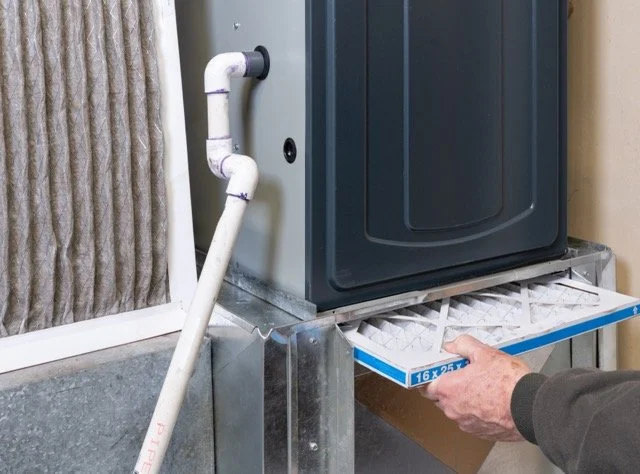
Air filters trap dust, pollen, pet dander, and other particles before they enter the furnace blower and heat exchanger. Over time, the filter clogs. When it does, airflow drops. When airflow drops too far, the furnace shuts down to protect itself from overheating.
Here's how it happens: the furnace fires, the burners light, and the heat exchanger starts warming up. Normally, the blower pulls cool air from your house through the return ducts, pushes it across the hot heat exchanger, and sends warm air back through the supply ducts. But if the filter is clogged, the blower can't pull enough air. The heat exchanger gets hotter and hotter with nowhere for the heat to go.
Eventually, the limit switch (a safety device mounted on the plenum) detects the excessive temperature and shuts off the burners. The furnace cycles off. It tries again a few minutes later, overheats again, and shuts off again. This is called short-cycling, and it's one of the most common symptoms of a dirty filter.
In severe cases, the furnace won't run at all. Modern high-efficiency furnaces have pressure switches that monitor airflow. If the filter is so clogged that the pressure switch can't detect sufficient airflow, it won't allow the furnace to ignite. The blower might run, but the burners never light. You get cold air blowing through the vents.
Where is your filter? Most furnaces have the filter in one of three places: in a slot on the side of the furnace cabinet, in the return air grille on the wall or ceiling, or in a separate filter rack between the return duct and the furnace. Pull it out and hold it up to a light. If you can't see light through it, it's clogged. Replace it.
Standard fiberglass filters (MERV 1-4) should be replaced every 30 days. Pleated filters (MERV 8-11) last 60 to 90 days. High-efficiency filters (MERV 13-16) last 90 days but restrict airflow more, so make sure your furnace blower can handle them. Check your furnace manual or ask a tech before upgrading to a MERV 13+ filter.
Homeowners enrolled in the Next Care Plan get filter replacements during their seasonal tune-ups, which prevents this issue before it becomes a no-heat emergency.
4. Pilot Light or Ignition Failure
Older furnaces (pre-2000) use a standing pilot light: a small gas flame that burns continuously and ignites the main burners when the thermostat calls for heat. Newer furnaces use electronic ignition: either a hot surface ignitor (a ceramic element that glows orange-hot) or an intermittent pilot (a spark ignitor that lights a pilot only when needed).
If you have a standing pilot and it goes out, the furnace won't light. You can usually see the pilot flame through a small viewing window on the furnace cabinet. If there's no flame, the pilot is out. Most furnaces have relighting instructions printed on a label inside the access panel. The process typically involves turning the gas valve to OFF, waiting five minutes for any residual gas to dissipate, turning the valve to PILOT, holding down the pilot button, and using a long lighter to ignite the pilot flame.
If the pilot won't stay lit after you release the button, the thermocouple is likely bad. The thermocouple is a safety device that senses the pilot flame and keeps the gas valve open. When it fails, it shuts off gas flow to the pilot, and the flame goes out. Thermocouples cost $20 to $50 and take about 20 minutes to replace, but you need basic hand tools and some mechanical comfort. If you're not confident, call a tech.
For furnaces with electronic ignition, you won't see a pilot flame when the furnace is off. That's normal. When the thermostat calls for heat, you should hear a click or a hum, then see the ignitor glow bright orange (if it's a hot surface ignitor) or hear a rapid ticking sound (if it's a spark ignitor). A few seconds later, the burners should light with a whoosh.
If the ignitor glows but the burners don't light, you likely have a gas supply problem (valve closed, low pressure, or a clogged orifice). If the ignitor doesn't glow at all, it's either burned out or not getting power. Hot surface ignitors are fragile and crack over time. They're one of the most common failure points on Carrier, Lennox, and Trane furnaces built in the 2000s and 2010s.
Replacing an ignitor is straightforward for a technician but not a DIY job for most homeowners. The ceramic element is brittle and expensive ($80 to $150 for the part), and if you crack it during installation, you've just bought two ignitors.
5. Flame Sensor Covered in Carbon Buildup
The flame sensor is a thin metal rod (usually stainless steel, about 1/8 inch in diameter and 3 to 4 inches long) that sits in the path of the burner flames. Its job is to verify that the burners are actually lit after the gas valve opens. If the sensor detects a flame, the furnace keeps running. If it doesn't, the furnace shuts off the gas valve within a few seconds to prevent raw gas from flooding the combustion chamber.
Over time, the flame sensor gets coated with carbon, soot, and oxidation. This buildup acts as an insulator, preventing the sensor from detecting the flame even when the burners are lit. The furnace goes through the ignition sequence, the burners light, and then three seconds later the gas valve shuts off and the burners go out. The blower keeps running for a minute or two, then the whole cycle repeats.
This is one of the most frustrating failures for homeowners because the furnace seems like it's trying to work. You hear the ignitor click, you see the flames light, and then it all shuts down. It feels like the furnace is teasing you.
The fix is simple: remove the flame sensor, clean it with fine-grit sandpaper or a dollar bill (yes, really—the texture of a dollar bill is abrasive enough to remove light oxidation), and reinstall it. Total time: 10 minutes. But you need to remove the burner access panel, disconnect the sensor wire, and unscrew the sensor mounting bracket. If you're comfortable with basic hand tools, you can do this yourself. If not, it's a quick service call.
Flame sensors fail most often on furnaces that run frequently (cold climates like Michigan) and furnaces that sit unused for months (summer). The sensor oxidizes faster when it's exposed to repeated heating and cooling cycles or when it sits idle in a humid basement. We replace or clean flame sensors on nearly every fall tune-up in Macomb County.
6. Limit Switch Tripped Due to Overheating
The limit switch is a safety device mounted on the furnace plenum (the large sheet metal box directly above the heat exchanger). It monitors the temperature of the air leaving the furnace. If that temperature exceeds a preset limit (usually 160 to 200 degrees Fahrenheit), the switch opens and shuts off the burners to prevent the furnace from overheating and potentially cracking the heat exchanger.
There are two types of limit switches: manual reset and auto reset. Auto-reset switches close again once the temperature drops, allowing the furnace to restart. Manual-reset switches stay open until you physically press a reset button. If your furnace has a manual-reset limit switch and it trips, you'll need to find the button (usually a red or black button on the side of the switch) and press it to restore operation.
But here's the important part: if the limit switch tripped, something caused the furnace to overheat. The most common cause is restricted airflow (dirty filter, closed supply registers, blocked return grilles, undersized or kinked ductwork). The second most common cause is a failing blower motor or capacitor. The blower either isn't running at all, or it's running too slowly to move enough air across the heat exchanger.
Don't just reset the switch and walk away. You need to figure out why it tripped. Check the filter first. If it's clean, check your supply registers. Walk through your house and make sure at least 80% of the registers are open. Closing too many registers forces the blower to work harder and reduces airflow across the heat exchanger.
If the filter is clean and the registers are open, the problem is likely mechanical: a weak blower motor, a bad capacitor, or ductwork that's too small for the furnace output. That's a job for a technician. We see this often in older homes in Troy and Rochester Hills where homeowners have upgraded to a larger, higher-efficiency furnace but kept the original 1970s ductwork. The ducts can't handle the airflow, the furnace overheats, and the limit switch trips.
7. Cracked Heat Exchanger (Serious Issue)
The heat exchanger is the heart of your furnace. It's a series of metal chambers (usually steel or aluminized steel) where combustion gases flow. The burners heat the metal, and the blower pushes air across the outside of the chambers. The air picks up heat from the metal and carries it into your home. The combustion gases stay inside the heat exchanger and vent out through the flue pipe.
When a heat exchanger cracks, combustion gases can leak into the air stream that goes to your house. Those gases include carbon monoxide, a colorless, odorless poison that can kill you. This is not a minor issue. A cracked heat exchanger is a safety hazard, and the furnace should be shut down immediately.
Heat exchangers crack for several reasons. Age is the most common. Metal expands when heated and contracts when cooled. After 15 to 25 years of heating and cooling cycles, the metal fatigues and cracks. Oversized furnaces (furnaces that are too large for the house) short-cycle, which accelerates fatigue. Poor combustion (dirty burners, insufficient airflow, incorrect gas pressure) creates hot spots that weaken the metal.
Symptoms of a cracked heat exchanger include: the furnace shuts off randomly, the burner flames flicker or roll out of the combustion chamber, you smell a metallic or chemical odor near the furnace, or your carbon monoxide detector goes off. If you experience any of these, shut off the furnace at the thermostat and the gas valve, open windows, and call a technician immediately.
Diagnosing a cracked heat exchanger requires a visual inspection with a camera probe or a combustion analysis test. Some cracks are obvious: you can see light through the metal or see soot stains where gases are leaking. Other cracks are hairline fractures that only open when the metal is hot. A good technician will use multiple methods to confirm the diagnosis before recommending replacement.
Can you repair a cracked heat exchanger? Technically, yes. Practically, no. Replacement heat exchangers for residential furnaces cost $800 to $1,500 just for the part, and labor adds another $600 to $1,200. You're looking at $1,400 to $2,700 for a repair on a furnace that's already 15+ years old and likely has other components near failure. In almost every case, it makes more financial sense to replace the entire furnace.
We've written extensively about replacement costs in our guide on what to expect from a free HVAC replacement estimate, including how we calculate load requirements and match equipment to your home.
What to Check Before Calling a Technician
Before you call for service, run through this checklist. You might save yourself a service call fee and get heat back in your house faster.
1. Check the thermostat. Is it set to HEAT? Is the temperature set higher than the current room temperature? Are the batteries fresh?
2. Check the circuit breaker. Go to your electrical panel and make sure the furnace breaker hasn't tripped. If it has, reset it fully (OFF, then ON).
3. Check the furnace power switch. Most furnaces have a light switch mounted on or near the unit. It's usually on the side of the furnace or on the wall nearby. Make sure it's in the ON position. Homeowners accidentally flip this switch all the time, especially if it's near the basement stairs.
4. Check the air filter. Pull it out and hold it up to a light. If you can't see through it, replace it.
5. Check the gas valve. The gas valve is usually a yellow or red handle on the gas line leading to the furnace. Make sure it's parallel to the pipe (ON position). If it's perpendicular, it's closed and no gas is flowing.
6. Listen and look. Go stand next to the furnace. Do you hear any clicking, humming, or whooshing sounds? Do you see any error codes on the display (if your furnace has one)? Do you smell gas? If you smell gas, leave the house immediately and call your gas company.
If you've checked all of the above and the furnace still won't run, it's time to call a professional. Don't start taking apart the furnace or bypassing safety switches. Modern furnaces have multiple interlocked safety devices, and disabling one can create a dangerous situation.
When to Call NEXT Heating & Cooling
Some furnace problems are DIY-friendly. Dead thermostat batteries, tripped breakers, and dirty filters are easy fixes. But most failures require diagnostic tools, technical knowledge, and replacement parts that homeowners don't have on hand.
Call a technician if:
- The furnace won't ignite after you've checked the thermostat, breaker, and filter
- The burners light but shut off after a few seconds (flame sensor or gas valve issue)
- The blower runs but no heat comes out (limit switch, ignition failure, or heat exchanger problem)
- You smell gas near the furnace (potential gas leak—leave the house and call your gas company first, then call us)
- You hear loud banging, popping, or scraping noises from the furnace (mechanical failure or ductwork issue)
- Your carbon monoxide detector goes off (shut down the furnace immediately and evacuate)
- The furnace is more than 15 years old and has required multiple repairs in the past two years (it's probably time to replace it)
We offer 24/7 emergency service across Macomb, Oakland, and St. Clair counties. If your furnace stops working at 2:00 AM during a polar vortex, we'll send a NATE-certified technician to your house. No upselling, no commission-based sales, just honest diagnostics and fair pricing. That's the same approach that's kept our family-owned HVAC company in business for over 35 years.
For less urgent issues, you can schedule a service call through our website. We'll give you a two-hour arrival window and send you a text when the technician is on the way. You'll get a photo of the tech, their name, and their certification credentials before they knock on your door.
Cost Reality: Repair vs. Replacement
Furnace repairs in Southeast Michigan typically range from $150 to $800, depending on the part and labor involved. Here's what common repairs cost:
- Thermostat replacement: $150 to $300 (basic programmable) or $250 to $450 (smart thermostat with installation)
- Flame sensor cleaning: $120 to $180 (service call plus labor)
- Ignitor replacement: $200 to $400 (part plus labor)
- Blower motor replacement: $400 to $700 (part plus labor)
- Gas valve replacement: $350 to $600 (part plus labor)
- Control board replacement: $400 to $800 (part plus labor)
- Heat exchanger replacement: $1,400 to $2,700 (rarely worth it—usually better to replace the furnace)
The age of your furnace matters. If your furnace is less than 10 years old and the repair costs less than $500, repair it. If your furnace is 15+ years old and the repair costs more than $800, start thinking about replacement. If your furnace is 20+ years old, replacement almost always makes more sense unless the repair is trivial (like a thermostat battery or a dirty filter).
Modern high-efficiency furnaces (95%+ AFUE) cost less to operate than older 80% AFUE furnaces. A new Carrier or Lennox 96% AFUE furnace can save you $300 to $600 per year on gas bills compared to a 1995-era 80% AFUE furnace. Over a 15-year lifespan, that's $4,500 to $9,000 in savings, which offsets much of the replacement cost.
We've seen too many homeowners pour $2,000 into repairs on a 22-year-old furnace, only to have it fail again six months later. At that point, they've spent money on repairs and still need to buy a new furnace. Our advice: if the furnace is old and the repair is expensive, get a replacement quote before you authorize the repair. We'll give you both options and let you decide. No pressure, no commission-based sales.
Homeowners who join the Next Care Plan for HVAC in Metro Detroit get two seasonal tune-ups per year (fall furnace check, spring AC check) for just $5 per month. Those tune-ups catch small problems before they turn into expensive failures. We clean flame sensors, check ignitors, test limit switches, measure gas pressure, and inspect heat exchangers. Members also get 10% off repairs and priority scheduling, which means we'll get to your house faster when something does break.
Furnace Not Working? We'll Get You Warm Again
NEXT Heating & Cooling has been keeping Michigan homes comfortable for over 35 years. Our NATE-certified technicians show up on time, diagnose the problem honestly, and give you options without pressure. 24/7 emergency service across Macomb, Oakland, and St. Clair counties.
Schedule Your Furnace RepairFrequently Asked Questions
The most common cause is a dead thermostat battery, followed by a tripped circuit breaker or a clogged air filter. Check these three things first before calling a technician. If the furnace is older than 15 years, component failure (ignitor, flame sensor, blower motor) becomes more likely.
First, check your electrical panel and reset the furnace circuit breaker (flip it fully OFF, then fully ON). Next, check the thermostat and make sure it's still set to HEAT with the temperature above the current room temperature. If the thermostat uses batteries, replace them. Finally, check the furnace power switch (usually mounted on or near the unit) and make sure it's ON. The furnace should restart within a few minutes.
Yes. A severely clogged filter restricts airflow, which causes the furnace to overheat. The limit switch detects the high temperature and shuts off the burners to protect the heat exchanger. On high-efficiency furnaces, a clogged filter can prevent the pressure switch from closing, which stops the ignition sequence entirely. Replace your filter every 30 to 90 days depending on the type.
It depends on the cause. Simple fixes like thermostat batteries or a tripped breaker cost nothing. Flame sensor cleaning runs $120 to $180. Ignitor replacement costs $200 to $400. Blower motor replacement costs $400 to $700. Control board replacement costs $400 to $800. Heat exchanger replacement costs $1,400 to $2,700, but at that point replacement usually makes more sense than repair.
You can safely check the thermostat, replace batteries, reset the circuit breaker, and replace the air filter. You can also check the gas valve position and the furnace power switch. Beyond that, furnace repair requires technical knowledge and tools most homeowners don't have. Don't bypass safety switches, disassemble the burner assembly, or attempt to relight a pilot if you're not confident. Gas leaks and carbon monoxide poisoning are real risks.
If your furnace is more than 15 years old and the repair costs more than $800, start considering replacement. If it's more than 20 years old, replacement almost always makes more financial sense unless the repair is trivial. A new high-efficiency furnace (95%+ AFUE) will save you $300 to $600 per year on gas bills compared to an older 80% AFUE unit, and you'll avoid the cycle of repeated repairs on aging equipment.
This is usually caused by a dirty flame sensor. The sensor gets coated with carbon and can't detect the burner flame, so the furnace shuts off the gas valve as a safety precaution. The fix is to remove the sensor and clean it with fine-grit sandpaper. Other possible causes include a faulty gas valve, incorrect gas pressure, or a cracked heat exchanger (which requires immediate shutdown and professional inspection).