

R-410A Phase-Out: What Macomb Township AC Owners Need to Know
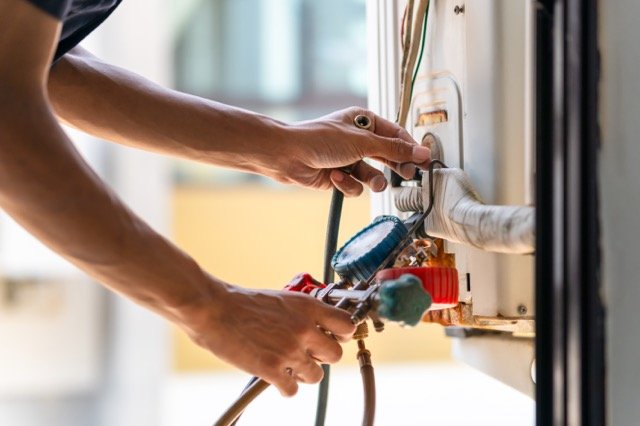
If you own an air conditioning system in Macomb Township, you need to know about a major change happening right now. As of January 1, 2025, R-410A refrigerant — the cooling agent inside nearly every residential AC system installed in the last 15 years — is being phased out across the United States.
This isn't a distant future problem. If your AC system needs a refrigerant recharge this summer, or if you're deciding whether to repair or replace an aging unit, this phase-out directly affects your decision and your wallet.
We've been installing and servicing AC systems across Southeast Michigan for over 35 years. We've seen refrigerant transitions before — R-22 (Freon) was phased out between 2010 and 2020, and we helped thousands of homeowners navigate that change. The R-410A phase-out follows a similar pattern, but the timeline is faster and the stakes are higher if you're caught unprepared.
Here's what you need to know, what it costs, and when you should act. No sales pitch — just the facts from NATE-certified HVAC technicians who work on these systems every day in Macomb County.
What's Happening with R-410A
R-410A refrigerant — marketed under brand names like Puron, Genetron R-410A, and Suva 410A — has been the industry standard refrigerant in residential air conditioning and heat pump systems since the mid-2000s. If your AC was installed after 2010, it almost certainly uses R-410A.
Under the American Innovation and Manufacturing (AIM) Act, passed in 2020, the Environmental Protection Agency (EPA) has mandated a phase-down of hydrofluorocarbons (HFCs), including R-410A. The key dates:
- January 1, 2025: Manufacturing of new AC systems using R-410A is prohibited. Manufacturers like Carrier, Lennox, Trane, Rheem, Bryant, and Goodman can no longer produce residential air conditioners or heat pumps that use R-410A.
- 2025 and beyond: R-410A refrigerant will still be available for servicing existing systems, but production is capped and will decline each year. Expect prices to rise as supply shrinks — similar to what happened with R-22 after 2010.
- No retrofit requirement: You are not required to replace your current R-410A system. It can continue to operate for its remaining lifespan. But when it fails or needs major repairs, replacement becomes the smarter financial move.
This is a manufacturing ban, not an ownership ban. Your existing AC system isn't illegal. But the clock is ticking on affordable service and repair parts as the industry shifts to new refrigerants.
Why R-410A Is Being Phased Out
R-410A was introduced in the early 2000s as a replacement for R-22 (Freon), which was damaging the ozone layer. R-410A doesn't harm the ozone, so why is it being phased out now?
The answer is global warming potential (GWP). R-410A has a GWP of 2,088 — meaning it traps 2,088 times more heat in the atmosphere than carbon dioxide over a 100-year period. When refrigerant leaks from AC systems during installation, service, or disposal, it contributes significantly to climate change.
The AIM Act requires the HVAC industry to transition to refrigerants with a GWP below 700. This is part of a broader international agreement (the Kigali Amendment to the Montreal Protocol) that the U.S. ratified in 2022.
For homeowners, the "why" matters less than the "what now." But understanding the regulatory driver helps explain why this change is mandatory and irreversible. Manufacturers aren't choosing to phase out R-410A — federal law requires it.
What Replaces R-410A
The primary replacement refrigerant is R-454B, marketed by Carrier and other manufacturers as Puron Advance. R-454B has a GWP of 466 — about 78% lower than R-410A — which meets the federal requirement.
R-454B belongs to a class of refrigerants called A2L refrigerants. The "A2L" designation means:
- A: Low toxicity (safe for residential use)
- 2L: Mildly flammable under very specific conditions (lower flammability than gasoline or propane)
The mild flammability requires new safety standards. AC systems using R-454B must include leak detection sensors and automatic shutoff mechanisms. Installation requires updated training and certification — our NATE-certified technicians completed A2L refrigerant training in 2024 to stay ahead of the transition.
Other A2L refrigerants entering the market include R-32 (used in some ductless mini-split systems) and R-454C. But R-454B is the dominant choice for ducted residential systems from major manufacturers.
Can you retrofit an R-410A system to use R-454B? No. R-454B operates at different pressures and requires different compressor oils, expansion valves, and system components. Attempting to retrofit would void warranties and likely cause compressor failure. When your R-410A system reaches end-of-life, replacement is the only option.
What This Means for Your Current AC
If your AC system is working fine, you don't need to do anything right now. R-410A systems installed in the last 5-10 years have plenty of service life remaining — most AC units last 12-15 years in Michigan's climate, where we run cooling equipment hard from May through September and deal with humidity that stresses compressors.
But if your system is 10+ years old, or if it needs a major repair this season, the phase-out changes your decision calculus. Here's the framework we walk Macomb Township homeowners through:
Scenario 1: Your AC Is Less Than 8 Years Old and Working Well
Keep it. Service it annually with our $5/month HVAC maintenance plan to maximize its lifespan. R-410A refrigerant will remain available for servicing existing systems through the 2030s, though prices will gradually increase.
If you need a refrigerant recharge due to a leak, we'll repair the leak first (as required by EPA regulations) and then recharge the system. Expect R-410A prices to rise 10-20% per year as production caps tighten.
Scenario 2: Your AC Is 10-15 Years Old and Needs a $1,500+ Repair
This is the gray zone. If your compressor fails, your evaporator coil cracks, or your condenser unit rusts through (common in Michigan due to road salt and humidity), you're looking at repair costs between $1,500 and $3,500.
At that price point, replacement usually makes more financial sense — especially now that R-410A systems are being discontinued. Here's why:
- You're investing $2,000+ into a 12-year-old system that may only last another 3-5 years.
- R-410A refrigerant costs will increase every year, making future repairs more expensive.
- New R-454B systems are 15-25% more efficient (SEER2 ratings of 16-20+ vs. older SEER 13-14 systems), which cuts your summer cooling bills by $200-$400/year in a typical Macomb Township home.
- New systems come with 10-year parts warranties and often include labor warranties from reliable HVAC contractors like us.
We've been having this conversation with homeowners across Sterling Heights, Clinton Township, and Shelby Township all spring. The math almost always favors replacement when you're facing a major repair on a system that's already past its median lifespan.
Scenario 3: Your AC Is 15+ Years Old
Replace it. Even if it's still running, a 15-year-old AC system in Michigan is on borrowed time. Compressors wear out, coils corrode, and refrigerant leaks develop. You're one hot July away from an emergency replacement when demand is highest and availability is lowest.
Replacing now — before it fails — gives you time to research options, compare bids, and schedule installation during a slower season when pricing is more competitive. We see this every year: homeowners who wait until their AC dies in June end up paying 15-20% more than those who replace in April or May.
Cost Reality for Macomb Township Homeowners
Let's talk numbers. What does a new AC system actually cost in Southeast Michigan in 2026?
For a typical 1,500-2,000 square foot home in Macomb Township — a 1960s ranch or a 1990s colonial with existing ductwork in decent shape — here's what we're seeing:
- Budget-tier system (Goodman, Amana, York): $4,500-$6,000 installed. SEER2 16-17. Single-stage compressor. 10-year parts warranty. These are solid, no-frills systems that will cool your home reliably.
- Mid-tier system (Carrier, Bryant, Rheem): $6,000-$7,500 installed. SEER2 17-18. Two-stage compressor for better humidity control and quieter operation. 10-year parts warranty, often with extended labor coverage.
- Premium system (Carrier Infinity, Lennox Signature, Trane XV): $7,500-$9,500 installed. SEER2 18-20+. Variable-speed compressor and blower for maximum efficiency and comfort. Communicating thermostats. 10-12 year warranties.
These prices assume your existing ductwork is in good condition and properly sized. If we find undersized ducts, leaking return plenums, or collapsed flex duct in your crawl space (common in older Macomb County homes), add $1,500-$3,000 for ductwork modifications.
If you're replacing both your furnace and AC at the same time — which often makes sense if your furnace is also 12+ years old — you'll save on labor costs. A matched system (same brand furnace and AC) also performs better and qualifies for better warranties. See our guide on furnace installation costs in Southeast Michigan for more detail.
Financing reality: Most homeowners finance AC replacements. At current rates (7-9% APR for good credit), a $6,500 system financed over 5 years costs about $130/month. Factor in $30-$50/month in cooling cost savings from higher efficiency, and your net monthly cost is $80-$100 — less than most homeowners were spending on repairs and high electric bills with their old system.
When You Should Replace Your AC System
Here are the clear signals that it's time to replace your R-410A system rather than repair it:
Age
If your AC is 12+ years old, start planning for replacement within the next 1-3 years. If it's 15+ years old, replace it now before it fails. AC systems don't improve with age — they become less efficient, more prone to breakdowns, and more expensive to repair as parts become scarce.
Repair Costs Exceeding 50% of Replacement Cost
The industry rule of thumb: if a repair costs more than half the price of a new system, replace instead. For a $6,000 replacement, that threshold is $3,000. Compressor replacements, evaporator coil replacements, and condenser unit replacements all fall into this category.
Frequent Breakdowns
If you're calling for AC repairs every summer — capacitor failures, refrigerant leaks, fan motor replacements — you're in the "repair cycle." Each fix is a temporary patch on a system that's fundamentally worn out. Replacement stops the bleeding.
Rising Energy Bills
An aging AC system loses efficiency every year. Dirty coils, worn compressor bearings, and refrigerant leaks all force the system to work harder and run longer to achieve the same cooling. If your summer electric bills have climbed 20-30% over the past few years (and you haven't changed your thermostat settings), your AC is the likely culprit.
Humidity Problems
Michigan summers are humid — we regularly hit 70-80% relative humidity in July and August. A properly functioning AC system should dehumidify your home as it cools, keeping indoor humidity between 40-50%. If your home feels clammy or you see condensation on windows even when the AC is running, your system isn't removing moisture effectively. This usually indicates a failing compressor or an oversized system that short-cycles before completing a dehumidification cycle.
Uneven Cooling
Hot and cold spots throughout your home can indicate ductwork problems, but they can also signal a failing AC system that can't maintain consistent airflow and refrigerant pressures. If your bedroom is 75°F while the living room is 68°F, something's wrong. Sometimes it's ductwork (see our post on AC not blowing cold air), but often it's a compressor that can't maintain capacity.
What to Look for in a New AC System
If you're shopping for a replacement AC system in 2026, here's what matters:
SEER2 Rating
SEER2 (Seasonal Energy Efficiency Ratio 2) replaced the old SEER rating in 2023. It's a more accurate measure of real-world efficiency. Federal minimum is SEER2 13.4 in the northern U.S. (including Michigan). We recommend SEER2 16-18 for most Macomb Township homes — it's the sweet spot between upfront cost and long-term savings.
SEER2 20+ systems cost significantly more but deliver diminishing returns unless you're running AC heavily or have a very large home. For a typical 1,800 square foot colonial, a SEER2 17 system saves about $350/year compared to a SEER2 13 system. A SEER2 20 system saves an additional $100-$150/year over the SEER2 17 — not enough to justify a $2,000 price premium for most homeowners.
Compressor Type
- Single-stage: On or off. Runs at 100% capacity whenever it's cooling. Less expensive, noisier, less efficient. Fine for budget-conscious homeowners.
- Two-stage: Runs at 65-70% capacity most of the time, ramping to 100% on very hot days. Quieter, better humidity control, more efficient. The best value for most Michigan homes.
- Variable-speed (modulating): Adjusts capacity from 25% to 100% in small increments. Maximum comfort and efficiency, but costs $1,500-$2,500 more than two-stage. Worth it if you prioritize quiet operation and perfect temperature control.
Brand and Warranty
We install Carrier, Lennox, Trane, Rheem, Bryant, Goodman, Amana, York, and RUUD systems. All are reliable when properly installed and maintained. The differences come down to warranty coverage, dealer support, and specific features.
Carrier and Trane tend to have the strongest dealer networks and parts availability in Southeast Michigan. Lennox has excellent high-efficiency models. Rheem and Bryant offer solid mid-tier value. Goodman and Amana are budget-friendly workhorses.
More important than brand: choose a licensed HVAC contractor who sizes the system correctly (using Manual J load calculations, not guesswork), installs it to manufacturer specifications, and stands behind their work. A Goodman system installed correctly will outperform a Carrier system installed poorly.
Proper Sizing
This is critical. An oversized AC system short-cycles (runs in short bursts), which wastes energy, fails to dehumidify, and wears out components faster. An undersized system runs constantly and can't keep up on hot days.
Proper sizing requires a Manual J load calculation that accounts for your home's square footage, insulation levels, window area, orientation, and Michigan's climate data. It takes about 30 minutes. Any contractor who quotes you a system size based solely on square footage is guessing — and probably wrong.
We see this constantly in Macomb County: 1,600 square foot ranches with 4-ton AC units (way oversized) because the previous contractor used a "1 ton per 400 square feet" rule of thumb. Those homes have humidity problems, high electric bills, and systems that fail prematurely. The correct size is usually 2.5-3 tons.

Ready to Upgrade Your AC System?
NEXT Heating & Cooling has been keeping Michigan homes comfortable for over 35 years. Our NATE-certified technicians provide honest diagnostics, accurate load calculations, and fair pricing on all major AC brands. We're not the biggest HVAC company — and that's the point. You get experienced techs who show up on time and explain your options without pressure.
Schedule Your Free Estimate