

Spring AC Tune-Up Benefits Every Michigan Homeowner Needs

Every April, we get the same call from homeowners across Sterling Heights, Troy, and Royal Oak: "I turned on my AC for the first time this year, and it's not working right." By that point, they're already behind — competing with hundreds of other homeowners for emergency service slots when temperatures hit 80°F in late May.
Here's what 35 years of servicing HVAC systems in Southeast Michigan has taught us: the difference between a $150 spring tune-up and a $3,500 compressor replacement in July often comes down to timing. Michigan's unique climate — humid summers following cold winters, temperature swings that stress refrigerant systems, and lake-effect moisture that clogs condensate drains — creates specific maintenance needs that homeowners in drier or more temperate climates don't face.
This isn't a sales pitch. It's mechanical reality. When you understand what happens inside your AC system during a Michigan winter and what a proper spring tune-up actually addresses, the benefits become obvious. Let's walk through exactly what your system needs, why it needs it, and what you're preventing by scheduling heating and cooling services in Metro Detroit before the summer rush.
Why Michigan's Climate Makes Spring Tune-Ups Essential
Southeast Michigan puts unique stress on air conditioning systems that homeowners in Arizona or Florida never deal with. Understanding these climate-specific factors explains why spring maintenance isn't optional here — it's preventive.
Temperature Swings and System Stress
Michigan AC systems sit dormant for 6-7 months every year. During that time, outdoor temperatures can swing from -10°F in January to 75°F in April. These temperature extremes cause metal components to contract and expand, refrigerant to settle, and seals to harden. When you fire up your system for the first time in May without a tune-up, you're asking cold, settled refrigerant to suddenly circulate through components that haven't moved in months.
This is when we see compressor failures. The compressor — the most expensive component in your AC system — relies on refrigerant oil for lubrication. When that oil settles during winter dormancy and the compressor starts without proper preparation, metal-on-metal contact accelerates wear. A spring tune-up includes a controlled startup sequence that verifies oil circulation before the compressor runs under full load.
Humidity and Condensate System Challenges
Michigan summers are humid. Macomb County routinely sees 70-80% relative humidity in July and August. Your AC doesn't just cool air — it removes moisture. A properly functioning system pulls 15-20 gallons of water per day out of your home's air during peak summer conditions.
That water drains through a condensate line that's been sitting idle all winter. Algae grows. Debris accumulates. The P-trap dries out, allowing sewer gas into your home. When we perform spring tune-ups in Clinton Township and Shelby Township, clogged condensate drains are one of the top three issues we find. Left unaddressed, these clogs cause water damage to ceilings, walls, and furnace cabinets — repairs that cost $800-$2,500 depending on severity.
Pollen, Cottonwood, and Outdoor Unit Contamination
Spring in Michigan means pollen. Cottonwood trees release their seeds in May and June, coating outdoor AC units with a white, fibrous material that blocks airflow through condenser coils. We've measured temperature differences of 15-20°F on condenser coils clogged with cottonwood and pollen versus clean coils.
When airflow drops, your system's refrigerant can't reject heat properly. Head pressure rises. The compressor works harder, draws more amperage, and runs hotter. This is how a $150 coil cleaning prevents a $1,800 compressor replacement. The outdoor unit sits dormant all winter, accumulating leaves, dirt, and debris. A spring tune-up removes this contamination before it impacts performance.
What Actually Happens During a Spring AC Tune-Up
Not all tune-ups are equal. Some contractors show up, change a filter, and leave. That's not maintenance — it's theater. Here's what a legitimate spring AC tune-up from NATE-certified HVAC technicians actually involves, and why each step matters.
Thermostat Calibration and System Testing
We start inside. The thermostat controls everything, and if it's reading temperature incorrectly or communicating improperly with your system, nothing else matters. We verify calibration using a separate thermometer, test the heat/cool changeover, and confirm that the indoor blower responds correctly to thermostat commands.
For homes with programmable or smart thermostats, we check battery backup (if applicable) and verify scheduling settings. Many homeowners don't realize their thermostat lost its programming during a winter power outage.
Refrigerant Charge Verification
This is the most critical part of the tune-up, and it's where inexperienced technicians often fail. Your AC system contains a precise amount of refrigerant — not "a little" or "enough," but a specific charge measured in ounces. Too much or too little refrigerant reduces efficiency, damages components, and shortens system life.
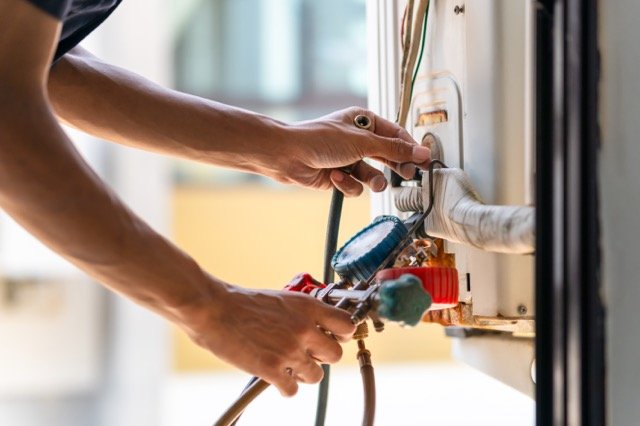
We connect manifold gauges to the service ports and measure superheat and subcooling. Superheat tells us if the evaporator coil is starving for refrigerant (undercharged system). Subcooling tells us if the condenser is overcharged. These measurements must account for outdoor temperature and indoor humidity — a 410A system running at 85°F outdoor temperature should show subcooling around 10-15°F, but that changes based on airflow and indoor conditions.
If refrigerant is low, we don't just add more. We find the leak. Refrigerant doesn't "get used up" like gasoline. If it's low, it escaped somewhere. We use electronic leak detectors and nitrogen pressure testing to locate leaks in coils, line sets, and service valves before adding refrigerant.
Important note on R-22 refrigerant: If your system uses R-22 (Freon), it was manufactured before 2010. R-22 production ended in 2020, and remaining supplies are expensive — often $150-$200 per pound. If your R-22 system needs more than 2-3 pounds of refrigerant, replacement is more cost-effective than repair. We'll give you honest numbers either way.
Electrical Component Inspection and Testing
AC systems run on 240-volt power. The outdoor unit draws 15-30 amps depending on size. Electrical failures cause most mid-summer breakdowns we service in Warren and St. Clair Shores.
We test capacitors using a multimeter. Capacitors provide the electrical boost that starts the compressor and fan motors. They're rated in microfarads (µF), and they degrade over time. A 35 µF capacitor that tests at 28 µF will fail soon — usually on the hottest day of summer when the system is working hardest. Replacing a weak capacitor during a spring tune-up costs $120-$180. Emergency replacement on a 95°F Saturday costs $350-$450.
We also inspect contactors (the electrical relays that control power to the compressor and fan), measure voltage at the disconnect, and check wire connections for corrosion or looseness. Loose connections create resistance, which generates heat, which accelerates failure.
Coil Cleaning and Airflow Optimization
Both the indoor evaporator coil and outdoor condenser coil need cleaning. The evaporator coil sits in your furnace or air handler, and it accumulates dust, pet hair, and biological growth during the cooling season. A dirty evaporator coil restricts airflow, reducing system capacity and efficiency.
We measure airflow across the coil using a manometer or anemometer. Residential AC systems need approximately 400 CFM (cubic feet per minute) of airflow per ton of cooling capacity. A 3-ton system should move 1,200 CFM. If airflow is low, we check for dirty coils, clogged filters, undersized ductwork, or closed supply registers.
The outdoor condenser coil gets power-washed or chemically cleaned to remove cottonwood, pollen, grass clippings, and dirt. We clean from the inside out — spraying water from inside the unit outward — to avoid pushing debris deeper into the coil fins.

Condensate Drain Maintenance
We clear the condensate drain line using a wet/dry vacuum or compressed air, verify proper drainage, and treat the drain pan with algaecide tablets. This prevents the mid-summer clogs that cause water damage and emergency service calls.
We also check the condensate pump (if your system has one). Homes with furnaces in basements or crawl spaces often use condensate pumps to move water upward to a drain or sump pit. Pump failures cause flooding — we test the float switch and verify the pump cycles correctly.
Blower Motor and Belt Inspection
If your system uses a belt-driven blower (common in older furnaces), we check belt tension and condition. Worn belts squeal, slip, and eventually break — usually in July when you need cooling most. We also lubricate blower motor bearings if the motor has oil ports (many modern motors are sealed and don't require lubrication).
The Real Financial Benefits
Let's talk numbers. Spring AC tune-ups cost $120-$180 depending on system size and accessibility. The Next Care Plan includes two annual tune-ups (spring AC and fall furnace) for $5/month — $60/year total. Here's what that investment prevents and returns.
Energy Efficiency Improvements
A well-maintained AC system runs 15-20% more efficiently than a neglected one. For a typical Southeast Michigan home running a 3-ton AC system 1,000 hours per summer, that efficiency difference translates to $180-$280 in reduced electricity costs annually.
The U.S. Department of Energy confirms that dirty coils alone can reduce efficiency by 30%. Refrigerant charge that's off by just 10% cuts efficiency by 20%. These aren't theoretical numbers — we measure them with clamp ammeters and temperature probes during service calls.
Breakdown Prevention Cost Analysis
Here's what common AC repairs cost when they fail mid-summer versus what preventive maintenance costs:
- Compressor replacement: $1,800-$3,500 (prevented by proper refrigerant charge and electrical maintenance)
- Capacitor replacement (emergency): $350-$450 (prevented by spring testing and replacement)
- Condensate drain overflow damage: $800-$2,500 (prevented by drain cleaning and treatment)
- Evaporator coil replacement: $1,200-$2,200 (prevented by regular cleaning and airflow maintenance)
- Contactor failure (emergency): $280-$380 (prevented by spring inspection and replacement)
Emergency service calls on weekends and evenings carry premium pricing — typically $150-$200 more than scheduled service. When your AC fails on a Saturday afternoon in July, you're paying for urgency, not just parts and labor.
Extended Equipment Lifespan
The average lifespan of a residential AC system in Michigan is 12-15 years. Systems that receive annual spring tune-ups consistently last 15-18 years. That's 3-6 additional years of service from a system that costs $4,500-$8,000 to replace.
The math is straightforward: spending $150/year on maintenance to extend a $6,000 system's life by 4 years returns $24,000 in delayed replacement costs over that system's lifetime. Even accounting for the cost of tune-ups, you're ahead by thousands of dollars.
Signs Your AC Needs More Than a Tune-Up
Spring tune-ups extend system life, but they can't fix everything. Here's when we recommend replacement instead of repair, and why these decisions are based on economics, not upselling.
Age and Efficiency Ratings
If your AC system is 12-15 years old, it's approaching end of life. Systems manufactured before 2006 have SEER ratings of 10-12. Modern systems from Carrier, Lennox, Trane, Rheem, Bryant, and Goodman range from 14-20 SEER. That efficiency difference is real money — a 10 SEER system costs roughly 40% more to operate than a 14 SEER system.
For a typical Michigan home running AC 1,000 hours per summer, upgrading from a 10 SEER to a 16 SEER system saves $400-$600 annually in electricity costs. The system pays for itself in 8-10 years through energy savings alone.
R-22 Refrigerant Obsolescence
If your system uses R-22 refrigerant (manufactured before 2010), and it needs a major repair — compressor, evaporator coil, or significant refrigerant recharge — replacement makes more financial sense than repair. R-22 is expensive and increasingly unavailable. Systems using 410A refrigerant (the current standard) are more efficient, more reliable, and easier to service.
Compressor Failure Symptoms
If your compressor is failing — making grinding noises, drawing excessive amperage, or short-cycling — and your system is over 10 years old, replace the system rather than the compressor. A new compressor costs $1,800-$3,500 installed. A complete system replacement costs $4,500-$8,000. You're paying 50-70% of replacement cost to fix a single component in an aging system.
We'll give you both options with honest pricing. Some homeowners choose compressor replacement to buy 2-3 more years. Others choose full replacement to avoid repeated repairs. Both decisions are valid depending on your budget and timeline. What we won't do is pressure you either way — that's not how we operate at Metro Detroit's reliable HVAC contractor.
When to Schedule Your Spring AC Service
Timing matters. Here's the optimal schedule for spring AC tune-ups in Southeast Michigan, and why scheduling early saves you money and stress.
The April-May Window
We recommend scheduling spring AC tune-ups between mid-April and mid-May. This timing accomplishes three things:
- Availability: We can schedule appointments within 3-5 days instead of 2-3 weeks (the June wait time)
- Pricing: No emergency surcharges or peak-season pricing
- Preparation: Your system is ready before the first 85°F day in late May or early June
Homeowners who wait until June are competing with hundreds of other service requests. We prioritize emergency no-cooling calls over scheduled maintenance during peak season, which means tune-up appointments get pushed back.
Next Care Plan Priority Scheduling
Homeowners enrolled in the $5/month HVAC maintenance plan get priority scheduling. We contact Next Care Plan members in March to schedule spring tune-ups before general availability opens. This guarantees service during the optimal April-May window and includes:
- Two annual home visits (spring AC tune-up, fall furnace tune-up)
- No service call fees ($95-$125 value per visit)
- 10% discount on all repairs
- Priority scheduling during peak seasons
- Extended parts and labor warranties
For homeowners in Rochester Hills, Bloomfield Hills, and Grosse Pointe Farms who want predictable HVAC maintenance without the scheduling stress, the Next Care Plan is the most cost-effective option we offer.
What to Do Before the Technician Arrives
You can help us complete your tune-up efficiently by doing a few things before we arrive:
- Clear vegetation and debris from around the outdoor unit (12-inch clearance minimum)
- Ensure access to the indoor furnace or air handler (move stored items if necessary)
- Note any unusual sounds, smells, or performance issues to mention during the visit
- Replace your indoor air filter if it's been more than 3 months (or have extras on hand if you want us to replace it)
Ready to Schedule Your Spring AC Tune-Up?
NEXT Heating & Cooling has been keeping Michigan homes comfortable for over 35 years. Our NATE-certified technicians provide honest diagnostics, fair pricing, and no-pressure service. We show up on time, explain what we find, and give you options — not sales pitches.
Schedule Your ServiceFrequently Asked Questions
Spring AC tune-ups typically cost $120-$180 depending on system size and accessibility. The Next Care Plan includes two annual tune-ups (spring AC and fall furnace) for $5/month ($60/year total), which also includes priority scheduling, no service call fees, and 10% off repairs. Emergency service calls during peak summer season cost significantly more — often $350-$450 for the same work.
A complete tune-up includes thermostat calibration, refrigerant charge verification (measuring superheat and subcooling), electrical component testing (capacitors, contactors, voltage), indoor and outdoor coil cleaning, condensate drain clearing and treatment, blower motor inspection, airflow measurement, and a full system performance test. We also inspect for refrigerant leaks, check safety controls, and verify proper drainage. The entire process takes 60-90 minutes.
Schedule between mid-April and mid-May for best availability and pricing. This timing ensures your system is ready before the first hot days in late May or early June. Homeowners who wait until June face 2-3 week scheduling delays and compete with emergency no-cooling calls for technician availability. Next Care Plan members get priority scheduling and first access to April-May appointments.
You can, but it's expensive long-term. Systems that skip annual maintenance fail 3-5 years earlier than maintained systems and run 15-20% less efficiently. A typical Southeast Michigan home wastes $180-$280 per summer in excess electricity costs with a neglected system. More importantly, small issues caught during tune-ups (weak capacitors, low refrigerant, dirty coils) become expensive emergency repairs when they fail mid-summer. A $150 tune-up prevents $1,800-$3,500 compressor replacements.
We'll explain what we found, why it matters, and give you options with transparent pricing. You're never pressured to approve repairs on the spot. Common findings include weak capacitors ($120-$180 to replace), low refrigerant requiring leak detection and recharge ($350-$650), or worn contactors ($150-$220). We prioritize repairs by urgency — what needs immediate attention versus what can wait. Next Care Plan members receive 10% off all repair costs.
Well-maintained systems last 15-18 years in Michigan. Neglected systems fail at 10-12 years. If your system is over 12 years old, uses R-22 refrigerant, or needs a major repair (compressor, evaporator coil), replacement is often more cost-effective than repair. Modern systems (14-20 SEER) run 30-40% more efficiently than systems manufactured before 2006 (10-12 SEER), saving $400-$600 annually in electricity costs. We provide honest replacement-versus-repair analysis with real numbers, not sales pressure.
Yes. Our NATE-certified technicians service all major brands including Carrier, Lennox, Trane, Rheem, Bryant, Goodman, Amana, York, and RUUD. We maintain manufacturer certifications and stock common parts for faster repairs. Whether your system is 2 years old or 15 years old, we have the training and equipment to service it properly. We also install new systems from all major manufacturers and help you choose the right equipment based on your home's load calculation and your budget.