

AC Refrigerant Leak: What Detroit Homeowners Need to Know

Your AC is running constantly, but the house feels warm. You notice ice forming on the copper lines outside. Your electric bill jumped 30% last month. These are the warning signs we see every summer in Sterling Heights, Warren, and across Metro Detroit — your air conditioner has a refrigerant leak.
After 35 years of furnace and AC installation services across Southeast Michigan, we've diagnosed thousands of refrigerant leaks. Some are quick fixes. Others mean it's time for a replacement conversation — especially if you're still running an older R-22 system.
Here's what you need to know about refrigerant leaks, what they actually cost to repair, and when replacement makes more financial sense than another recharge.
What Is Refrigerant and Why It Matters
Refrigerant is the chemical that makes air conditioning possible. It circulates through a closed-loop system inside your AC, absorbing heat from your indoor air and releasing it outside. It doesn't get "used up" like gasoline in a car — it cycles endlessly between liquid and gas states.
That's why a properly functioning AC system should never need refrigerant added. If your system is low on refrigerant, it means you have a leak somewhere in the copper lines, coils, or connections.
Modern air conditioners use R-410A refrigerant, which operates at higher pressures than older systems. If your AC was installed before 2010, it likely uses R-22 (commonly called Freon). R-22 production was banned in the United States in 2020 under the EPA's Clean Air Act Section 608, which created a supply problem we'll address later in this article.
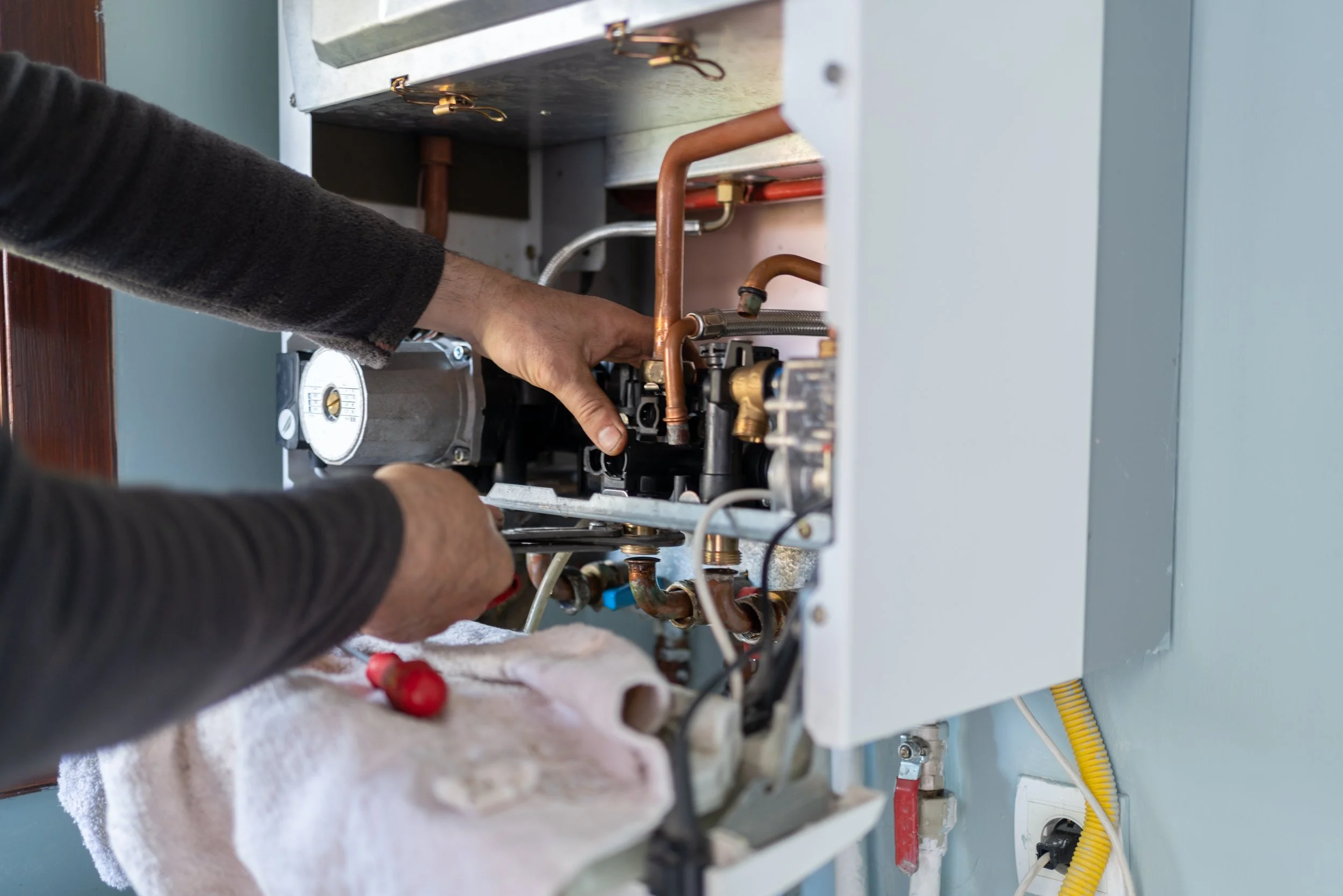
When refrigerant levels drop, your AC can't absorb enough heat from your indoor air. The system runs longer, works harder, and still can't keep up. You'll notice warm air from the vents, ice buildup on components, and higher electric bills — all while your compressor is being damaged by inadequate lubrication and improper pressures.
Signs Your AC Has a Refrigerant Leak
Most homeowners in Clinton Township and Shelby Township don't realize they have a refrigerant leak until the house stops cooling properly. Here's what we look for during seasonal AC inspections:
Warm Air From Vents
Your AC is running, but the air coming from the registers feels barely cool or room temperature. Low refrigerant means low heat absorption — the evaporator coil can't pull enough heat from your indoor air.
Ice on the Indoor Coil or Outdoor Lines
This seems counterintuitive, but low refrigerant causes freezing. When refrigerant pressure drops, the evaporator coil gets too cold. Moisture in the air freezes on contact. You'll see ice forming on the copper lines running to your outdoor unit, or frost covering the indoor coil in your furnace cabinet.
Michigan-Specific Issue: Basement humidity makes this worse. Homes in Macomb County with unfinished basements often have higher indoor moisture levels, which accelerates ice buildup on low-pressure coils.
Hissing or Bubbling Sounds
A significant leak in the refrigerant lines creates a hissing sound as pressurized gas escapes. If the leak is in the liquid line, you might hear a bubbling sound. These are usually audible near the outdoor condenser unit or along the line set running through the basement.
Higher Electric Bills
Your AC runs longer cycles trying to reach the thermostat setting. A system that's 30% low on refrigerant can use 20% more electricity while delivering less cooling. We see this pattern every June when homeowners in Royal Oak and Troy call about sudden bill spikes.
AC Runs Constantly
The compressor never shuts off because the system can't reach the temperature you've set. This is hard on the equipment — compressors are designed for intermittent operation, not continuous runtime.
Where Refrigerant Leaks Happen in Michigan Systems
After diagnosing refrigerant leaks across Southeast Michigan for three decades, we see patterns. Certain components fail more often, especially in our climate.
Evaporator Coil Corrosion
The indoor evaporator coil sits in your furnace cabinet or air handler. In Michigan basements with moisture issues, these coils corrode from the outside in. Formaldehyde off-gassing from building materials can also cause formicary corrosion — tiny pinhole leaks that are difficult to locate.
Carrier, Lennox, and Trane all had coil corrosion issues with certain models manufactured between 2004-2012. If your system falls in that range and you're experiencing repeated leaks, coil replacement is often the only permanent solution.
Line Set Connections
The copper lines connecting your indoor and outdoor units are joined with flare fittings or brazed connections. These can loosen over time from vibration, thermal expansion and contraction, or poor initial installation. We find connection leaks most often at the service valves on the outdoor condenser.
Service Ports and Valves
The Schrader valves (similar to tire valves) where technicians connect gauges to check pressures can develop slow leaks. The valve cores can fail, or the cap gets left off and debris damages the seal. This is one of the easiest and cheapest leaks to fix.
Condenser Coil Damage
The outdoor coil is vulnerable to physical damage. We've seen coils punctured by lawn mowers throwing rocks, damaged by weed trimmers, dented by hail, and corroded by dog urine. Keeping a 24-inch clearance around your outdoor unit prevents most of these issues.
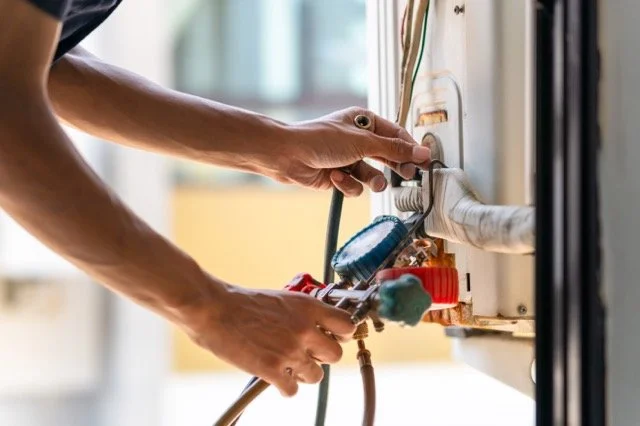
What a Refrigerant Leak Repair Actually Costs
This is the question we get most often. The answer depends on where the leak is located, what type of refrigerant your system uses, and how much needs to be recharged after the repair.
Leak Detection: $200-$400
Before we can fix a leak, we have to find it. Small leaks require electronic leak detectors, UV dye injection, or nitrogen pressure testing. This takes time — sometimes 1-2 hours for a slow leak in a hard-to-access location.
Small Leak Repair + Recharge: $400-$1,200
If the leak is at a service valve, flare connection, or accessible line set joint, the repair itself is straightforward. The cost includes:
- Leak repair (brazing or component replacement)
- System evacuation (removing air and moisture)
- Refrigerant recharge (R-410A costs $50-$100 per pound)
- Pressure testing to verify the repair
Most residential systems hold 6-15 pounds of refrigerant depending on tonnage and line set length. A complete recharge on a 3-ton R-410A system runs $300-$450 in refrigerant alone.
Evaporator Coil Replacement: $1,200-$2,800
If the leak is in the indoor coil, replacement is usually the only permanent fix. The coil itself costs $400-$1,200 depending on brand and tonnage. Labor adds another $800-$1,600 because the coil sits inside your furnace cabinet — we often have to remove the furnace to access it.
This is where the repair vs. replace decision gets serious. If your AC is 12 years old and needs a $2,000 coil replacement, you're often better off replacing the entire outdoor unit at the same time for $3,500-$5,500 total. You get a new system with a warranty instead of putting $2,000 into old equipment.
Condenser Coil Replacement: $1,000-$2,500
Outdoor coil replacement is labor-intensive. The refrigerant must be recovered, the old coil removed, the new coil brazed in, and the system recharged. On older systems, replacement coils are sometimes unavailable — manufacturers discontinue parts after 10-12 years.
R-22 (Freon) Phaseout: What Detroit Homeowners Need to Know
If your AC was installed before 2010, this section matters. R-22 refrigerant (Freon) production ended in January 2020. The only R-22 available now is reclaimed from old systems, and the price reflects that scarcity.
We're seeing reclaimed R-22 prices at $100-$150 per pound in 2026. A system that needs 8 pounds recharged costs $800-$1,200 in refrigerant alone — before you've fixed the leak.
Your Options With an R-22 System
Option 1: Repair the leak and recharge with reclaimed R-22. This makes sense if your system is relatively young (installed 2008-2010), the leak is minor, and you only need 1-2 pounds added. You're buying time, not a long-term solution.
Option 2: Convert to a drop-in replacement refrigerant. Refrigerants like R-421A or MO99 can work in R-22 systems with some modifications. The refrigerant itself is cheaper, but performance isn't always equivalent. Some manufacturers void warranties if you convert. We're honest about this — it's a band-aid, not a fix.
Option 3: Replace the system. This is what we recommend for systems 15+ years old with significant leaks. A new R-410A system with a 16 SEER rating will cut your cooling costs 30-40% compared to your old 10 SEER R-22 unit. The payback period through energy savings is 7-10 years, and you get a 10-year parts warranty.
Real Example from Troy: A homeowner with a 2006 Carrier R-22 system called us about warm air. We found a corroded evaporator coil. Repair cost: $2,400 (coil replacement + R-22 recharge). Replacement cost: $4,800 for a new 16 SEER Lennox system. They chose replacement and saved $85/month on electric bills all summer.
When to Repair vs. Replace Your AC Unit
We don't sell equipment unless it makes financial sense. Here's the framework we use when talking through options with homeowners in Rochester Hills and Grosse Pointe Farms.
Age of the System
Air conditioners last 12-16 years in Michigan. If your system is under 8 years old and the repair is under $800, fix it. If it's 12+ years old and the repair is over $1,500, replacement usually makes more sense.
The 50% Rule
If the repair cost exceeds 50% of replacement cost and your system is past the halfway point of its expected lifespan, replace it. Example: Your 13-year-old AC needs a $2,000 coil. A new system costs $4,500. That's 44% of replacement cost on a system that's 81% through its expected life. Replace it.
SEER Rating Upgrade
Older systems operate at 10-12 SEER. New systems start at 14 SEER and go up to 20+ SEER. A 16 SEER system uses 33% less electricity than a 12 SEER system doing the same work. Over 12 years, that's $3,000-$5,000 in savings for a typical 2,000 sq ft home in Southeast Michigan.
Warranty Considerations
Parts warranties on residential AC systems are typically 10 years (registered with the manufacturer). Labor warranties are 1-2 years unless you're working with a reliable HVAC contractor in Metro Detroit who offers extended coverage. If your system is out of warranty and needs a major repair, you're paying full price for parts and labor with no protection if something else fails next year.
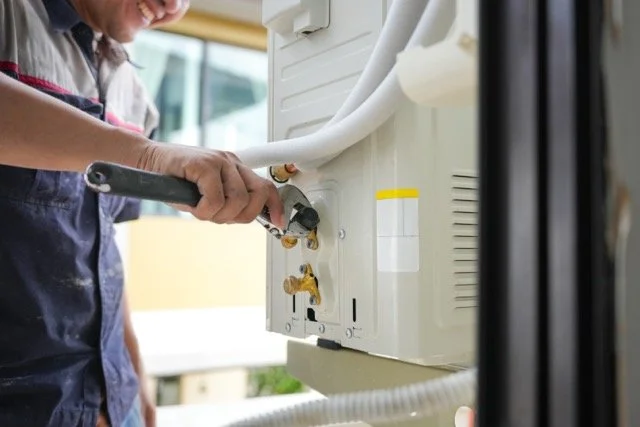
How to Prevent Refrigerant Leaks
You can't prevent all leaks — coil corrosion and manufacturing defects are beyond your control. But you can reduce the risk significantly with proper maintenance.
Seasonal AC Maintenance
An annual spring tune-up catches small leaks before they become big problems. Our NATE-certified technicians check refrigerant pressures, inspect coils for corrosion, examine line set connections, and verify proper airflow. We find 60% of refrigerant leaks during routine maintenance, not emergency service calls.
The Next Care Plan includes two annual visits (spring AC tune-up and fall furnace inspection) for $5/month. We catch problems early, you avoid emergency repair costs, and your equipment lasts longer.
Keep Coils Clean
Dirty coils work harder and run hotter. Excessive heat accelerates corrosion. We clean both indoor and outdoor coils during maintenance visits. Between visits, keep the area around your outdoor unit clear — no grass clippings, leaves, or debris blocking airflow.
Proper Landscaping Clearance
Maintain 24 inches of clearance around your outdoor condenser. Trim bushes, move decorative rocks, and keep lawn equipment away from the unit. Physical damage from weed trimmers and lawn mowers is one of the most common — and most preventable — causes of condenser coil leaks.
Address Basement Humidity
If you have an unfinished basement in Macomb County or St. Clair County, consider a dehumidifier. Keeping basement relative humidity below 50% reduces evaporator coil corrosion and extends equipment life. This is especially important in older homes with fieldstone foundations.
Need an AC Refrigerant Leak Diagnosed?
NEXT Heating & Cooling has been keeping Southeast Michigan homes comfortable for over 35 years. Our NATE-certified technicians give you honest diagnostics, clear repair-vs-replace guidance, and fair pricing — no pressure, no upselling.
Schedule Your Service CallFrequently Asked Questions About AC Refrigerant Leaks
No. Adding refrigerant without fixing the leak is illegal under EPA regulations and wastes money. The refrigerant will leak out again, and you'll be back where you started — except you've also damaged your compressor by running it with improper charge levels. Any licensed HVAC contractor will locate and repair the leak before recharging the system.
R-410A and R-22 are both low-toxicity refrigerants, but they displace oxygen in enclosed spaces. A large leak in a small, unventilated room could cause dizziness or difficulty breathing. If you smell a sweet, chemical odor near your indoor unit or notice symptoms like headache or nausea, leave the area, turn off your AC, and call for service. This is rare — most residential leaks are slow and outdoors.
Simple repairs (service valve replacement, tightening a connection) take 1-2 hours including leak detection, repair, evacuation, and recharge. Coil replacement takes 4-8 hours depending on accessibility. If the evaporator coil is buried inside your furnace cabinet, we may need a full day. We'll give you a time estimate once we've diagnosed the leak location.
Usually no. Most homeowners insurance policies exclude mechanical breakdown and normal wear-and-tear. If the leak was caused by a covered peril (like hail damage to the outdoor coil or a tree falling on the unit), you might have coverage. Check your policy or call your agent. We provide detailed invoices that break down the cause of failure for insurance claims.
Yes. Low refrigerant pressure causes the evaporator coil to get too cold, freezing moisture from the air on contact. You'll see ice on the copper lines or frost covering the indoor coil. Other causes of freezing include dirty air filters, blocked return vents, and failed blower motors — but refrigerant leaks are the most common cause we see in Southeast Michigan.
Once a year during your spring AC tune-up. A properly functioning system should never need refrigerant added — it's a closed loop. If you're adding refrigerant every year, you have a leak that needs to be found and fixed. Our affordable HVAC maintenance plan includes annual refrigerant pressure checks and leak detection as part of the spring visit.
R-22 (Freon) is an older refrigerant that was phased out in 2020 due to ozone depletion concerns. It operates at lower pressures and is no longer manufactured — only reclaimed R-22 is available, at $100-$150/lb. R-410A is the current standard for residential AC systems. It operates at higher pressures, doesn't deplete ozone, and costs $50-$100/lb. The two are NOT compatible — you can't simply swap one for the other without system modifications.