

How to Prepare Your AC for Summer in Southeast Michigan
Every spring, we get the same call: "My AC won't turn on, and it's supposed to hit 85 degrees tomorrow." By the time June rolls around in Metro Detroit, our schedule is packed with emergency service calls that could have been prevented with an hour of preparation in April.
Here's what 35 years of heating and cooling services in Metro Detroit has taught us: Michigan homeowners who prepare their air conditioners in spring avoid 80% of the breakdowns that happen during the first heat wave. That's not a sales pitch — that's what happens when you catch small problems before they turn into expensive failures.
This guide walks through the exact steps our NATE-certified HVAC technicians follow when preparing an air conditioning system for Michigan's cooling season. Some you can handle yourself. Others require professional equipment and training. We'll tell you which is which.
Why Spring AC Prep Matters in Michigan
Michigan's climate creates unique challenges for air conditioning systems. Your AC sits dormant for seven or eight months while your furnace handles the heating load. During that time, several things happen that affect cooling performance:
Debris accumulation. Leaves, grass clippings, cottonwood seeds, and pollen pack into the outdoor condenser unit throughout fall and winter. A quarter-inch layer of debris on the condenser coils reduces heat transfer efficiency by 20-30%. Your system runs longer to achieve the same cooling, which increases your electric bill and shortens equipment life.
Refrigerant leaks. Temperature swings from -10°F in January to 85°F in May cause metal components to expand and contract. Small refrigerant leaks that started last summer get worse over winter. A system that's low on refrigerant can't absorb heat properly — it runs constantly without cooling your home effectively.
Electrical connection corrosion. Michigan's humidity affects outdoor electrical components. Corroded connections create resistance, which generates heat and can trip breakers or damage the compressor contactor. We've seen contactors fail on the first 90-degree day because corrosion built up over winter.
Condensate drain clogs. The drain line that carries moisture away from your indoor evaporator coil can develop algae or mold growth during the dormant months. When you fire up the AC in June and humidity is high, a clogged drain line causes water to back up into your furnace cabinet or overflow onto your floor.
Spring preparation catches these issues before they cause failures during the cooling season. In Sterling Heights and Troy, where we service hundreds of AC systems each year, the homes that get spring tune-ups rarely call us for emergency repairs in July and August.
The 8-Step Spring AC Preparation Checklist
This is the same checklist our technicians follow during a spring AC tune-up. Steps 1-5 are homeowner-friendly. Steps 6-8 require professional tools and training.
Step 1: Replace or Clean Your Air Filter
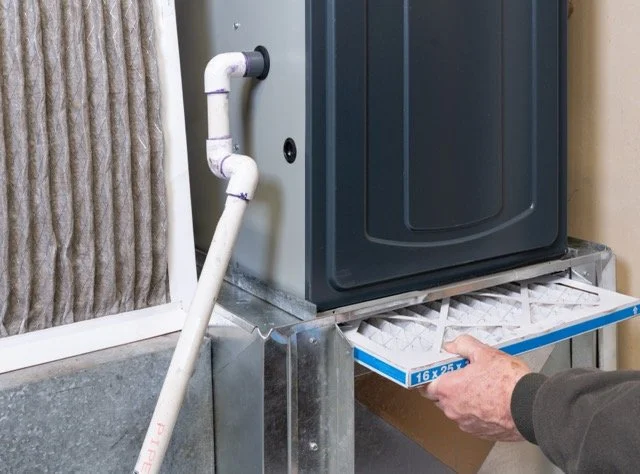
Start with the simplest task that has the biggest impact. A dirty air filter restricts airflow across the evaporator coil, which reduces cooling capacity and can cause the coil to freeze. Check your filter every 30-90 days depending on whether you have pets, how many people live in your home, and whether you run your HVAC fan continuously.
Standard 1-inch pleated filters (MERV 8-11) work well for most Michigan homes. Higher MERV ratings (13-16) capture more particles but restrict airflow if your system wasn't designed for them. If you're not sure what your system can handle, stick with MERV 8-11.
The filter location varies by system. Most are in the return air grille, the furnace cabinet, or a dedicated filter rack. If you have a reusable filter, wash it with water, let it dry completely, and reinstall it.
Step 2: Clear Debris from the Outdoor Unit
Your outdoor condenser unit needs at least 2 feet of clearance on all sides for proper airflow. Remove leaves, grass clippings, branches, and any debris that accumulated over winter. Trim back bushes, shrubs, or ornamental grasses that grew close to the unit.
Check the top of the unit where the fan exhausts hot air. We've found bird nests, squirrel damage, and even wasp nests in outdoor units that haven't been checked since last fall. If you see animal damage to wiring or insulation, that's a sign you need professional service before starting the system.
Step 3: Inspect the Condensate Drain Line
The condensate drain line is a PVC pipe that runs from your indoor air handler to a floor drain, sump pump, or outside drain. During cooling season, your AC removes moisture from the air — sometimes several gallons per day in Michigan's humid summers.
Locate the drain line (usually 3/4-inch white PVC) and verify water can flow freely. Pour a cup of white vinegar through the line to kill algae and prevent clogs. If the line has a cleanout port, remove the cap and check for standing water or blockage. A wet-dry vacuum can clear minor clogs, but stubborn blockages need professional attention.
Step 4: Test Your Thermostat
Switch your thermostat from heat to cool mode. Set the temperature 5 degrees below the current room temperature. The system should start within a few minutes. Listen for the outdoor unit to kick on, and feel for cool air coming from your supply vents within 10-15 minutes.
If you have a programmable or smart thermostat, verify the cooling schedule matches your summer routine. Replace thermostat batteries if your model uses them — weak batteries cause erratic behavior that looks like an AC problem but isn't.
Step 5: Check Indoor Vents and Registers
Walk through your home and verify all supply vents are open and unobstructed. Furniture, curtains, and area rugs commonly block vents, which creates hot and cold spots and forces your AC to work harder. Vacuum dust from vent covers — accumulated dust restricts airflow and gets pulled into your ductwork.
In Macomb County homes with basements, check return air grilles for dust buildup. The return side of your system moves more air than the supply side, so a blocked return grille has a bigger impact on system performance than a blocked supply vent.
Michigan HVAC Reality Check: The five steps above take most homeowners 30-45 minutes and prevent the majority of early-season AC failures. If your system is older than 10 years, has needed repairs in the past two years, or you've skipped maintenance for multiple seasons, the professional steps below become more critical.
Step 6: Inspect Outdoor Unit Components
This step requires technical knowledge and safety equipment. A licensed technician inspects:
- Condenser coils: Looking for bent fins, corrosion, or debris embedded in the coil that can't be removed with a garden hose
- Refrigerant lines: Checking insulation condition, looking for oil stains that indicate leaks, and verifying line sets are properly secured
- Electrical connections: Tightening terminals, checking for corrosion, measuring voltage and amperage at the contactor and capacitor
- Fan motor and blade: Listening for bearing noise, checking blade balance, verifying proper rotation direction
- Compressor: Checking for unusual sounds, verifying proper startup behavior, measuring operating pressures
We find problems during this inspection that homeowners can't detect without gauges and meters. A compressor drawing 15% more amperage than nameplate rating is failing — it still runs, but it's working too hard and will quit during the first extended heat wave.
Step 7: Clean the Outdoor Coils
Condenser coils need professional cleaning if they're packed with debris or coated with cottonwood fuzz (common in Oakland County). We use specialized coil cleaners and low-pressure water to clean from the inside out, which removes debris without bending the delicate aluminum fins.
Homeowners can gently spray coils with a garden hose from the inside out, but never use a pressure washer — the force bends fins and reduces airflow. If your coils are heavily soiled or you see black mold growth, professional cleaning with chemical coil cleaner is the better option.
Step 8: Check Refrigerant Charge and System Performance
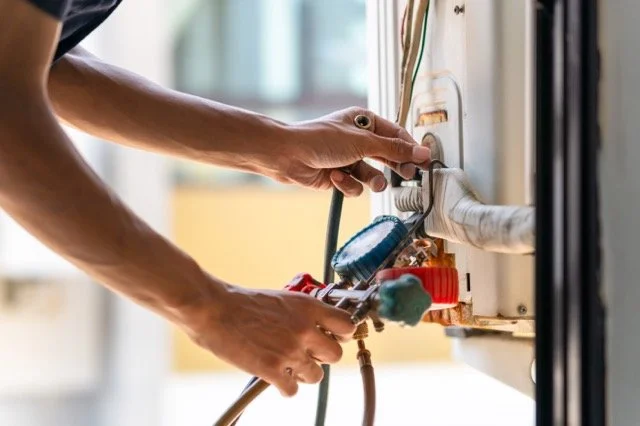
This step requires EPA 608 certification and specialized gauges. A technician connects manifold gauges to the service ports and measures:
- Suction pressure: The low-side pressure indicates how much refrigerant is returning to the compressor
- Discharge pressure: The high-side pressure shows how effectively the condenser is rejecting heat
- Superheat and subcooling: Temperature measurements that reveal whether the system has the correct refrigerant charge
- Temperature split: The difference between return air temperature and supply air temperature (should be 15-20°F for proper cooling)
Systems that are low on refrigerant need leak detection and repair before adding refrigerant. Simply topping off the charge without fixing the leak wastes money and harms the environment. Our licensed HVAC contractors use electronic leak detectors and UV dye to locate leaks that aren't obvious during visual inspection.
What Michigan Homeowners Miss During DIY AC Prep
We respect homeowners who maintain their own equipment. But three decades in this business has shown us what gets overlooked without professional training and equipment:
Failing capacitors. The start capacitor and run capacitor store electrical energy that helps the compressor and fan motors start and run efficiently. Capacitors weaken over time, especially in systems that run through Michigan's temperature extremes. A weak capacitor causes hard starting, higher electric bills, and premature compressor failure. Testing capacitors requires a multimeter and knowing what readings indicate failure.
Ductwork problems. Disconnected ducts, crushed flex duct, and gaps at seams waste 20-30% of your cooled air in unconditioned spaces like attics and crawlspaces. You're paying to cool your attic instead of your living room. Most ductwork is hidden, so homeowners don't see these problems. A thorough inspection includes looking at accessible ductwork with a flashlight and checking for air leaks at register boots.
Evaporator coil condition. The indoor coil that sits above your furnace can develop mold, dust buildup, or refrigerant leaks. You can't see this coil without removing the access panel and using a flashlight. A dirty evaporator coil restricts airflow and reduces cooling capacity, but the symptoms look like other problems — weak airflow, warm air from vents, or ice formation on refrigerant lines.
Blower motor issues. The blower motor that circulates air through your home runs year-round if you use continuous fan mode. Bearings wear out, belts slip (on older systems), and motors draw excessive amperage before they quit completely. A technician measures motor amperage and listens for bearing noise that indicates the motor is near failure.
Refrigerant charge accuracy. This is the big one. Homeowners can't legally purchase refrigerant or the gauges needed to check system charge. Systems lose 2-5% of their refrigerant per year through normal permeation, and small leaks accelerate the loss. An undercharged system runs constantly without cooling properly. An overcharged system (from a previous incorrect service) damages the compressor.
These aren't scare tactics. They're the problems we document on service reports every spring in Sterling Heights, Royal Oak, and Grosse Pointe Farms. Homeowners who handle steps 1-5 and call professionals for steps 6-8 get the best balance of DIY savings and professional thoroughness.
When Your AC Needs Professional Service Before Summer
Certain symptoms indicate your air conditioner needs professional attention before the cooling season starts. Don't wait until June to address these issues:
The system won't turn on. Check your thermostat batteries and circuit breakers first. If those are fine and the system still won't start, you likely have an electrical problem — tripped safety switch, failed contactor, or compressor issue. These aren't DIY repairs.
Ice forms on the refrigerant lines. Ice on the copper lines running to your outdoor unit indicates restricted airflow (dirty filter, blocked evaporator coil, weak blower motor) or low refrigerant. Never run an AC system with ice on the lines — you'll damage the compressor. Turn the system off and call for service.
The outdoor unit makes grinding, squealing, or clanking sounds. These sounds indicate mechanical failure — bad bearings in the fan motor, loose components, or compressor damage. Continuing to run the system causes more expensive damage.
Water leaks from the indoor unit. A small amount of condensation is normal during startup, but standing water or active leaks mean your drain line is clogged or your drain pan is cracked. Water damage to ceilings, walls, and flooring costs more to repair than fixing the AC problem.
The system runs constantly but doesn't cool the house. This symptom has multiple possible causes: low refrigerant, dirty coils, failed compressor, undersized equipment, or ductwork problems. A technician needs to diagnose the root cause with temperature measurements and pressure readings.
Your system is 12+ years old and hasn't been maintained. AC systems have an average lifespan of 15-20 years with proper maintenance, but Michigan's temperature extremes reduce that to 12-15 years for neglected systems. If your equipment is in this age range, a pre-season inspection identifies whether you're looking at repairs or replacement. It's better to know in April than during a July heat wave when lead times for new equipment stretch to weeks.
We run into homeowners every spring who say, "It worked fine last September, so it should be fine this June." That's not how mechanical systems work. Components fail during the dormant season, and problems that were minor last fall become major by spring. Early detection saves money.
The Real Cost of Skipping Spring AC Maintenance
Let's talk numbers, because Michigan homeowners are practical about money. A spring AC tune-up from a reliable HVAC contractor in Metro Detroit typically costs $125-$175 as a standalone service. Here's what happens when you skip it:
Higher electric bills. A dirty condenser coil reduces efficiency by 20-30%. On a system that uses 3,000 kWh per cooling season (typical for a 1,800 sq ft Michigan home), that's an extra 600-900 kWh. At $0.17 per kWh (average DTE Energy rate), you're paying an extra $102-$153 per summer in wasted electricity.
Emergency service call premiums. When your AC quits on a 90-degree Saturday in July, you'll pay $150-$250 just for the emergency service call before any repair costs. Parts and labor for common failures add hundreds more: compressor contactor ($200-$300), capacitor replacement ($150-$250), refrigerant leak repair and recharge ($400-$800).
Shortened equipment life. Systems that run with dirty coils, low refrigerant, or weak capacitors work harder and fail sooner. Replacing a residential AC system in Southeast Michigan costs $3,500-$7,000 depending on size, efficiency rating, and brand (Carrier, Lennox, Trane, Rheem). Getting 15 years instead of 12 years from your equipment saves you $1,200-$2,300 per extra year of service life.
Comfort loss during peak season. When your AC fails in July, you're looking at 2-5 days without cooling while waiting for parts and service availability. Hotel rooms for a family during a heat wave cost $150-$200 per night. The discomfort and disruption can't be measured in dollars, but it's real.
The math is straightforward: spending $125-$175 on spring maintenance prevents $500-$1,500 in avoidable costs during the cooling season. That's not even accounting for the major failures — compressor replacement ($1,800-$3,500) or full system replacement — that happen when minor problems go undetected.
Real Example from Last Summer: A homeowner in Clinton Township called us in late June because their AC wasn't cooling. We found a failed compressor contactor (a $35 part) that could have been detected during spring maintenance. Because the system ran for two weeks with a bad contactor, the compressor overheated and failed. Total repair cost: $2,800. A spring tune-up would have caught the failing contactor for $150 total including the service call.
How the Next Care Plan Simplifies AC Preparation
We designed the Next Care Plan specifically for Michigan homeowners who want reliable HVAC performance without thinking about maintenance schedules. For $5 per month ($60 per year), you get:
- Two annual home visits: Spring AC tune-up (April-May) and fall furnace tune-up (September-October)
- Complete system inspection: All eight steps in the preparation checklist above, plus safety checks and performance testing
- Priority scheduling: Care Plan members get first access to our service calendar, which matters during peak season
- 10% discount on repairs: If we find a problem during maintenance, parts and labor are discounted
- No service call fees: The $95-$125 diagnostic fee is waived for Care Plan members
The plan pays for itself with the first service call you avoid. We track maintenance history in our system, so we know exactly when your equipment was last serviced, what we found, and what to watch for during the next visit. That continuity catches problems early — we notice when a component that was fine six months ago is now showing wear.
Care Plan members in Shelby Township and Bloomfield Hills have the lowest emergency service call rates of any customer group we track. That's not coincidental. Regular maintenance prevents emergencies.
If you're managing multiple properties or rental units, we offer commercial maintenance agreements with flexible scheduling. Property managers in Macomb County use our commercial plans to keep tenant comfort issues from turning into middle-of-the-night emergencies.
Ready to Get Started?
NEXT Heating & Cooling has been keeping Michigan homes comfortable for over 35 years. Get honest diagnostics and fair pricing from NATE-certified technicians who show up on time.
Schedule Your ServiceFrequently Asked Questions
Schedule maintenance in April or early May before the first heat wave. Our service calendar fills up by mid-May, and by June we're handling emergency calls from homeowners who skipped spring prep. Early scheduling gives you the widest appointment availability and ensures your system is ready before you need it.
Check your filter monthly during cooling season and replace it when it looks dirty — typically every 30-60 days for standard 1-inch filters. Homes with pets, multiple occupants, or continuous fan operation need more frequent changes. A dirty filter is the most common cause of reduced cooling performance and frozen evaporator coils.
No. Pressure washers bend the delicate aluminum fins on condenser coils, which reduces airflow and efficiency. Use a garden hose with a spray nozzle set to gentle pressure, and spray from the inside of the unit outward to push debris out rather than packing it deeper into the coils. For heavily soiled coils, call a professional who has specialized coil cleaning equipment.
Set your thermostat to 72-76°F when you're home and 78-80°F when you're away. Every degree below 72°F increases cooling costs by 3-5%. Use a programmable or smart thermostat to automatically adjust temperatures based on your schedule. In Michigan's humid summers, running your system at a moderate temperature continuously works better than setting it very cold — constant operation removes more humidity than short, intense cooling cycles.
Common causes include low refrigerant (from a leak), dirty condenser coils, a clogged air filter, a frozen evaporator coil, or a failed compressor. Start by checking your air filter and clearing debris from the outdoor unit. If those are fine and the system still won't cool, you need professional diagnosis — the problem requires gauges, meters, and technical knowledge to identify.
A thorough spring AC tune-up takes 60-90 minutes. That includes inspecting the outdoor unit, checking refrigerant charge, testing electrical components, cleaning or replacing the air filter, verifying thermostat operation, checking the condensate drain, and testing system performance. If we find problems that need repair, we'll explain what's wrong and give you options before proceeding.
Yes, especially in Michigan's climate. Annual maintenance catches small problems before they become expensive failures, keeps your system running efficiently (which lowers electric bills), and extends equipment life by 3-5 years on average. Most AC manufacturers require annual maintenance to keep warranties valid. The cost of maintenance ($125-$175) is far less than the cost of emergency repairs ($400-$1,500) or premature system replacement ($3,500-$7,000).