

AC Won't Turn On At All? Macomb County Troubleshooting

It's the first hot Saturday in June. You walk over to the thermostat, set it to 72°F, and wait for that familiar hum from the basement. Nothing. You check the outdoor unit. Silent. No fan spinning, no compressor clicking on. Your AC won't turn on at all.
This is one of the most common service calls we get at NEXT Heating & Cooling every summer across Macomb County, Sterling Heights, and Clinton Township. The good news? About half the time, it's something you can fix yourself in under ten minutes. The other half requires a trained tech—but knowing the difference saves you time, money, and a lot of frustration on a 90-degree afternoon.
This guide walks you through the exact troubleshooting steps our NATE-certified technicians use when diagnosing a no-start AC situation. We'll cover what's safe for homeowners to check, what requires professional tools and training, and when to stop and call for AC repair services in Metro Detroit.
Check Your Thermostat First
Start here. It sounds too simple, but thermostat issues account for roughly 30% of the "AC won't turn on" calls we run in Macomb County. Many of these don't require a service visit at all.
Replace the Batteries
If you have a battery-powered thermostat (most programmable models use AA or AAA batteries), they typically last 1-2 years. When batteries die, the screen goes blank or shows a low-battery icon. The thermostat can't send the signal to start your AC. Pop in fresh batteries and wait 30 seconds for the system to reboot.
Verify the Mode and Temperature Settings
This happens more than you'd think: someone bumped the thermostat to OFF or HEAT mode during spring cleaning. Make sure it's set to COOL. Then check the temperature setting—it needs to be at least 3-5 degrees below the current room temperature to trigger the compressor. If your house is 78°F and the thermostat is set to 76°F, the system should call for cooling.
Check for a Tripped Safety Lockout
Some digital thermostats have a built-in delay (usually 3-5 minutes) after you change settings or restore power. This protects the compressor from rapid cycling. If you just flipped the breaker back on or changed the temperature, give it five minutes before assuming there's a problem.
Michigan-Specific Issue: Older homes in Sterling Heights and Warren often have original thermostats from the 1980s or 1990s mounted on exterior walls. These can lose calibration over time, especially after harsh winters. If your thermostat reads 75°F but the room feels like 80°F, it might not be calling for cooling when it should. A simple thermostat upgrade (around $150-$300 installed) often solves chronic comfort issues.
Inspect Your Electrical Panel
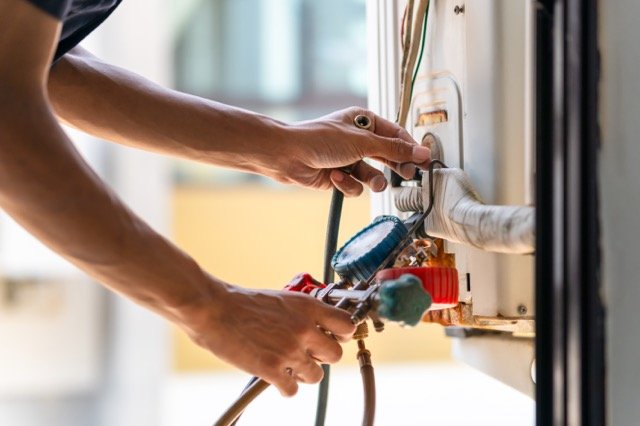
Air conditioners pull significant amperage—a typical 3-ton central AC unit in Michigan draws 15-20 amps when running. Electrical issues are the second most common cause of no-start situations.
Check the Main AC Breaker
Go to your electrical panel (usually in the basement or garage). Look for a breaker labeled "AC," "Air Conditioner," or "Condenser." It's typically a double-pole breaker (two switches connected together) rated for 30-60 amps depending on your unit size. If it's in the OFF position or sitting in the middle (tripped), flip it fully OFF, then back ON.
If the breaker trips again immediately, stop. You have a short circuit or ground fault somewhere in the system. This requires a licensed electrician or HVAC tech with electrical diagnostic tools. Running a system with a recurring breaker trip can cause compressor damage or electrical fire risk.
Find the Outdoor Disconnect Switch
Walk outside to your condenser unit (the big metal box with the fan on top). Within a few feet, you'll see a gray metal box mounted on the house or on a post. This is the outdoor disconnect switch. Pull the handle or flip the switch to make sure it's in the ON position. Sometimes landscapers, kids, or homeowners accidentally flip this off.
Check for GFCI Outlets
Some newer AC installations in Michigan (especially those done after 2020) have GFCI-protected outdoor outlets near the condenser for service use. If your condenser is plugged into one of these (uncommon but possible for smaller units or mini-splits), check that the GFCI hasn't tripped. Press the RESET button on the outlet.
Why Michigan Storms Matter: Macomb County gets intense summer thunderstorms with lightning strikes that can cause power surges. Even if your breaker didn't trip, a surge can damage the control board or capacitor inside your AC unit. If your AC stopped working right after a storm, mention that to your tech—it changes the diagnostic approach.
Look at Your Outdoor Unit
Your condenser needs airflow to operate. If it's blocked or excessively dirty, the system won't start—or it'll start and shut down on a safety limit within minutes.
Clear Debris and Vegetation
Walk around the outdoor unit. Remove any leaves, grass clippings, sticks, or trash within 2 feet of the unit. In late May and early June, Southeast Michigan gets hit with cottonwood seeds that coat condenser coils like a blanket. If you see white fuzz covering the fins, turn off power to the unit at the disconnect switch, then gently spray the coils from the inside out with a garden hose (low pressure—don't bend the fins).
Check the Condenser Fan
Look down through the top of the unit. You should see the fan blades. Make sure nothing is lodged in there—we've pulled out everything from bird nests to children's toys. If the fan blade is visibly damaged or bent, don't attempt to run the unit. A damaged fan can cause vibration that destroys the compressor.
Listen for Unusual Sounds
If you've restored power and the thermostat is calling for cooling, go back outside and listen. Do you hear a humming sound but no fan spinning? That's often a bad capacitor (we'll cover that below). Do you hear clicking but nothing else? Could be a contactor issue or low refrigerant triggering a pressure switch. These require professional diagnosis.
For more guidance on when it's time to replace your AC unit instead of repairing it, we have a dedicated resource that covers age, efficiency, and cost thresholds specific to Michigan homes.
Check Your Air Filter
A severely clogged air filter can prevent your AC from starting. Here's why: when airflow is restricted, the evaporator coil (the indoor coil that gets cold) can freeze. Modern systems have safety sensors that detect this and shut the system down before damage occurs.
Where to Find Your Filter
Most central air systems in Michigan homes have the filter in one of three places:
- Return air grille: Usually a large vent on a wall or ceiling (common in ranch homes)
- Furnace cabinet: In the blower compartment or a slot near the return duct (most common in basement installations)
- Return duct: A metal slot in the main return duct before it reaches the furnace
What to Look For
Pull the filter out and hold it up to a light. If you can't see light through it, it's clogged. Replace it with a new filter of the same size. For most Michigan homes, a MERV 8-11 pleated filter is ideal—it captures dust, pollen, and pet dander without restricting airflow too much.
If your filter looks fine but you haven't changed it in 4-6 months, replace it anyway. Macomb County homes with pets, older ductwork, or proximity to industrial areas (Warren, Eastpointe) accumulate dust faster than average.
Frozen Coil Recovery: If you suspect your evaporator coil is frozen (you might see ice on the copper lines near the furnace), turn the system OFF at the thermostat and let it thaw for 2-3 hours with the fan set to ON. Once thawed, replace the filter and try again. If it freezes again, you likely have a refrigerant leak or airflow problem that requires professional attention.
Examine the Condensate Drain
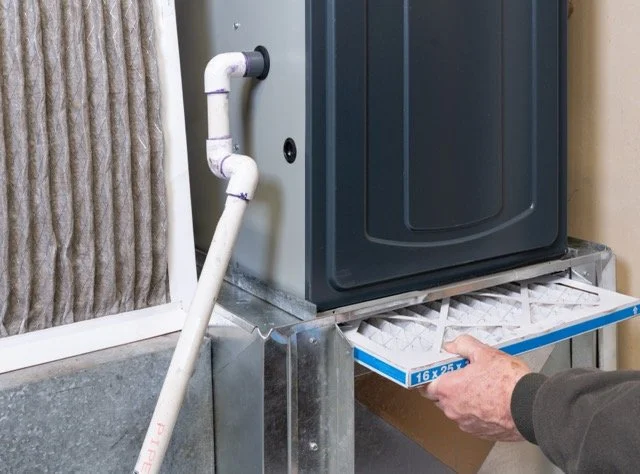
When your AC runs, it removes humidity from the air. That moisture drips into a condensate drain pan and flows out through a PVC pipe (usually to a floor drain, sump pump, or outside). If that drain clogs, water backs up. When the pan fills, a float switch kills power to the system to prevent water damage.
Locate the Drain Pan
Look at the indoor evaporator coil (usually above or inside your furnace). You'll see a plastic or metal pan underneath it. Some systems have a secondary overflow pan as a backup. Check if there's standing water in the pan.
Clear the Drain Line
Follow the PVC pipe from the drain pan to where it exits. If you see water pooling or the line is clogged, you can try clearing it with a wet/dry vacuum. Attach the vacuum hose to the end of the drain line (outside or at the floor drain) and run it for 30-60 seconds. This often pulls out algae, mold, or debris.
If the drain line is clear but the pan is still full, there might be a clog at the pan outlet or a problem with the drain trap. This is a common issue in humid Michigan basements, especially in older homes in Clinton Township and Chesterfield where the drain lines have been in place for 20+ years.
Preventive Maintenance Tip: Pour a cup of white vinegar or a condensate drain tablet into the drain pan every spring. This prevents algae and mold growth that causes clogs. This is included in both tune-ups when you sign up for the Next Care Plan—our techs clear and treat your condensate drain as part of the spring AC checkup.
When to Stop and Call a Pro
If you've worked through the checklist above and your AC still won't turn on, you're now in the territory where specialized tools, training, and licensing are required. Here's what our NATE-certified technicians check next—and why these aren't DIY-safe.
Capacitor Failure
The capacitor is a small cylindrical component (looks like a battery) that gives your compressor and fan motors the electrical "kick" they need to start. Capacitors fail gradually in hot weather—and Michigan's humid summers accelerate this. A bad capacitor is the #1 reason for AC no-start calls in June and July.
Symptoms: You hear a humming sound from the outdoor unit but the fan doesn't spin. Or the compressor tries to start, makes a groaning sound, then shuts off.
Why you shouldn't DIY this: Capacitors store high voltage (up to 440 volts) even when the unit is off. Touching the terminals without proper discharge tools can cause serious injury or death. A licensed tech has the tools to safely discharge, test, and replace capacitors. The part costs $15-$40; the labor is $150-$250 depending on the service call fee.
Contactor Issues
The contactor is an electrical relay that closes when the thermostat calls for cooling, sending power to the compressor and fan. Contactors can weld shut (causing the AC to run continuously) or fail open (preventing startup).
Symptoms: You hear a clicking sound from the outdoor unit but nothing else happens. Or the unit ran fine yesterday and suddenly won't start today.
A tech can test the contactor with a multimeter and replace it in 15-20 minutes. Contactor replacement typically runs $175-$300 including the service call.
Low Refrigerant or Leak
If your system is low on refrigerant (R-410A in most systems installed after 2010, R-22 in older units), it won't start or will start and shut down immediately on a low-pressure safety switch. Refrigerant doesn't "get used up"—if it's low, you have a leak.
Symptoms: The compressor tries to start but shuts off within seconds. You might see ice forming on the copper lines near the outdoor unit. The system worked fine last year but struggles this year.
Why you need a pro: Handling refrigerant requires EPA 608 certification. A tech will use electronic leak detectors, pressure gauges, and UV dye to find the leak, repair it, then recharge the system to the manufacturer's specification. Cost varies widely ($300-$1,500+) depending on leak location. If you're dealing with an old R-22 system, refrigerant costs have skyrocketed—this is often when we have the conversation about replacement versus repair.
Compressor Failure
The compressor is the heart of your AC system. If it's failed (seized, shorted, or mechanically broken), the system won't cool. Compressor failure is more common in units over 12-15 years old or systems that have run with low refrigerant for extended periods.
Symptoms: Breaker trips repeatedly. You hear a loud buzzing or grinding sound. The outdoor unit is completely silent even when the thermostat is calling for cooling.
Compressor replacement is expensive ($1,800-$3,500+ depending on tonnage and refrigerant type). For most homeowners with a system over 10 years old, this is the point where replacement makes more financial sense than repair. We walk through this cost analysis in our guide on central air conditioner costs in Michigan.
Control Board or Wiring Problems
Modern AC systems have circuit boards that control compressor staging, fan speed, defrost cycles, and safety shutoffs. Lightning strikes, power surges, and age can fry these boards. Similarly, rodents in attics or basements can chew through low-voltage wiring between the thermostat and the air handler.
Diagnosis requires a multimeter, wiring diagrams, and experience. Control board replacement typically runs $300-$800 depending on the brand (Carrier, Lennox, Trane, Rheem, etc.) and availability.
What an AC Diagnostic Call Actually Costs in Southeast Michigan
Let's talk real numbers. If you've tried everything in this guide and your AC still won't start, you're calling for service. Here's what to expect from a reliable HVAC contractor in Metro Detroit.
Diagnostic/Service Call Fee
Most HVAC companies charge a service call fee just to send a tech to your home. In Macomb, Oakland, and St. Clair counties, this typically ranges from $89 to $150. At NEXT Heating & Cooling, our standard service call is $99—and that's waived if you proceed with the recommended repair the same day.
The service call covers:
- Travel to your home
- Visual inspection of the indoor and outdoor units
- Electrical testing (voltage, amperage, capacitance)
- Refrigerant pressure check
- Thermostat verification
- Written diagnosis and repair estimate
Common Repair Costs
Based on our 35+ years serving Southeast Michigan, here are typical repair costs for the issues covered in this guide:
- Capacitor replacement: $150-$250
- Contactor replacement: $175-$300
- Thermostat replacement: $150-$400 (depending on model—basic programmable vs. Wi-Fi smart)
- Condensate drain clearing: $100-$200
- Refrigerant leak repair + recharge: $300-$1,500+ (depends on leak location and refrigerant type)
- Compressor replacement: $1,800-$3,500+
- Control board replacement: $300-$800
These prices include parts, labor, and our warranty on the work performed. Prices are higher for emergency service (nights, weekends, holidays) or for obsolete equipment where parts are hard to source.
The Value of Preventive Maintenance
Here's the reality: most capacitor failures, dirty coils, clogged drains, and electrical issues are caught during routine maintenance before they cause a no-start situation. A spring tune-up costs $100-$150 as a one-time service—or it's included twice a year (spring and fall) with the Next Care Plan for just $5/month.
When you're a Next Care Plan member, you also get:
- Priority scheduling (we bump you to the front of the line during heat waves)
- 10% discount on all repairs
- No service call fees for plan members
- Extended parts and labor warranties
Over the 35+ years we've been serving Michigan families, we've seen the math play out consistently: homeowners who invest in preventive maintenance spend 40-60% less on HVAC repairs over the life of their equipment. For more on why this matters during Michigan's humid summers, check out our article on AC maintenance for St. Clair Shores.
AC Still Won't Start? We're Here to Help
NEXT Heating & Cooling has been keeping Macomb County homes comfortable since 1991. Our NATE-certified technicians show up on time, diagnose the problem honestly, and give you options without pressure. No commission-based sales. Just old-school service done right.
Schedule Your AC RepairFrequently Asked Questions
If your thermostat settings are correct but the AC won't start, the most common causes are: tripped breaker, blown fuse in the disconnect box, failed capacitor, bad contactor, or low refrigerant triggering a safety switch. Start by checking your electrical panel and outdoor disconnect switch. If both are on and the unit still won't start, you'll need a technician to test the electrical components and refrigerant pressures.
After resetting a tripped breaker, give the system 5 minutes to stabilize (many thermostats have a built-in delay to protect the compressor). If the breaker trips again immediately or within a few minutes, stop and call for service. A recurring breaker trip indicates a short circuit, ground fault, or failing compressor—running the system in this condition can cause expensive damage.
No. Capacitors store high voltage (up to 440 volts) even when the unit is powered off. Without proper discharge tools and training, touching a capacitor can cause serious injury or death. A licensed HVAC technician has the equipment to safely discharge, test, and replace capacitors. The service call is worth the safety—and most capacitor replacements are completed in under 30 minutes once the tech arrives.
This is the classic symptom of a failed capacitor. The compressor is trying to start (that's the humming sound) but doesn't have enough electrical "boost" to overcome inertia. The fan motor is in the same situation. A technician will test the capacitor with a multimeter and replace it if it's out of spec. This is one of the most common AC repairs in Michigan during June and July when capacitors fail in hot weather.
Yes. When airflow is severely restricted by a clogged filter, the evaporator coil can freeze. Modern AC systems have safety sensors that detect frozen coils and shut the system down to prevent compressor damage. If you suspect this is the issue, turn the system off at the thermostat, set the fan to ON (to help thaw the coil), replace the filter, and wait 2-3 hours before trying to restart. If the coil freezes again, you likely have a deeper airflow or refrigerant issue.
Service call fees in Southeast Michigan typically range from $89 to $150. At NEXT Heating & Cooling, our standard diagnostic visit is $99—and we waive that fee if you proceed with the recommended repair the same day. The service call includes a complete system inspection, electrical testing, refrigerant pressure check, and a written estimate for any needed repairs.
The general rule: if the repair cost is more than 50% of a new system's cost and your AC is over 10-12 years old, replacement usually makes more sense. For example, if your compressor fails ($2,500+ to replace) and your system is 14 years old, you're better off investing that money in a new, high-efficiency unit that will last another 15-20 years and cut your cooling costs by 30-40%. We walk through this decision in detail during diagnostic visits—no pressure, just honest math.