

When Should You Replace Your AC Unit? Michigan Signs

You're standing in your living room on a humid July afternoon in Sterling Heights, and your air conditioner is running constantly — but the house still feels like a sauna. The electric bill arrived yesterday, and it's $80 higher than last summer. Your AC is making a grinding noise that wasn't there last week. And when you mention it to your neighbor, they tell you their 14-year-old unit just died and cost them $6,200 to replace.
Now you're wondering: is my AC about to fail? Should I replace it before it breaks down completely? Or am I jumping the gun?
After 35 years keeping Michigan homes comfortable through brutal summers, we've helped thousands of homeowners in Macomb, Oakland, and St. Clair counties make this exact decision. The truth is, there's no single magic number that tells you when to replace your AC unit — but there are clear warning signs that tell you when replacement makes more financial sense than another repair.
This guide will show you exactly what to watch for, what replacement actually costs in Southeast Michigan in 2026, and how to make the smartest decision for your home and budget. We'll cover the real lifespan of AC systems in our climate, the math that determines repair vs. replace, and what you need to know before hiring a contractor.
How Long Should an AC Unit Last in Michigan?
The Department of Energy estimates central air conditioners last 12 to 17 years with proper maintenance. But that's a national average — and Michigan isn't exactly average when it comes to weather.
Here's what actually affects AC lifespan in Southeast Michigan:
Temperature swings wear out components faster. Your compressor — the heart of your AC system — cycles on and off based on outdoor temperature. In Michigan, we can see 90-degree days in June followed by 60-degree nights. That constant cycling stresses the compressor, contactor, and capacitor more than steady climates experience. Systems in Arizona might run continuously for months, but they're not turning on and off dozens of times per day like ours do.
Humidity accelerates corrosion. Lake Huron, Lake St. Clair, and the Detroit River create humid conditions that corrode condenser coils, electrical connections, and refrigerant lines faster than dry climates. If you live near the water in Grosse Pointe Farms or St. Clair Shores, you've probably noticed this effect on outdoor equipment.
Installation quality matters more than brand. A properly sized and installed Goodman or Rheem system will outlast an oversized or poorly installed Carrier or Lennox unit every time. We've replaced 8-year-old premium systems that were installed incorrectly and serviced 22-year-old builder-grade units that were sized right and maintained consistently.
Maintenance extends life significantly. Systems enrolled in preventive maintenance programs like the Next Care Plan typically last 3-5 years longer than neglected systems. Annual spring tune-ups catch refrigerant leaks, clean coils, and replace worn contactors before they cause compressor failure.
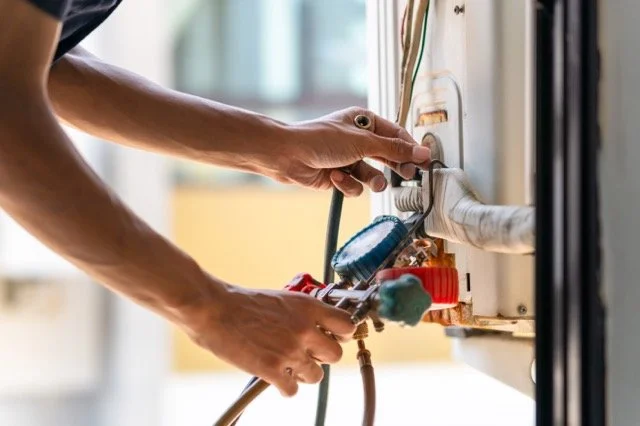
In our service area across Macomb and Oakland counties, we see most systems start having significant problems around year 12. By year 15, repair frequency and costs usually make replacement the smarter financial choice — even if the system is still technically running.
7 Warning Signs Your AC Needs Replacement
Age alone doesn't determine when to replace your air conditioner. These seven warning signs tell you when replacement makes more sense than continuing to repair:
1. Your System Is Over 15 Years Old and Needs Frequent Repairs
If your AC is 15+ years old and you've called for service twice in the past two years, you're approaching the end of its useful life. The compressor, condenser fan motor, and control board are all wearing out simultaneously. What feels like "bad luck" is actually predictable mechanical aging.
We see this pattern constantly in Troy and Rochester Hills, where many homes still have original builder-installed systems from the early 2010s. One repair might be worth it. Three repairs in 18 months means you're pouring money into a depreciating asset.
2. Energy Bills Keep Rising Despite Normal Usage
Your electric bill should be relatively consistent year-over-year when adjusted for weather. If you're paying $220/month this July when you paid $160/month last July — and usage patterns haven't changed — your AC efficiency has dropped significantly.
This happens when refrigerant slowly leaks out, compressor valves wear down, or the condenser coil gets permanently restricted with debris. The system runs longer to achieve the same cooling, burning more electricity every cycle.
Older systems also have lower SEER ratings (Seasonal Energy Efficiency Ratio). A 15-year-old unit might be 10-12 SEER. A new system starts at 14 SEER and can go up to 20+ SEER. That efficiency difference translates directly to your electric bill all summer long.
3. Inconsistent Cooling and Hot/Cold Spots Throughout the House
If your bedroom is 68 degrees while the living room is 76 degrees — and it wasn't always that way — your AC is losing capacity. This happens when the compressor can't generate enough pressure to move refrigerant efficiently, or when the blower motor is failing and can't push air through the ductwork.
Sometimes this is a ductwork problem that can be fixed separately. But if the ducts haven't changed and the temperature imbalance is new, the AC itself is failing. Our HVAC services in Metro Detroit include load calculations and airflow testing to diagnose the real cause.
4. Strange Noises That Weren't There Before
Air conditioners make some noise — that's normal. But new noises mean something has changed:
- Grinding or squealing from the outdoor unit: Compressor bearings are failing or the condenser fan motor needs replacement. These are expensive repairs, and if the system is over 12 years old, they often indicate multiple components are near end-of-life.
- Banging or clanking when starting up: The compressor contactor is worn, or internal compressor components are loose. This is a warning sign before complete failure.
- Hissing or bubbling sounds: Refrigerant leak. If it's a small leak in an accessible line, repair might make sense. If it's in the evaporator coil or compressor, replacement is usually more cost-effective.
We wrote a detailed guide on why your air conditioning unit is so loud that covers specific sounds and what they mean.
5. Repair Costs Are Approaching Half the Replacement Cost
This is where the $5,000 Rule comes in (more on this below). If your compressor fails and the repair quote is $2,800 — and a new system costs $6,500 — you're spending 43% of replacement cost on a 14-year-old system that still has all its other aging components.
That's not a smart investment. The repaired system might last another 2-3 years, but you'll likely face another major repair before then. And you'll still have an inefficient system with a low SEER rating driving up your electric bills.
6. Your System Uses R-22 Refrigerant (Freon)
If your AC was installed before 2010, it probably uses R-22 refrigerant — commonly called Freon. The EPA banned production of R-22 in 2020 under the Clean Air Act because it damages the ozone layer.
R-22 is still legal to use in existing systems, but supply is limited and prices have skyrocketed. What used to cost $50/pound now costs $150-200/pound. If your system needs 6 pounds to recharge after a leak, that's $900-1,200 just for refrigerant — before labor and leak repair.
Any R-22 system with a refrigerant leak should be replaced, not recharged. You're paying premium prices for an obsolete refrigerant in an aging system. New systems use R-410A refrigerant, which is widely available and significantly cheaper.
7. Poor Humidity Control Even When Cooling Works
Air conditioners remove humidity as a byproduct of cooling. If your house feels clammy and sticky even when the temperature is set correctly, your AC isn't running efficiently enough to dehumidify properly.
This is common in oversized systems that cool the house too quickly and shut off before completing a full dehumidification cycle. It also happens when the evaporator coil is partially frozen or restricted, reducing contact time with humid air.
Michigan summers are humid — we're surrounded by the Great Lakes. Your AC should keep indoor humidity between 40-50%. If you're consistently above 60% humidity indoors, the system isn't doing its job.
The $5,000 Rule: Repair vs. Replace Math
Here's the formula HVAC professionals use to determine whether repair makes financial sense:
Age of System (years) × Repair Cost = Decision Number
If the Decision Number is greater than $5,000, replace the system.
If it's less than $5,000, repair might make sense.
Let's look at two real examples from service calls we ran last summer in Shelby Township:
Example 1: 8-year-old system, $850 repair (capacitor and contactor replacement)
8 years × $850 = $6,800
Decision: Repair makes sense. The system is relatively young and this is a minor component failure.
Example 2: 14-year-old system, $2,400 repair (compressor replacement)
14 years × $2,400 = $33,600
Decision: Replace. The system is near end-of-life and the repair cost is too high relative to its remaining lifespan.
This formula isn't perfect — it doesn't account for efficiency gains, refrigerant type, or your specific comfort needs — but it gives you an objective starting point when a contractor presents repair options.
One factor this formula doesn't capture: future repair probability. That 14-year-old system with the failed compressor also has a 14-year-old condenser fan motor, contactor, capacitor, reversing valve (if it's a heat pump), and control board. Even if you replace the compressor today, you're likely facing another major repair within 18-24 months.
What AC Replacement Actually Costs in Southeast Michigan
Replacement costs vary based on system type, efficiency rating, home size, and installation complexity. Here's what homeowners in Metro Detroit actually paid in 2025-2026:
Basic Single-Stage System (14-16 SEER): $4,800 - $7,200 installed
Entry-level efficiency. Works fine for most homes. Brands like Goodman, Amana, and York fall in this range. Expect the lower end for a straightforward replacement with no ductwork modifications, higher end for larger homes or complex installations.
Mid-Efficiency Two-Stage System (17-18 SEER): $6,500 - $9,800 installed
Better humidity control and quieter operation. Runs at low speed most of the time, which improves comfort and efficiency. Brands like Bryant, Rheem, and Carrier offer solid options here. This is the sweet spot for most Michigan homeowners — good efficiency without premium pricing.
High-Efficiency Variable-Speed System (19-21 SEER): $8,200 - $13,500 installed
Top-tier comfort and lowest operating costs. Variable-speed compressors adjust output continuously rather than cycling on/off. Lennox, Carrier Infinity, and Trane XV series dominate this category. Worth it if you plan to stay in the house 10+ years and want maximum efficiency.
Ductless Mini-Split Systems: $3,800 - $11,000 installed
Wide range depending on number of zones. Single-zone systems start around $3,800. Multi-zone systems for whole-home cooling can reach $11,000+. Good option for homes without existing ductwork or room additions.
These prices include removal of the old system, installation of the new condenser and evaporator coil, refrigerant, electrical connections, thermostat, startup, and warranty registration. They assume your existing ductwork is in good condition and properly sized.
Add $800-2,200 if you need significant ductwork modifications, new electrical service, or a new air handler to match the outdoor unit. Add another $200-400 for a smart thermostat if you want WiFi control and advanced scheduling.
We published a detailed breakdown of the best central air conditioners for Michigan homes in 2026 if you want to compare specific models and features.
Choosing the Right Replacement System
Bigger isn't better when it comes to air conditioners. An oversized system costs more upfront, cycles on and off too frequently (which wears out components faster), and doesn't dehumidify effectively because it cools the house too quickly.
Here's what actually matters when selecting a replacement:
Proper Sizing Through Load Calculation
Your contractor should perform a Manual J load calculation before recommending a system size. This calculation accounts for your home's square footage, insulation levels, window types, orientation, ductwork design, and typical occupancy.
The output is a precise BTU (British Thermal Unit) requirement — usually expressed in tons. One ton of cooling equals 12,000 BTUs. Most Michigan homes need 2-5 tons depending on size and construction.
If a contractor recommends a system size without measuring your house and asking about insulation, find a different contractor. Guessing based on square footage alone leads to oversized systems that cost more and perform worse.
SEER Rating: Efficiency vs. Cost
SEER (Seasonal Energy Efficiency Ratio) measures how efficiently an air conditioner converts electricity into cooling. Higher SEER means lower operating costs, but higher upfront costs.
The federal minimum is 14 SEER as of 2023 (15 SEER in southern states). Michigan doesn't have a higher state requirement, so 14 SEER systems are legal and common here.
For Michigan's climate, here's what makes sense:
- 14-16 SEER: Good value if you're on a tight budget or plan to move within 5 years. The lower upfront cost outweighs the efficiency savings in a shorter timeframe.
- 17-18 SEER: Best long-term value for most homeowners. Efficiency gains pay for the upfront premium within 6-8 years through lower electric bills.
- 19-21 SEER: Worth it if you have high cooling loads, plan to stay 10+ years, or prioritize maximum comfort and quiet operation over payback period.
Don't obsess over SEER ratings above 18 unless you're also investing in insulation, air sealing, and window upgrades. A 20 SEER system in a poorly insulated house still wastes energy — you're just wasting it more efficiently.
Single-Stage vs. Two-Stage vs. Variable-Speed Compressors
The compressor determines how your AC adjusts to cooling demand:
Single-stage compressors run at 100% capacity or off. Simple, reliable, least expensive. Works fine for smaller homes or moderate climates. Can feel less comfortable in Michigan's humid summers because they cycle on and off frequently.
Two-stage compressors run at either 65% or 100% capacity. They operate at low speed most of the time, which provides better humidity control and more even temperatures. Only ramp up to high speed on the hottest days. This is the sweet spot for Michigan homes — noticeably better comfort without premium pricing.
Variable-speed compressors adjust output continuously from 40% to 100%. Maximum comfort and efficiency. Quietest operation. Best humidity control. Premium pricing. Worth it if comfort is your top priority and budget allows.
Brand Comparison: What Actually Matters
We install Carrier, Lennox, Trane, Rheem, Bryant, Goodman, Amana, York, and RUUD systems. Here's the truth about brand differences:
All major brands are reliable when properly installed and maintained. The difference between a "premium" brand like Carrier or Lennox and a "builder-grade" brand like Goodman or Amana is mostly warranty length, noise levels, and advanced features — not fundamental reliability.
Installation quality matters far more than brand name. A properly sized, correctly charged, well-maintained Goodman will outlast a poorly installed Trane every time.
That said, here's what we see in the field:
- Carrier and Lennox: Premium pricing, longest warranties (10 years parts), quietest operation, best advanced features (WiFi, zoning, air purification integration). Worth it if you want top-tier comfort and plan to stay long-term.
- Trane: Built like tanks. Heavier components, more durable construction. Not the quietest, but extremely reliable. Good middle-ground between premium and value.
- Bryant and Rheem: Solid mid-tier options. Good efficiency, reasonable pricing, reliable performance. Bryant is Carrier's sister brand with slightly shorter warranties and fewer premium features.
- Goodman, Amana, and York: Best value. Lower upfront cost, shorter warranties (5-6 years parts), noisier operation. Perfectly reliable for homeowners prioritizing budget over premium features.
We published an in-depth comparison of Carrier vs. Trane vs. Lennox furnaces that applies equally to air conditioners — same manufacturers, same quality tiers.
How to Find a Reliable AC Contractor in Metro Detroit
The contractor you choose matters more than the equipment brand. A great contractor will size your system correctly, install it properly, charge refrigerant precisely, and stand behind their work. A bad contractor will sell you an oversized system, rush the installation, and disappear when problems arise.
Here's what to look for when comparing contractors:
Michigan Mechanical Contractor License
This isn't optional — it's legally required. Any company installing or servicing HVAC systems in Michigan must hold a valid mechanical contractor license. You can verify this through the Michigan Department of Licensing and Regulatory Affairs.
Unlicensed contractors can't pull permits, aren't insured properly, and have no accountability when installations fail. Don't hire them regardless of price.
NATE Certification
North American Technician Excellence (NATE) is the industry's leading certification for HVAC technicians. It's not required by law, but it demonstrates technical competency beyond basic licensing.
NATE-certified techs have passed rigorous exams on refrigeration cycles, electrical troubleshooting, airflow calculations, and system diagnostics. When you hire a reliable HVAC contractor in Metro Detroit, ask if their technicians are NATE-certified.
Load Calculation and Proper Sizing
Any contractor who quotes a system size without measuring your house is guessing. Ask explicitly: "Will you perform a Manual J load calculation before recommending a system size?"
If they say "we'll match the size of your current system" or "we can estimate based on square footage," that's a red flag. Your current system might be oversized. Square footage alone doesn't account for insulation, windows, or ductwork.
Multiple Options, Not Pressure
Good contractors present options at different price points and efficiency levels, explain the tradeoffs clearly, and let you decide. Bad contractors push the most expensive system and create artificial urgency ("this price is only good today").
You should see at least two options — usually a mid-tier system and a high-efficiency system — with honest explanations of what you gain by spending more. If the contractor only quotes one system, ask for alternatives.
Written Estimates With Model Numbers and SEER Ratings
The estimate should specify exact equipment model numbers, SEER ratings, tonnage, warranty terms, and what's included in installation (removal, disposal, electrical work, thermostat, startup, etc.).
Vague estimates that just say "Carrier AC system" without model numbers make it impossible to verify you're getting what you paid for. Detailed estimates show the contractor knows exactly what they're installing.
References and Reviews From Local Homeowners
Ask for references from recent installations in your area — ideally homes similar to yours. Check Google reviews, BBB ratings, and local Facebook groups for unfiltered feedback.
Pay attention to how contractors respond to negative reviews. Everyone gets a bad review occasionally. Contractors who respond professionally and try to make things right demonstrate accountability. Contractors who ignore complaints or get defensive are showing you their true character.
NEXT Heating & Cooling has been serving Southeast Michigan for over 35 years under the same ownership as NEXT Exteriors. We're BBB A+ accredited, our technicians are NATE-certified, and we hold a Michigan Mechanical Contractor License. We don't pay our techs on commission, so you get honest diagnostics without sales pressure.
Need Help Deciding Whether to Repair or Replace Your AC?
NEXT Heating & Cooling provides honest diagnostics and fair pricing from NATE-certified technicians. We'll perform a complete system evaluation, explain exactly what's wrong, and give you repair and replacement options with clear cost breakdowns — no pressure, no upselling.
Schedule Your System EvaluationFrequently Asked Questions
Most residential AC replacements take 4-8 hours for a straightforward installation. If we're also replacing the air handler, modifying ductwork, or upgrading electrical service, it might take a full day. We'll give you a specific timeline during the estimate. You'll have cooling the same day in most cases.
If both are near end-of-life (12+ years old), replacing them together saves money on labor and ensures the indoor and outdoor units are properly matched for efficiency. You'll also get better warranty coverage when components are installed as a complete system. If your furnace is relatively new (under 8 years) and working well, you can replace just the AC. We'll evaluate both systems and give you options.
Technically yes, but it's rarely a good idea. Outdoor condensers and indoor air handlers are designed to work together as matched systems. Mismatched components reduce efficiency, void manufacturer warranties, and can cause premature failure. If your air handler is old, it likely uses R-22 refrigerant, which isn't compatible with new R-410A condensers. Budget for both components when planning replacement.
Spring (April-May) or fall (September-October) offer the best combination of availability and pricing. Contractors are less busy, so you'll get faster scheduling and sometimes better pricing. Avoid waiting until June or July when demand spikes and you're competing with emergency replacements. If your system is struggling, replace it before it fails completely — emergency replacements always cost more and limit your options.
It depends on what you're replacing. If you're upgrading from a 10 SEER system to an 18 SEER system, you could save 40-45% on cooling costs — typically $300-600 per summer for an average Michigan home. If you're replacing a 12 SEER system with a 16 SEER system, savings are more modest — maybe 20-25%, or $150-300 per summer. Higher SEER ratings provide diminishing returns above 18 SEER unless you have very high cooling loads.
Not always, but often recommended. If you're upgrading to a two-stage or variable-speed system, you'll need a compatible thermostat to take advantage of those features. Basic single-stage systems can usually work with your existing thermostat if it's in good condition. Many homeowners use AC replacement as an opportunity to upgrade to a smart thermostat with WiFi control, scheduling, and energy tracking — usually adds $200-400 to the project but improves comfort and efficiency.
Annual spring tune-ups are essential — even for brand-new systems. We check refrigerant levels, clean condenser coils, test electrical connections, lubricate motors, and verify airflow. This catches small issues before they become expensive repairs and keeps your warranty valid (most manufacturers require proof of annual maintenance). The $5/month HVAC maintenance plan covers two visits per year (spring AC tune-up and fall furnace tune-up) plus priority scheduling and repair discounts.