

Furnace Won't Turn On After Summer? Here's What's Wrong
The first cold snap hits Sterling Heights. You walk over to the thermostat, turn it from COOL to HEAT, bump the temperature up to 70, and wait. Nothing. No rumble from the basement. No warm air from the vents. Your furnace won't turn on after sitting idle all summer.
This scenario plays out in thousands of Michigan homes every September and October. After months of running your air conditioner, the furnace sits dormant in a basement or utility closet. Dust settles. Electrical connections loosen. Batteries die. Then the temperature drops, you flip the switch, and the system refuses to respond.
The good news? Most fall furnace failures have simple causes. Some you can fix yourself in five minutes. Others require a service call from a reliable HVAC contractor in Metro Detroit. This guide walks you through both.
Why Furnaces Fail After Summer Shutdown
A furnace that sits unused for four to six months faces different stresses than one running daily. The shutdown period creates specific failure points.
Dust accumulates inside the cabinet and on sensitive components. In Michigan basements, humidity fluctuates. Electrical connections expand and contract with temperature swings. Batteries in thermostats drain even when the system isn't calling for heat. Rodents occasionally nest in ductwork or chew wiring during the warm months.
Gas furnaces face additional challenges. The pilot light (on older models) can blow out. The flame sensor, a thin metal rod that confirms the burner is lit, corrodes from months of exposure to basement air. The hot surface ignitor, a fragile ceramic element that glows orange to light the gas, weakens over time and can crack when the system tries to fire after a long break.
These aren't design flaws. They're predictable wear patterns that show up when a machine transitions from months of inactivity to full operation. A furnace that ran perfectly in April might refuse to start in October simply because of what happened while it sat idle.
7 Common Causes When Your Furnace Won't Turn On
After 35 years of heating and cooling services in Metro Detroit, we see the same handful of issues every fall. Here's what prevents furnaces from starting after summer, ranked by frequency.
1. Dead Thermostat Batteries
Most programmable and smart thermostats run on AA or AAA batteries that last 12 to 18 months. If you installed batteries in spring 2025, they might die by fall 2026. The thermostat display might look normal, but without battery power, it can't send the signal to start the furnace.
Swap in fresh batteries. If the furnace starts within two minutes, you just saved yourself a service call.
2. Thermostat Set to COOL or OFF
This sounds obvious, but it accounts for about 15% of our fall "no heat" calls. Someone adjusted the thermostat during a warm September day and left it on COOL. Or the system is set to OFF instead of AUTO or HEAT. Check the mode setting before you do anything else.
3. Tripped Circuit Breaker
Furnaces pull significant amperage when the blower motor starts. If the breaker weakened over the summer or if you added a new appliance to the same circuit, the first startup attempt can trip it. Walk to your electrical panel and look for a breaker in the middle position (not fully ON or OFF). Reset it by switching it all the way off, then back on.
If it trips again immediately, stop. You have a short circuit or a failing component. Call a technician before you cause electrical damage.
4. Clogged Air Filter
Even when the furnace isn't running, air circulates through the filter if your thermostat fan is set to ON instead of AUTO. Dust from summer construction projects, pollen, and pet hair build up. When you fire the furnace for the first time, the blower can't pull enough air through the clogged filter. The limit switch detects overheating and shuts the system down before it ever produces heat.
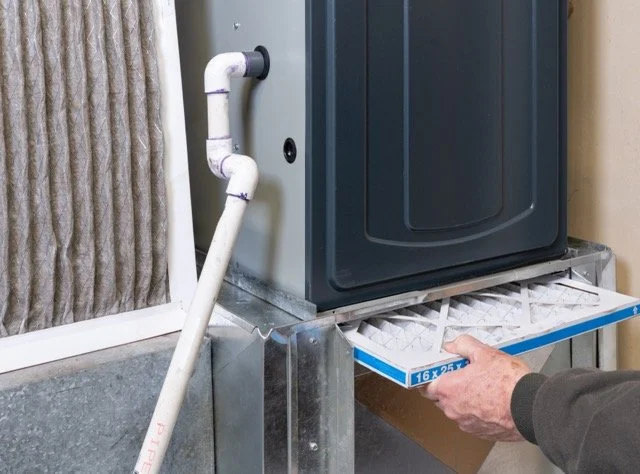
Pull the filter. Hold it up to a light. If you can't see through it, replace it. Standard 1-inch filters should be changed every 30 to 60 days during heating season. If you skipped this all summer, the filter is likely restricting airflow.
5. Gas Valve Closed
If someone worked on your water heater, sump pump, or gas line over the summer, they might have closed the gas valve to your furnace and forgotten to reopen it. The valve is usually located on the gas line leading into the furnace. The handle should be parallel to the pipe (open). If it's perpendicular, it's closed. Turn it parallel and try the system again.
Never force a stuck valve. If it won't turn easily, call a professional. Gas valves can crack, and a cracked valve is a safety hazard.
6. Dirty Flame Sensor
The flame sensor is a thin metal rod positioned in the burner flame. It detects the presence of fire and tells the gas valve to stay open. Over time, carbon and oxidation coat the sensor. The system tries to ignite, the burners light for a few seconds, then everything shuts off. This cycle repeats because the sensor can't confirm the flame.
A technician can clean the sensor with fine steel wool or emery cloth in about 10 minutes. This is one of the most common repairs we make during 24-hour furnace repair calls in September and October.
7. Failed Ignitor
Modern gas furnaces use a hot surface ignitor instead of a standing pilot light. The ignitor is a ceramic or silicon carbide element that glows orange and lights the gas. These ignitors are fragile. They weaken with age and can crack from thermal stress. If the ignitor fails, the burners never light. You'll hear the blower run, but no heat comes out.
Ignitors are not DIY-friendly. They're brittle, specific to your furnace model, and require proper electrical connections. Replacement takes a trained technician 20 to 30 minutes and costs between $150 and $300 in most cases.
What You Can Check Before Calling a Technician
You don't need HVAC training to troubleshoot the basics. Here's a safe, logical sequence to follow when your furnace won't turn on after summer.
Step 1: Check the thermostat. Verify it's set to HEAT. Set the temperature at least 5 degrees above the current room temperature. Replace the batteries if it's been more than a year. Wait five minutes.
Step 2: Inspect the circuit breaker. Go to your electrical panel. Look for a tripped breaker. Reset it if needed. If it trips again, stop and call a technician.
Step 3: Replace the air filter. Locate the filter (usually in the return air duct or inside the furnace cabinet). Pull it out. If it's visibly dirty or you can't see light through it, replace it with a new filter of the same size.
Step 4: Check the gas valve. For gas furnaces, locate the valve on the gas line near the unit. Make sure the handle is parallel to the pipe. If it's perpendicular, open it.
Step 5: Listen for ignition. After completing these checks, go back to the thermostat and raise the temperature. Listen at a floor register. You should hear the blower motor start within 30 to 90 seconds. If the blower runs but no heat comes out after five minutes, the ignition system likely failed.
If none of these steps restore heat, you've eliminated the simple causes. The problem is internal: a failed ignitor, a dirty flame sensor, a bad gas valve, or a failed control board.
Safety Note: If you smell gas at any point, leave the house immediately and call your gas utility company from outside. Do not flip light switches, use your phone inside, or try to locate the leak yourself. Natural gas leaks are rare, but they require immediate professional response.

When to Call a Professional
Some furnace problems require diagnostic tools, replacement parts, and technical knowledge you won't find in a YouTube video. Here's when to stop troubleshooting and call a licensed HVAC contractor.
The furnace tries to ignite but shuts off after a few seconds. This indicates a flame sensor issue, a failed pressure switch, or a venting problem. The system is protecting itself from unsafe operation. Don't keep cycling it on and off. Each failed ignition attempt wastes gas and stresses components.
The blower runs but no heat comes out. The ignition system failed. Either the ignitor cracked, the flame sensor is too dirty to detect fire, or the gas valve isn't opening. All three require parts and expertise.
You smell gas near the furnace. Shut off the gas at the meter if you know how. Leave the house. Call your gas company and a licensed HVAC contractor. Gas leaks are not diagnostic puzzles for homeowners.
The furnace is 15+ years old and has failed repeatedly. At this age, you're facing a decision point. Repair costs add up. Efficiency has declined. A new furnace costs between $3,500 and $7,000 in Southeast Michigan, depending on size, efficiency, and installation complexity. If your current furnace needs a $1,200 repair and it's already 17 years old, replacement often makes more financial sense.
The system short-cycles. Short-cycling means the furnace runs for a minute or two, shuts off, then starts again. This pattern indicates a limit switch problem, a bad thermostat, or an oversized furnace. It wastes energy and wears out the blower motor. A technician needs to diagnose the root cause.
NEXT Heating & Cooling runs 24-hour emergency HVAC service for situations like these. Our NATE-certified technicians carry common parts (ignitors, flame sensors, capacitors, thermostats) on their trucks. Most fall furnace failures can be fixed in one visit.
Cost Reality: Repair vs. Replacement
Michigan homeowners ask this question every fall: should I repair this furnace or replace it?
Here's the honest breakdown. Common fall repairs cost between $150 and $600 in most cases. A flame sensor cleaning runs $150 to $250. An ignitor replacement costs $200 to $350. A new thermostat ranges from $150 to $400, depending on whether you want a basic programmable model or a smart thermostat like an Ecobee or Honeywell Wi-Fi unit.
Control board failures, cracked heat exchangers, and blower motor replacements push costs higher. A control board runs $400 to $800. A blower motor replacement costs $450 to $900. A cracked heat exchanger means the furnace is done. Heat exchangers can't be repaired, and replacement costs more than a new furnace in most cases.
Use this decision framework: If the furnace is under 10 years old and the repair costs less than $500, fix it. If the furnace is 15+ years old and the repair exceeds $1,000, replace it. The middle ground (10 to 15 years old, $500 to $1,000 repair) requires judgment. Consider the furnace's maintenance history, your budget, and whether you plan to stay in the house.
Modern furnaces offer real efficiency gains. If you're replacing a 15-year-old 80% AFUE furnace with a 96% AFUE model, you'll cut your heating bills by roughly 20%. Over a Michigan winter, that's $200 to $400 in annual savings, depending on gas prices and your home's size. A 96% AFUE furnace pays for itself faster in Michigan than in milder climates because we run our furnaces hard from October through April.
Preventative Maintenance Saves Money: The Next Care Plan costs $60 per year and includes two annual home visits: a fall furnace tune-up and a spring AC tune-up. Our technicians clean flame sensors, test ignitors, check gas pressure, inspect heat exchangers, and replace filters. Members get priority scheduling, 10% off repairs, and no service call fees. Most fall furnace failures we see could have been prevented with a September tune-up.
Michigan-Specific Considerations
Southeast Michigan weather creates unique furnace demands. Our winters aren't just cold. They're long. A furnace in Warren or Rochester Hills might run 180 days per year, compared to 120 days in North Carolina or 90 days in Tennessee. That extended runtime accelerates wear.
Basements in older Michigan homes (1950s through 1980s ranches and colonials) often lack proper ventilation. Humidity fluctuates. Concrete walls sweat. These conditions corrode flame sensors and electrical connections faster than in newer homes with conditioned mechanical rooms.
Power outages from ice storms can reset thermostats and trip breakers. If your furnace won't turn on after a storm, check the thermostat settings and the circuit breaker before you assume a mechanical failure.
Homes in Shelby Township, Clinton Township, and Chesterfield often have crawl spaces instead of full basements. Furnaces in crawl spaces face more extreme temperature swings and higher humidity. These units need more frequent filter changes and annual maintenance to avoid premature failures.
Ready to Get Started?
NEXT Heating & Cooling has been keeping Michigan homes comfortable for over 35 years. Get honest diagnostics and fair pricing from NATE-certified technicians who show up on time.
Schedule Your ServiceFrequently Asked Questions
Give it five minutes. The blower motor should start within 30 to 90 seconds. Warm air should flow from the vents within three to five minutes. If you hear the blower running but no heat comes out after five minutes, the ignition system likely failed. If nothing happens at all after five minutes, check your thermostat batteries and circuit breaker.
A dusty or burning smell during the first few cycles is normal. Dust that accumulated on the heat exchanger over the summer burns off when the furnace heats up. This smell should disappear within 20 to 30 minutes. If it persists, or if you smell gas, shut the system off and call a technician. A persistent burning smell can indicate a wiring issue or a cracked heat exchanger.
Not safely in most cases. Ignition system repairs involve gas lines, electrical connections, and fragile components. A dirty flame sensor can sometimes be cleaned by a homeowner with mechanical aptitude, but you need to shut off the gas and power, remove the sensor without breaking it, clean it with fine steel wool, and reinstall it correctly. Most homeowners are better off calling a licensed technician. The cost difference between a DIY attempt and a professional repair is small, and the risk of damaging a $200 part or creating a gas leak is high.
Most fall repairs cost between $150 and $600. A service call to diagnose the problem typically runs $89 to $150. If the issue is a dirty flame sensor, total cost is usually $150 to $250. An ignitor replacement costs $200 to $350. A new thermostat ranges from $150 to $400. Control boards, blower motors, and gas valves push costs higher, into the $400 to $900 range. Emergency service calls (nights, weekends, holidays) add $50 to $150 to the base cost.
A professional furnace tune-up includes inspection and cleaning of the burners, flame sensor, and ignitor. The technician tests gas pressure, checks the heat exchanger for cracks, inspects the blower motor and capacitor, tests the thermostat calibration, measures airflow, and replaces the air filter. They also check the venting system for blockages and test the carbon monoxide detectors. A thorough tune-up takes 60 to 90 minutes and catches most problems before they cause a breakdown. The Next Care Plan includes a fall furnace tune-up every year for $60 annually.
Not necessarily. A well-maintained 15-year-old furnace can run another five years if it hasn't had major repairs. However, if you're facing a repair bill over $1,000, replacement makes more sense. Modern 96% AFUE furnaces cut heating bills by 20% compared to older 80% AFUE models. Over a Michigan winter, that's $200 to $400 in annual savings. Factor in the cost of future repairs, declining efficiency, and the risk of a breakdown during a polar vortex. If your furnace is 15+ years old and needs significant work, start planning for replacement within the next two to three years.
Dead batteries are one cause, but not the only one. If fresh batteries don't solve the problem, check the circuit breaker next. Then verify the furnace power switch (usually located on or near the furnace, looks like a light switch) is in the ON position. If all those check out, the problem is inside the furnace: a failed ignitor, a tripped limit switch, a bad control board, or a safety lockout from repeated ignition failures. At this point, you need a technician with diagnostic tools to identify the failed component.