

How Much Does AC Installation Cost in Metro Detroit? Real 2026 Pricing

You're sitting at your kitchen table in Sterling Heights, scrolling through three different HVAC quotes. One contractor says $4,200. Another says $7,800. The third wants $11,500 for what looks like the same job. And none of them will explain why the numbers are so different.
I've been installing air conditioning systems across Southeast Michigan for over two decades, and I can tell you this: AC installation pricing isn't mysterious. It's just that most contractors don't want to explain how it works because transparency doesn't serve their sales process.
Here's what actually drives the cost of a new central air conditioner in Metro Detroit—and what you should expect to pay in 2026 based on your home size, existing ductwork, and the equipment you choose. No sales pitch. Just the honest numbers from a licensed HVAC contractor in Metro Detroit who's tired of watching homeowners get confused by inflated estimates.
What Actually Drives AC Installation Costs in Michigan
Most homeowners think the air conditioner itself is the biggest cost. It's not. The equipment typically represents 40-50% of your total installation cost. The rest? Labor, materials, permits, and the complexity of connecting that outdoor condenser to your home's existing ductwork and electrical system.
Here's what we're actually pricing when we give you a quote for AC installation services:
Equipment Costs
The outdoor condenser unit and indoor evaporator coil are matched components—you can't just buy the cheapest outdoor unit and expect it to work efficiently with whatever's in your furnace cabinet. Manufacturers design these as systems, and mixing brands or mismatching SEER2 ratings creates performance problems we'll be troubleshooting for years.
In 2026, a basic 14 SEER2 system (the new minimum efficiency standard) costs contractors $1,800-$2,400 wholesale for a 2.5-ton unit. A high-efficiency 18 SEER2 variable-speed system runs $3,200-$4,800 wholesale for the same tonnage. That's before we add our markup, which covers warranty support, callbacks, and the reality that we stock parts for every brand we install.
Labor and Installation Complexity
A straightforward replacement—same tonnage, existing line set works, no electrical upgrades needed—takes a two-person crew about 6-8 hours. We're pulling the old equipment, installing the new condenser on a level pad, mounting the evaporator coil in your furnace cabinet, pressure-testing refrigerant lines, pulling a vacuum to remove moisture, charging the system, and commissioning everything to manufacturer specs.
But here's where it gets complicated. If your home has undersized ductwork (common in 1960s-1980s ranches across Macomb County), we can't just bolt on a new AC and call it done. Restricted airflow will freeze the evaporator coil, flood the compressor with liquid refrigerant, and kill your new system in 3-5 years instead of the 15-20 you're expecting.
Refrigerant Line Set Replacement
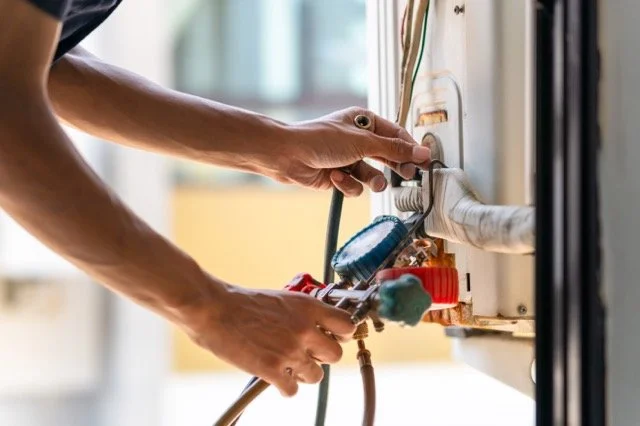
Most AC systems installed before 2010 used R-22 refrigerant. Your new system uses R-410A or the newer R-32. The old line sets can technically be reused if they're in good shape, but we're flushing them with nitrogen, pressure-testing to 450 PSI, and hoping there's no internal contamination that'll poison your new compressor.
A new line set costs $400-$800 in materials and adds 2-3 hours of labor, but it eliminates the single biggest cause of premature compressor failure we see in Metro Detroit: contaminated refrigerant lines from the old system. Most contractors reuse the old lines to keep their bid competitive. We tell you the risk upfront and let you decide.
Electrical Upgrades
Older homes in Royal Oak and Grosse Pointe Farms often have 60-amp or 100-amp electrical service. A modern 3-ton AC condenser pulls 30-40 amps on startup. If your electrical panel is already maxed out (furnace, water heater, kitchen circuits, dryer), we need to upgrade the panel or install a subpanel before we can safely connect the new AC.
Electrical work isn't included in standard AC installation quotes. It's a separate trade, separate permit, and adds $800-$2,500 depending on what your home needs. But it's not optional—Michigan electrical code doesn't let us wire a 40-amp load into an overloaded panel just because the homeowner doesn't want to pay for the upgrade.
Permits and Inspections
Every AC installation in Michigan requires a mechanical permit. We pull it, we pay for it ($75-$150 depending on the municipality), and we schedule the inspection. Some homeowners ask why they're paying for a permit when "the old AC didn't need one."
The old AC was installed 15-20 years ago when codes were different. Modern permits ensure your system is installed to current safety standards, properly sized for your home, and won't burn your house down because someone bypassed a safety switch to save 20 minutes. We're Michigan-licensed HVAC contractors—we don't skip permits.
Real 2026 AC Installation Pricing for Metro Detroit Homes
Here's what we're actually charging for complete AC installations in Southeast Michigan this year. These are all-in numbers: equipment, labor, materials, permits, startup, and one year of warranty labor. No hidden fees, no "oh, by the way" charges when we show up.
| System Type | Tonnage | SEER2 Rating | Typical Home Size | Price Range |
|---|---|---|---|---|
| Basic Single-Stage | 2.5 Ton | 14-15 SEER2 | 1,200-1,500 sq ft | $4,200-$5,800 |
| Basic Single-Stage | 3 Ton | 14-15 SEER2 | 1,500-1,800 sq ft | $4,600-$6,200 |
| Mid-Tier Two-Stage | 3 Ton | 16-17 SEER2 | 1,500-1,800 sq ft | $5,800-$7,400 |
| Mid-Tier Two-Stage | 3.5 Ton | 16-17 SEER2 | 1,800-2,200 sq ft | $6,200-$7,900 |
| High-Efficiency Variable | 3 Ton | 18-20 SEER2 | 1,500-1,800 sq ft | $7,400-$9,800 |
| High-Efficiency Variable | 4 Ton | 18-20 SEER2 | 2,200-2,800 sq ft | $8,200-$11,200 |
These ranges assume straightforward installations: existing ductwork in good condition, no major electrical upgrades, accessible attic or basement for the evaporator coil, and a level outdoor location for the condenser within 25 feet of the indoor unit.
Why the price range? The low end is a basic replacement using value-tier brands (Goodman, Amana, York). The high end includes premium brands (Carrier, Lennox, Trane) with extended warranties and better build quality. Both will cool your home—the difference is in longevity, noise levels, and how well they handle Michigan's humidity swings.
System Size Matters: Matching Tonnage to Your Home
The biggest mistake we see in Metro Detroit: contractors sizing AC systems by square footage alone. "You've got 1,800 square feet, so you need a 3-ton unit." That's not how this works.
Proper sizing requires a Manual J load calculation—a detailed analysis of your home's insulation, window area, orientation, ductwork, and internal heat loads. A 1,800-square-foot ranch in Clinton Township with original 1970s windows and minimal attic insulation needs more cooling capacity than a 1,800-square-foot colonial in Shelby Township with new windows and R-49 attic insulation.
What Happens When Your AC Is Oversized
An oversized system cools your home too quickly. Sounds good, right? It's not. Air conditioning does two things: removes heat and removes humidity. When your AC short-cycles (runs for 5-8 minutes, shuts off, repeats constantly), it never runs long enough to dehumidify. Your home feels cold and clammy—68°F with 65% humidity is miserable.
We see this constantly in homes where the previous contractor just looked at the old nameplate and installed "the same size." But the old system might have been oversized to begin with, or the homeowner added insulation and new windows since 2005, reducing the actual cooling load by 20-30%.
What Happens When Your AC Is Undersized
An undersized system runs constantly on 90°F July days and never quite catches up. Your thermostat says 78°F, but it's been running for six hours straight trying to get to 72°F. The compressor is working harder, using more electricity, and wearing out faster because it never gets the rest cycles it needs.
Undersized systems also struggle with Michigan's humidity. That constant runtime should theoretically dehumidify well, but if the evaporator coil is too small for the airflow, you're moving air too fast across the coil to condense moisture effectively. Cold and humid again—just for different reasons.
How We Actually Size Systems
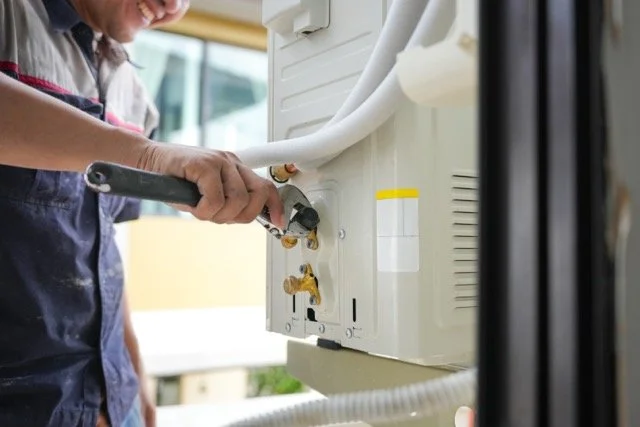
We measure your home. We count windows and note their orientation (south-facing glass adds significant heat load). We check attic insulation depth. We measure duct sizes and calculate static pressure. We ask about your comfort preferences—do you keep it at 68°F all summer, or are you fine with 74°F?
Then we run the Manual J calculation and give you the tonnage your home actually needs. Sometimes it's smaller than what you have now. Sometimes it's larger. But it's always based on your home's specific characteristics, not a square-footage chart from 1985.
Brand Comparison: What You Get at Different Price Points
Every HVAC manufacturer makes equipment at multiple price points. Here's what you're actually getting when you choose between a $4,500 system and a $9,000 system—and why we stock all of them.
Value Tier: Goodman, Amana, York ($4,200-$6,500)
These are the workhorse brands. Single-stage compressors, basic controls, 14-16 SEER2 efficiency. They'll cool your home reliably for 12-15 years if maintained properly through our $5/month HVAC maintenance plan. Parts are inexpensive and widely available. Warranties are 5-10 years on the compressor, 1-5 years on other parts.
We install a lot of Goodman systems in rental properties and for homeowners who need reliable cooling without premium features. They're louder than high-end units (65-75 decibels vs. 55-60 decibels), and they don't modulate capacity—they're either on at 100% or off. But they work, and they're honest equipment at an honest price.
Mid-Tier: Bryant, Rheem, Ruud ($5,800-$8,500)
Two-stage compressors, better build quality, 16-17 SEER2 efficiency. The second stage runs at 60-70% capacity most of the time, ramping to full capacity only on the hottest days. This gives you better humidity control, quieter operation, and more consistent temperatures throughout your home.
These brands offer 10-year parts warranties and optional extended labor coverage. The sheet metal is heavier gauge, the coil fins are closer together (better heat transfer), and the control boards are more sophisticated. We recommend these for homeowners planning to stay in their house for 10+ years who want better comfort without paying luxury prices.
Premium Tier: Carrier, Lennox, Trane ($7,400-$11,500)
Variable-speed compressors, fully modulating airflow, 18-20+ SEER2 efficiency. These systems can run anywhere from 25% to 100% capacity, adjusting in 1% increments to match your exact cooling load. On mild days, they run at 30-40% capacity for hours, removing humidity without overcooling.
The noise difference is dramatic—premium systems run at 55-58 decibels (quieter than normal conversation). The efficiency gains are real: a 20 SEER2 variable-speed system uses 30-40% less electricity than a 14 SEER2 single-stage system in real-world conditions.
Premium brands also offer the best warranties: 10-12 years on all parts, lifetime compressor warranties (registered within 60 days), and optional 10-year labor coverage. If you're in a $400K+ home in Bloomfield Hills or Rochester Hills and you keep your HVAC systems for 15-20 years, this tier makes financial sense.
Our honest take: Most Metro Detroit homeowners get the best value from mid-tier equipment. You're paying 20-30% more than value-tier for significantly better comfort and efficiency, without the 50-80% premium for features most people won't fully utilize. But every home is different—we'll show you all three options and let you decide what fits your budget and comfort priorities.
Hidden Costs Most Contractors Don't Mention Upfront
Here's where the $4,500 quote turns into a $7,200 final bill. Some contractors intentionally lowball the estimate to get in your door, then "discover" problems once they've already torn out your old system. We don't work that way—but you need to know what to ask about before you sign a contract.
Ductwork Modifications
If your existing ductwork is undersized, leaking, or poorly designed, we'll tell you during the estimate. Fixing it isn't optional—running a high-efficiency AC on bad ductwork is like putting premium gas in a car with a clogged fuel filter. You won't get the performance you paid for.
Common ductwork issues we find in Southeast Michigan homes:
- Undersized return ducts: Your system needs 400 CFM per ton of cooling. A 3-ton system needs 1,200 CFM of airflow, which requires approximately 600 square inches of return duct area. Most 1960s-1980s homes have 200-300 square inches. Adding return ducts costs $800-$2,200 depending on how much drywall we're cutting.
- Disconnected or crushed flex duct in the attic: We find this in almost every home over 30 years old. The insulation has compressed, the inner liner has separated, or someone stepped on it while running cable TV lines. Repairing 3-5 duct runs costs $600-$1,400.
- No return air in the basement: If your furnace is in the basement and you have no return duct down there, the system is pulling conditioned air from the first floor, cooling it, and blowing it back upstairs. Meanwhile, your basement stays 65°F year-round while your first floor struggles to reach 72°F. Adding a basement return costs $400-$900.
Most contractors don't mention ductwork problems in their initial quote because they know it'll make their price higher than the competition. We include it upfront because we're not interested in callbacks from homeowners whose "new AC doesn't work right."
Condensate Drain Modifications
Your AC produces 5-20 gallons of water per day during Michigan summers. That water drains from the evaporator coil through a PVC pipe to a floor drain, sump pump, or outside. If the drain is clogged, improperly pitched, or draining into a location that violates current building codes, we need to fix it.
A new condensate drain line costs $200-$600 depending on how far we're running it. It's not exciting, but it's the difference between a working AC and a flooded furnace cabinet that trips the overflow switch every three days.
Thermostat Upgrades
Your old mechanical thermostat won't work with a new variable-speed or two-stage AC. These systems need communicating thermostats that can tell the outdoor unit to run at 40% capacity, not just "on" or "off."
A basic programmable thermostat costs $120-$180 installed. A Wi-Fi thermostat (Honeywell, Ecobee) costs $280-$380 installed. A communicating thermostat matched to your specific equipment (required for Carrier Infinity or Lennox iComfort systems) costs $380-$580 installed.
Some contractors include the thermostat in their base price. Some don't. Ask before you compare quotes—a $500 price difference might just be one contractor including the thermostat and the other one planning to charge you for it later.
Refrigerant Line Set Replacement
We talked about this earlier, but it's worth repeating: reusing old refrigerant lines saves $600-$1,200 on the installation but creates a 30-40% higher risk of compressor failure in the first five years. We've replaced enough $2,200 compressors to know this isn't theoretical—it's the most common warranty claim we process.
If your contractor's quote says "reuse existing line set," ask what happens if the compressor fails due to contamination. Most manufacturers will deny the warranty claim if they find evidence of old refrigerant or oil in the system. You'll be paying for a new compressor out of pocket.
When to Replace vs. Repair Your Existing AC
Not every AC problem requires a full replacement. But homeowners waste thousands of dollars every summer repairing systems that should have been replaced three years ago. Here's how we actually make that decision—and how you can too.
The $5,000 Rule
Multiply the cost of the repair by the age of your AC in years. If the result is greater than $5,000, replace the system. If it's less than $5,000, repair it.
Example: Your 8-year-old AC needs a $900 compressor repair. 8 × $900 = $7,200. Replace it. Your 4-year-old AC needs the same $900 repair. 4 × $900 = $3,600. Repair it.
This formula accounts for the reality that older systems will need more repairs in the near future, and you're just delaying the inevitable replacement while throwing money at a depreciating asset.
Major Component Failures
If your compressor, condenser coil, or evaporator coil fails and your system is more than 10 years old, replace the whole system. These components represent 60-75% of the cost of a new AC, and you're not getting 60-75% of the remaining lifespan by replacing them.
We see homeowners spend $2,400 on a compressor replacement for a 12-year-old system, then call us back 18 months later when the condenser fan motor fails, the capacitor goes bad, and the evaporator coil starts leaking. They've now spent $3,800 on repairs and still need a new system. That $3,800 should have been the down payment on new equipment.
Refrigerant Leaks
If you have an R-22 system (installed before 2010) and it's leaking refrigerant, replace it. R-22 is no longer manufactured in the US, and recycled R-22 costs $80-$150 per pound. A typical recharge is 6-10 pounds. You're spending $600-$1,200 to refill a leaking system that'll be empty again in 6-18 months.
Even if you find and repair the leak, you're still running an R-22 system that's 15+ years old. The compressor, condenser coil, and evaporator coil are all original parts that have been running for 15 Michigan summers. Something else will fail soon.
When Repair Makes Sense
Systems less than 7 years old with minor failures (capacitor, contactor, fan motor, control board) are almost always worth repairing. These components cost $150-$600 to replace and don't indicate systemic problems.
If your AC is under warranty (most compressors have 10-year warranties, some parts have 5-year warranties), repair it. You're only paying labor, and the manufacturer is covering the parts. Even a $1,200 labor charge beats a $6,500 replacement.
And if you're planning to sell your house within the next 2-3 years, repair it. A working AC satisfies the home inspection. A new AC doesn't increase your sale price enough to justify the $6,000-$10,000 investment. You can read more about when to replace your air conditioner in our detailed guide.
How to Get Accurate Pricing Without the Sales Pressure
Most Metro Detroit homeowners get three quotes and pick the middle one, assuming the high quote is price gouging and the low quote is too good to be true. That's not a terrible strategy, but it doesn't tell you whether you're getting the right system for your home.
Here's how to actually evaluate HVAC quotes:
Demand a Manual J Load Calculation
If the contractor doesn't measure your home, count your windows, or ask about your insulation, they're guessing at the tonnage. A proper load calculation takes 45-90 minutes and produces a detailed report showing exactly how they arrived at the recommended system size.
Some contractors will say "we've been doing this for 30 years, we can eyeball it." That's not confidence—that's laziness. Eyeballing tonnage is how you end up with an oversized system that short-cycles and never dehumidifies properly.
Ask What's Included in the Price
Get a written quote that specifies:
- Exact equipment model numbers (outdoor condenser, indoor coil, thermostat)
- SEER2 rating and tonnage
- Whether they're reusing or replacing the refrigerant line set
- Whether ductwork modifications are included or extra
- Whether electrical upgrades are included or extra
- Permit costs (should be included)
- Warranty terms (parts and labor)
- Estimated installation timeline
If the quote just says "3-ton AC system - $6,200," you have no idea what you're getting. That's not a quote—it's a placeholder number designed to get you to sign a contract before you can compare it to anything else.
Verify Licenses and Insurance
Every HVAC contractor in Michigan must have a mechanical contractor license issued by the Department of Licensing and Regulatory Affairs. Ask for the license number and verify it online. Unlicensed contractors can't pull permits, can't get warranty support from manufacturers, and can't legally install HVAC equipment in Michigan.
Also verify general liability insurance and workers' compensation coverage. If an unlicensed, uninsured contractor falls off your roof or damages your home during installation, you're paying for it. Our credentials, including our Michigan Mechanical Contractor License and NATE certifications, are detailed on our about page.
Read the Fine Print on Warranties
Manufacturer warranties cover parts only—not labor. If your compressor fails in year 8 and you have a 10-year parts warranty, the manufacturer ships you a free compressor. You still pay $800-$1,200 for a technician to install it.
Some contractors offer extended labor warranties (we do—it's included in our mid-tier and premium installations). Some charge extra for it. Some don't offer it at all. Ask what happens if something breaks in year 5—who pays for the service call, diagnosis, and installation labor?
Watch for High-Pressure Sales Tactics
If a contractor offers you a "discount if you sign today," walk away. HVAC pricing doesn't change day-to-day. That "limited-time offer" will be available next week, next month, and next year. It's a manufactured urgency designed to prevent you from getting competitive quotes.
Same with "we just happen to have a cancellation tomorrow and can fit you in if you decide right now." We schedule installations 1-3 weeks out during peak season (May-August). Anyone who can start tomorrow either has no work or is lying to pressure you into a decision.
Ready to Get Honest AC Pricing for Your Metro Detroit Home?
NEXT Heating & Cooling has been installing air conditioning systems across Southeast Michigan for over 35 years. We'll perform a proper load calculation, explain your options, and give you a detailed written quote with no pressure to decide on the spot. Our NATE-certified technicians show up on time, respect your home, and install systems that actually work the way they're supposed to.
Schedule Your Free EstimateFrequently Asked Questions About AC Installation Costs
A complete 3-ton AC replacement in Southeast Michigan costs $4,600-$9,800 depending on efficiency level and brand. Basic single-stage systems (14-15 SEER2) from Goodman or Amana run $4,600-$6,200. Mid-tier two-stage systems (16-17 SEER2) from Bryant or Rheem cost $5,800-$7,400. Premium variable-speed systems (18-20 SEER2) from Carrier, Lennox, or Trane run $7,400-$9,800. These prices include the outdoor condenser, indoor evaporator coil, labor, materials, permits, and startup—but not ductwork modifications or electrical upgrades if needed.
It depends on how long you're staying in your home and your comfort priorities. A 20 SEER2 variable-speed system costs $2,500-$4,000 more than a 14 SEER2 single-stage system but uses 30-40% less electricity and provides significantly better humidity control. If you're in a $400K+ home in Bloomfield Hills or Rochester Hills and plan to stay 10+ years, the comfort and efficiency gains justify the premium. If you're in a starter home and planning to move in 3-5 years, mid-tier equipment offers the best value. We'll show you the math based on your actual electricity rates and usage patterns—no guessing.
Technically yes, but it's a terrible idea. Manufacturers design outdoor condensers and indoor evaporator coils as matched systems. Mismatching them creates efficiency losses (your 16 SEER2 condenser performs at 13 SEER2 with the wrong coil), warranty issues (most manufacturers void coverage if you mix brands or generations), and reliability problems (the refrigerant charge and metering device won't be optimized). We've seen mismatched systems fail within 2-3 years because the compressor was working against incorrectly sized coils. Save the $800-$1,200 on the coil now, spend $2,400 on a compressor replacement in three years. Not worth it.
A straightforward AC replacement takes 6-8 hours with a two-person crew. We're removing the old outdoor condenser and indoor coil, installing the new equipment, connecting refrigerant lines, wiring the electrical disconnect and thermostat, pressure-testing the system, pulling a vacuum to remove moisture, charging refrigerant to manufacturer specs, and commissioning everything. If we're replacing the refrigerant line set or making ductwork modifications, add another 2-4 hours. Complex installations (electrical panel upgrades, extensive ductwork repairs, difficult access) can take 1.5-2 days. We'll give you an accurate timeline during the estimate—not a vague "should be done by end of day" promise.
There's no universal answer—it depends on your home's insulation, window area, orientation, ductwork, and internal heat loads. A 1,800-square-foot ranch in Clinton Township with original 1970s windows and minimal attic insulation might need a 4-ton system. A 1,800-square-foot colonial in Shelby Township with new windows and R-49 attic insulation might only need a 2.5-ton system. We perform a Manual J load calculation that measures all these variables and gives you the exact tonnage your home needs. Guessing based on square footage is how you end up with an oversized system that short-cycles and never dehumidifies properly—or an undersized system that runs constantly and never quite catches up on 90°F days.
It depends on your current electrical service and what else is running in your home. A 3-ton AC condenser pulls 30-40 amps on startup. If you have a 100-amp or 60-amp electrical panel that's already running your furnace, water heater, kitchen circuits, and dryer, we might need to upgrade the panel or install a subpanel before connecting the new AC. This is especially common in older homes in Royal Oak, Grosse Pointe Farms, and Detroit built before 1980. We'll evaluate your electrical service during the estimate and tell you if an upgrade is needed. It's not optional—Michigan electrical code doesn't let us wire a 40-amp load into an overloaded panel just because it's cheaper.
If your furnace is more than 15 years old or showing signs of failure (frequent repairs, inconsistent heating, cracked heat exchanger), yes—replace both. You're already paying for labor, permits, and ductwork modifications. Adding a furnace to the job costs significantly less than doing two separate installations. You also get matched indoor and outdoor equipment designed to work together, better efficiency, and synchronized warranties. If your furnace is less than 10 years old and working fine, there's no reason to replace it just because you're doing the AC. But if it's borderline, do both now and avoid a second installation visit (and second permit, second labor charge, second disruption) in 2-3 years. Check out our guide on furnace replacement costs in Michigan for detailed pricing.