

Why Metro Detroit Homeowners Are Upgrading to High-Efficiency AC

Walk through any neighborhood in Sterling Heights or Rochester Hills right now, and you'll see something we've noticed over the past two summers: homeowners are replacing perfectly functional air conditioners with high-efficiency models. Not because the old units died—but because the math finally makes sense.
Between rising energy costs, significant utility rebates from DTE and Consumers Energy, and federal tax credits that run through 2032, the upfront investment in a 16+ SEER AC system now pays for itself faster than it did even three years ago. Add Michigan's increasingly humid summers—where older single-stage compressors struggle to control moisture—and you've got a perfect storm driving upgrades across Southeast Michigan.
We've installed over 200 high-efficiency systems in Macomb and Oakland counties since January 2025 alone. Here's what homeowners are discovering, what the real costs look like, and when upgrading actually makes financial sense for your home.
Why the Shift to High-Efficiency AC?
The decision to upgrade isn't just about keeping up with the neighbors. Three economic and environmental factors converged in 2024-2025 that changed the calculation for Michigan homeowners:
Energy costs climbed steadily. DTE Energy's residential rates increased roughly 18% between 2022 and 2025. Consumers Energy customers saw similar trends. A 14 SEER air conditioner that cost $140/month to run in July 2022 now costs closer to $165/month under the same usage pattern. Over a four-month cooling season, that's an extra $100 just from rate increases—before you factor in equipment inefficiency.
Rebates and tax credits improved dramatically. The Inflation Reduction Act extended the federal Energy Efficient Home Improvement Credit (25C) through 2032, offering up to $2,000 for qualifying HVAC equipment. DTE and Consumers Energy both expanded their rebate programs for high-efficiency systems. Combined, these incentives can cover 20-30% of installation costs—something that didn't exist at this scale five years ago.
Old AC units are hitting the end of useful life. Most central air conditioners installed between 2005 and 2015 are now 10-20 years old. They still run, but efficiency degrades over time. A 13 SEER system from 2010 might only be operating at 11 SEER today due to refrigerant loss, compressor wear, and dirty coils. Homeowners are realizing they're paying premium electricity rates to run subpar equipment.
When we perform heating and cooling services in Metro Detroit, we're seeing more homeowners ask about efficiency upgrades during routine maintenance visits—not just when systems fail. That's a shift. It means people are thinking proactively about operating costs, not just reactively about breakdowns.
What Makes an AC Unit "High-Efficiency"?
The term "high-efficiency" gets thrown around a lot, but it has a specific technical meaning tied to SEER rating—Seasonal Energy Efficiency Ratio. SEER measures how much cooling output (in BTUs) an air conditioner produces per watt of electricity consumed over a typical cooling season.
Current minimum standards: As of January 1, 2023, the U.S. Department of Energy requires all new air conditioners sold in the northern United States (including Michigan) to have a minimum SEER rating of 14. Anything below that is no longer manufactured or sold legally.
What qualifies as "high-efficiency": In practice, most HVAC professionals consider systems rated 16 SEER or higher to be high-efficiency. Premium models from Carrier, Lennox, Trane, and Bryant range from 18 to 26 SEER. The difference isn't just a bigger number—it's fundamentally different technology.
14 SEER vs. 16+ SEER: What Actually Changes
A 14 SEER system typically uses a single-stage compressor. It runs at 100% capacity whenever it's on—full blast until the thermostat is satisfied, then it shuts off. This on/off cycling is loud, inefficient, and struggles with humidity control because the system doesn't run long enough to pull moisture from the air during mild days.
A 16+ SEER system uses either a two-stage compressor or a variable-speed inverter compressor. Two-stage units can run at 65-70% capacity during moderate heat, ramping up to 100% only when needed. Variable-speed systems (common in 18+ SEER models) modulate continuously from 25% to 100%, matching output precisely to cooling demand.
The efficiency gain comes from avoiding the energy spike of constant start/stop cycles. A variable-speed compressor running at 40% capacity for six hours uses significantly less electricity than a single-stage unit cycling on and off every 12 minutes to achieve the same temperature.
Inverter technology: High-efficiency systems use inverter-driven compressors—the same technology that revolutionized refrigerators and washing machines. Instead of a fixed-speed motor, an inverter adjusts electrical frequency to control compressor speed dynamically. This is why Carrier Infinity, Lennox Signature, and Trane XV series systems are so much quieter and more efficient than older models.
Michigan-Specific Consideration: SEER ratings are calculated using a national average climate. Michigan's cooling season is shorter and less intense than, say, Arizona's. A 16 SEER system here delivers real-world performance closer to 17-18 SEER because we don't run AC at peak capacity for months on end. That means you see efficiency benefits faster than homeowners in hotter climates.
Real Cost Savings for Michigan Homeowners
Let's get specific about what upgrading actually saves. We pulled data from installations we completed in Troy, Clinton Township, and Shelby Township in 2025 to show real-world numbers.
Scenario: 1,800 sq ft ranch home in Sterling Heights with a 3-ton (36,000 BTU) air conditioner. Current system is a 13 SEER unit from 2012. Homeowner upgrades to a 16 SEER Carrier Comfort series with a two-stage compressor.
Annual cooling costs (based on DTE residential rates, $0.18/kWh average):
- 13 SEER system: approximately $685/year
- 16 SEER system: approximately $557/year
- Annual savings: $128
Payback calculation: The upgrade cost (after DTE rebate and federal tax credit) was roughly $1,850 more than replacing with a standard 14 SEER unit. At $128/year savings, the payback period is 14.5 years. That's longer than most homeowners expect—but here's what changes the math:
- Energy rates aren't static. If DTE rates increase another 10% over the next five years (consistent with historical trends), annual savings jump to $155-170/year, cutting payback to 11-12 years.
- Comfort value isn't measured in dollars. Homeowners consistently report better humidity control, fewer hot spots, and quieter operation. That quality-of-life improvement doesn't show up on a spreadsheet, but it's real.
- Resale value. Homes in Oakland and Macomb counties with newer, high-efficiency HVAC systems sell faster and for higher prices. Real estate agents in Rochester Hills and Grosse Pointe specifically mention HVAC upgrades in listings.
If you're enrolled in our $5/month HVAC maintenance plan, you're already thinking long-term about system performance. High-efficiency equipment maintained properly can run 18-22 years—well beyond the payback period.

Better Comfort in Michigan's Humid Summers
Energy savings get the headlines, but comfort is what makes homeowners actually happy with the upgrade. Michigan summers aren't Arizona-level hot, but the humidity is brutal—especially in July and August when dew points hit 70°F and the air feels like soup.
Single-stage systems and humidity: A 14 SEER single-stage AC cools your house to the thermostat setpoint, but it doesn't run long enough on mild days to remove moisture effectively. You end up with a 72°F house that feels clammy. Homeowners compensate by lowering the thermostat to 68°F just to trigger longer run times—which wastes energy and still doesn't solve the problem.
Variable-speed systems and dehumidification: A 16+ SEER system with a variable-speed compressor runs longer at lower capacity. On a 78°F day, it might operate at 35% for three hours instead of cycling on at 100% for 20 minutes. That extended run time pulls significantly more moisture from the air, even though it's using less total energy.
We've had customers in Lake Orion and Chesterfield report indoor humidity dropping from 60-65% (uncomfortable) to 45-50% (comfortable) after upgrading, without changing thermostat settings. That's not marketing—it's physics. Evaporator coils need time to condense water vapor. Variable-speed systems give them that time.
Temperature Consistency Throughout the House
Hot and cold spots are a common complaint in Michigan homes, especially two-story colonials and split-levels built in the 1970s-1990s. The upstairs bedrooms are 6-8°F warmer than the main floor, even with the AC running constantly.
High-efficiency systems don't magically fix poor ductwork or inadequate insulation, but they help. Variable-speed air handlers move air more consistently, reducing the temperature stratification that causes hot spots. Paired with proper duct balancing—something we evaluate during every installation—you get much more even cooling across all rooms.
If you're experiencing severe hot/cold spot issues, read our guide on why your AC is running but not cooling the house—ductwork problems are often the culprit, not the AC unit itself.
Rebates and Incentives Available Now
This is where the financial case gets significantly better. Between utility rebates and federal tax credits, you can recover a substantial portion of the upfront cost difference between a standard and high-efficiency system.
DTE Energy Rebates (2026)
DTE offers rebates for residential customers who install qualifying high-efficiency air conditioners:
- 16-17.9 SEER: $300 rebate
- 18+ SEER: $500 rebate
- Smart thermostat (when installed with qualifying AC): additional $50
Requirements: System must be installed by a licensed contractor (like NEXT Heating & Cooling), and you must submit the rebate application within 90 days of installation. Processing typically takes 6-8 weeks.
Consumers Energy Programs (2026)
Consumers Energy customers have access to similar incentives:
- 16+ SEER central AC: $400 rebate
- 18+ SEER with variable-speed air handler: $600 rebate
- Ductless mini-split heat pump (19+ SEER): $500 rebate
Consumers also offers a 0% financing program for qualified energy efficiency upgrades, which can spread the cost over 36-60 months with no interest.
Federal Tax Credit (Energy Efficient Home Improvement Credit - 25C)
The Inflation Reduction Act extended and expanded this credit through December 31, 2032. For air conditioners:
- 16+ SEER and 13+ EER (Energy Efficiency Ratio): 30% of cost, up to $600
- Heat pumps (16+ SEER, 12+ EER, 8+ HSPF): 30% of cost, up to $2,000
This is a tax credit, not a deduction—it reduces your tax liability dollar-for-dollar. If you owe $3,000 in federal taxes and claim a $600 AC credit, you now owe $2,400. You claim it when filing your annual return using IRS Form 5695.
Combined example: Install an 18 SEER Lennox XC18 system for $6,200. Receive $500 DTE rebate + $600 federal tax credit = $1,100 back. Effective cost: $5,100. Compare that to a 14 SEER replacement at $4,500, and you're only paying $600 more for significantly better performance and lower operating costs.
Pro Tip: We handle the rebate paperwork for our customers as part of installation. You don't need to navigate DTE or Consumers Energy portals yourself—we submit everything and confirm approval. The federal tax credit you claim yourself at tax time, but we provide all necessary documentation.
When It Makes Sense to Upgrade
Not every homeowner should rush to replace a working air conditioner. Here's how to evaluate whether upgrading makes sense for your situation.
Your AC Is 12+ Years Old
Air conditioners have an average lifespan of 15-18 years in Michigan, but efficiency starts declining after year 10. If your system is 12+ years old and you're facing a repair over $800-1,000, replacement often makes more financial sense than sinking money into aging equipment.
We use a simple formula: If the repair cost is more than 50% of replacement cost and the system is over 10 years old, replace it. If it's under 8 years old and the repair is minor (capacitor, contactor, refrigerant top-off), repair it. The gray area is 8-12 years—that's where we walk you through the math based on your specific system and usage.
Summer Energy Bills Keep Climbing
If your July and August bills have increased 15-20% over the past three years (beyond rate increases), your AC is likely losing efficiency. Common causes include refrigerant leaks, compressor wear, or dirty evaporator coils that restrict airflow.
Before upgrading, we recommend a thorough system evaluation. Sometimes a deep coil cleaning, duct sealing, or refrigerant recharge can restore 80-90% of lost efficiency for a fraction of replacement cost. But if the compressor is failing or you're dealing with multiple issues, upgrading to a 16+ SEER system makes sense.
You're Tired of Uneven Cooling and Humidity Issues
This is the most common reason homeowners in Bloomfield Hills and Royal Oak upgrade before their AC dies. They're simply frustrated with comfort problems that a single-stage system can't solve.
If you've already addressed ductwork, insulation, and air sealing—and you're still dealing with hot upstairs bedrooms or clammy indoor air—a variable-speed high-efficiency system is the solution. It's not a band-aid; it's fundamentally better technology for Michigan's climate.
You're Planning to Stay in Your Home 7+ Years
The payback period for high-efficiency AC in Michigan is typically 10-15 years, depending on usage and energy rates. If you're planning to sell in 2-3 years, the math doesn't work unless you're upgrading for comfort reasons or because the existing system is failing.
If you're staying long-term, the investment pays for itself and then continues saving money for another 5-10 years beyond payback. That's real value.
For detailed cost breakdowns, check our guide on what furnace replacement costs in Michigan—the same principles apply to AC installations.
What to Expect During Installation
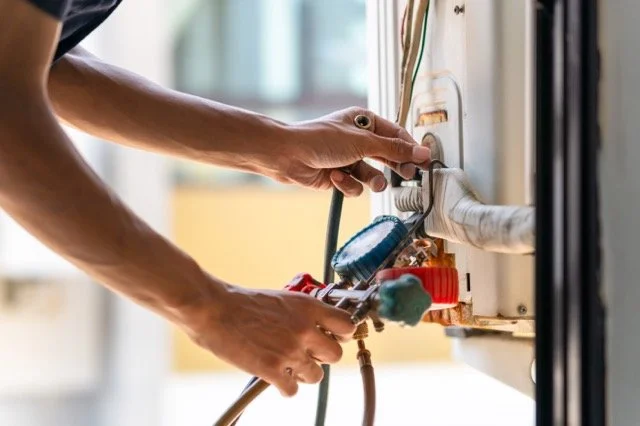
Installing a high-efficiency AC isn't just swapping condensers. Done correctly, it involves load calculations, ductwork evaluation, refrigerant line sizing, and careful commissioning. Here's what happens when you work with a reliable HVAC contractor in Metro Detroit who does it right.
Manual J Load Calculation
Before we recommend a system size, we perform a Manual J load calculation—an ACCA (Air Conditioning Contractors of America) protocol that determines your home's actual cooling needs based on square footage, insulation levels, window area, orientation, and occupancy.
Most homes don't need the oversized equipment that was common 20 years ago. A properly sized 2.5-ton high-efficiency system often outperforms an oversized 4-ton single-stage unit because it runs longer cycles, removes more humidity, and operates more efficiently.
Oversized AC is one of the biggest mistakes in HVAC. It short-cycles, fails to dehumidify, and wears out faster. We size systems based on science, not guesswork. If you're curious why sizing matters so much, read our article on how to size a furnace correctly—the same principles apply to cooling.
Ductwork Evaluation and Sealing
Even the most efficient AC won't perform well if your ductwork is leaking 20-30% of conditioned air into the attic or crawlspace. We inspect accessible ductwork for leaks, disconnected joints, and inadequate insulation.
In older Michigan homes—especially 1960s ranches with original ductwork—we often find flex duct that's crushed, torn, or improperly sized. If your ducts are in bad shape, we'll recommend sealing or replacement as part of the installation. Skipping this step is like putting premium gas in a car with a hole in the tank.
Refrigerant Line Sizing
High-efficiency systems often require specific refrigerant line sizes to operate at peak performance. If your existing line set is undersized or you're switching refrigerant types (R-410A to R-32, for example), we may need to install new lines.
This isn't upselling—it's engineering. A 16 SEER Carrier Infinity system with undersized refrigerant lines will underperform and potentially void the manufacturer warranty. We follow installation specs exactly.
Installation Timeline
A straightforward AC replacement (condenser and evaporator coil, existing ductwork in good shape) typically takes 6-8 hours. If we're also replacing the air handler, sealing ductwork, or running new refrigerant lines, plan for a full day or day-and-a-half.
We schedule installations Monday-Friday to avoid weekend rush charges. Emergency replacements during heat waves may require weekend work, but we're upfront about pricing—no surprises.
Commissioning and Testing
After installation, we don't just flip the switch and leave. We commission the system:
- Verify refrigerant charge using superheat/subcool measurements
- Test airflow at registers to ensure proper CFM (cubic feet per minute)
- Check temperature split across the evaporator coil (should be 15-20°F)
- Program and test the thermostat, including humidity settings
- Walk you through operation, maintenance requirements, and warranty registration
This takes an extra 30-45 minutes, but it's the difference between a system that works and a system that performs optimally for 15+ years.
Every installation includes enrollment in our Next Care Plan for the first year at no charge—two seasonal tune-ups to make sure your new system stays dialed in.
Ready to Upgrade to High-Efficiency Cooling?
NEXT Heating & Cooling has been keeping Michigan homes comfortable for over 35 years. Get honest diagnostics, fair pricing, and expert installation from NATE-certified technicians who show up on time. We'll walk you through rebates, tax credits, and financing options—no pressure, just the facts.
Schedule Your Free EstimateFrequently Asked Questions
For most Michigan homeowners, 16-18 SEER offers the best balance of upfront cost and long-term savings. Systems above 20 SEER cost significantly more and deliver diminishing returns in our climate because we don't run AC year-round. A 16 SEER two-stage system from Carrier, Trane, or Lennox will outperform your expectations and qualify for rebates. If you want maximum efficiency and have the budget, 18-20 SEER variable-speed systems provide exceptional comfort and humidity control.
A complete 16 SEER system installation (3-ton condenser, evaporator coil, and labor) typically ranges from $5,200 to $7,800 in Southeast Michigan, depending on brand and complexity. An 18+ SEER system runs $6,500 to $9,500. After DTE/Consumers Energy rebates ($300-600) and federal tax credits (up to $600), the net cost drops by $900-1,200. We provide detailed written estimates with all rebate information included—no hidden fees, no surprises.
Yes, but the ductwork needs to be evaluated first. High-efficiency systems require proper airflow to operate efficiently. If your ducts are leaking, undersized, or poorly insulated, we'll recommend sealing or modifications as part of the installation. In many cases, duct sealing costs $400-800 and makes a huge difference in system performance. We won't install a premium AC on substandard ductwork—it's a waste of your money and our reputation.
With proper maintenance, high-efficiency air conditioners last 18-22 years in Michigan. The key is annual preventive maintenance—spring tune-ups that include coil cleaning, refrigerant checks, and electrical inspections. Systems enrolled in our Next Care Plan consistently outlast neglected units by 4-6 years. Michigan's seasonal climate is actually easier on AC equipment than year-round cooling in southern states, so you get excellent longevity if you take care of it.
Yes, but the savings depend on your current system's efficiency and how much you use AC. Upgrading from a 13 SEER to a 16 SEER system typically saves $120-180/year on a 1,800 sq ft home running AC from June through September. If energy rates increase (which they have historically), savings grow over time. The bigger benefit is comfort—better humidity control, quieter operation, and more consistent temperatures. Those quality-of-life improvements are harder to quantify but make a real difference in how your home feels.
If your furnace is 12+ years old or showing signs of inefficiency, yes—upgrading both together saves on labor costs and ensures compatibility. High-efficiency AC systems often require variable-speed air handlers for optimal performance, and if you're replacing the air handler anyway, it makes sense to upgrade the furnace at the same time. We offer package pricing for complete system replacements that's more cost-effective than doing them separately. That said, if your furnace is newer and working well, there's no need to replace it just because you're upgrading AC.
We install Carrier, Lennox, Trane, Bryant, Rheem, and Goodman—all proven brands with strong warranties and local parts availability. For high-efficiency systems, Carrier Infinity, Lennox Signature, and Trane XV series are top-tier with variable-speed technology and SEER ratings up to 26. Bryant Evolution and Rheem Prestige offer excellent performance at mid-range pricing. We don't push one brand—we recommend based on your budget, home size, and performance priorities. All our installations are backed by manufacturer warranties and our own labor guarantee.