

Thermostat Not Reaching Set Temperature? 6 Common Causes
You set your thermostat to 72°F. An hour later, it's still stuck at 68°F. Or worse — it's January in Sterling Heights, and your furnace is running constantly but your house never gets past 65°F.
This is one of the most common service calls we get at NEXT Heating & Cooling. Homeowners across Macomb County, Oakland County, and St. Clair County call us frustrated because their HVAC system seems to be working — it's making noise, blowing air, cycling on and off — but the temperature never reaches what they set on the thermostat.
After 35 years of diagnosing heating and cooling problems in Southeast Michigan homes, we've learned that this issue usually comes down to six common causes. Some are simple fixes you can handle yourself. Others require professional diagnosis and repair. Let's walk through each one so you understand what's actually happening in your system.
1. Dirty Air Filter Restricting Airflow
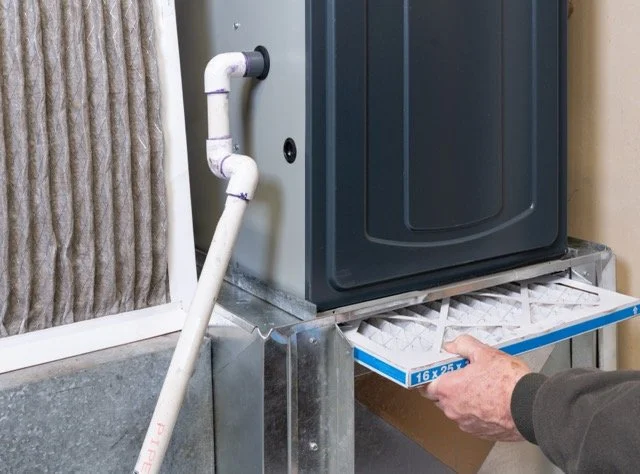
This is the first thing we check on every service call, and it's the problem about 40% of the time. A clogged air filter is the most common reason your HVAC system can't reach the set temperature — and it's the easiest to fix.
Here's what happens: Your furnace or air handler pulls air through the return vents, forces it through the filter, heats or cools it, then pushes it through your ductwork into your rooms. When the filter gets clogged with dust, pet hair, pollen, and Michigan's seasonal debris, airflow drops dramatically.
Reduced airflow means:
- Less heated or cooled air reaches your rooms — even though the equipment is running
- Your furnace or AC runs longer cycles trying to compensate, which wastes energy
- Heat exchangers or evaporator coils can overheat or freeze, triggering safety shutoffs
- Blower motors work harder, shortening their lifespan
In Michigan homes, filters get dirty faster than the national average. Between lake-effect humidity bringing in pollen, winter dust from forced-air heating, and homes sealed tight against the cold, we see filters that should last 90 days clog up in 30-45 days.
What to do: Check your filter right now. It's usually located in the return air duct or inside the furnace cabinet. If you can't see light through it when you hold it up to a window, replace it. Standard 1-inch pleated filters (MERV 8-11) cost $8-$15 and take 30 seconds to swap out.
If you're not sure when you last changed your filter, or if you've been running the same filter for more than 60 days, that's likely your problem. Replace it and give your system an hour to catch up. If the temperature still isn't reaching the set point, move to the next cause.
Homeowners who join our $5/month HVAC maintenance plan get filter reminders and discounted filter service during their seasonal tune-ups — which prevents this issue before it becomes a comfort problem.
2. Thermostat Location and Calibration Problems

Your thermostat is the brain of your HVAC system. If it's reading the wrong temperature or located in the wrong spot, your entire system will make bad decisions.
Poor Thermostat Placement
We see this constantly in older Michigan homes, especially 1960s and 1970s ranches where the thermostat was mounted wherever was convenient during construction — not where it would get an accurate temperature reading.
Problem locations include:
- Near exterior doors — cold drafts in winter make the thermostat think the house is colder than it is, triggering unnecessary heating cycles
- On exterior walls — the wall itself is colder in winter, skewing the reading
- In direct sunlight — afternoon sun through a window heats the thermostat, making it think the house is warmer than it is (your AC runs constantly while other rooms stay hot)
- Near heat sources — above a floor register, near a lamp, or next to a kitchen doorway
- In hallways with poor air circulation — the thermostat reads one temperature while the living room is 5°F different
The ideal thermostat location is on an interior wall, about 5 feet off the floor, in a room you use frequently (like a living room or main hallway), away from windows, doors, and heat sources. It should be in a spot that represents the average temperature of your home.
Calibration Drift
Older mechanical thermostats (the round dial type) can drift out of calibration over time. The internal components wear, and suddenly the thermostat that says 70°F is actually measuring 67°F. Your furnace thinks it's done its job, but you're sitting there in a sweater.
Digital thermostats are more accurate, but they can still develop issues:
- Dying batteries cause erratic behavior and inaccurate readings
- Dust buildup inside the unit can affect temperature sensors
- Loose wire connections create intermittent communication problems with your furnace or AC
If your thermostat is more than 10-15 years old, upgrading to a modern programmable or smart thermostat often solves temperature consistency problems. We install Carrier, Honeywell, Ecobee, and Nest thermostats regularly as part of our heating and cooling services in Metro Detroit, and homeowners immediately notice more accurate temperature control.
Quick test: Place an accurate thermometer next to your thermostat for 15 minutes. If there's more than a 2°F difference between what the thermostat displays and what the thermometer reads, you have a calibration problem.
3. Undersized or Aging HVAC Equipment
Sometimes your HVAC system can't reach the set temperature because it was never big enough to do the job in the first place — or it was the right size 20 years ago, but age and wear have reduced its capacity.
Undersized Equipment
HVAC systems are sized based on load calculations — a detailed analysis of your home's square footage, insulation levels, window area, ductwork design, and local climate. In Southeast Michigan, we use ACCA Manual J calculations that account for our extreme temperature swings: 95°F summer days and polar vortex events that hit -15°F.
We see undersized equipment in a few scenarios:
- Home additions without HVAC upgrades — you added a family room or finished the basement, but kept the same furnace and AC unit
- Contractor shortcuts — someone installed the smallest unit that would "probably work" to save money upfront
- Wrong load calculation — the installer eyeballed the square footage instead of doing proper Manual J calculations
An undersized furnace will run constantly on the coldest days but never quite get your house to 72°F. It might reach temperature on mild days (40°F outside), but when it drops to 10°F, you're stuck at 67-68°F no matter how long it runs.
The same applies to air conditioning. An undersized AC unit might keep up on a 75°F June day, but when we hit 90°F with high humidity in July, it runs 24/7 and your house stays at 76-77°F.
Aging Equipment Losing Capacity
Even if your system was sized correctly when new, furnaces and air conditioners lose efficiency over time. A 20-year-old furnace that was rated at 100,000 BTU output might only deliver 80,000 BTU now due to:
- Heat exchanger deterioration — cracks or corrosion reduce heat transfer
- Blower motor wear — older motors spin slower, moving less air
- Burner buildup — dirty burners don't burn as hot or efficiently
For air conditioners, capacity loss happens through:
- Refrigerant leaks — even small leaks reduce cooling capacity by 20-30%
- Compressor wear — older compressors don't compress refrigerant as effectively
- Dirty condenser coils — reduces heat rejection, forcing the system to work harder with less output
If your furnace or AC is 15+ years old and struggling to maintain temperature, it's not necessarily broken — it's just worn out. We cover this in detail in our guide on 5 signs your furnace is dying.
When we evaluate systems for homeowners in Rochester Hills, Troy, and Bloomfield Hills, we measure actual output versus rated capacity. If your system is delivering 70% or less of its rated capacity, replacement makes more sense than repeated repairs.
4. Ductwork Problems and Air Leaks
Your furnace might be producing plenty of heat, and your AC might be generating cold air just fine — but if that conditioned air is leaking out through holes in your ductwork before it reaches your rooms, you'll never hit the set temperature.
Ductwork problems are extremely common in Michigan homes, especially in:
- 1960s-1970s ranches with original ductwork that's never been sealed
- Homes with basement ductwork where ducts run through unconditioned crawl spaces
- Older homes with additions where new ducts were spliced into the existing system
Common Ductwork Issues We Find
Disconnected or loose duct joints: Over time, the metal collars and tape connections between duct sections fail. We routinely find basement ductwork where entire sections have separated — 100% of the heated air is dumping into your basement instead of reaching the second floor.
Holes and gaps at register boots: Where the ductwork meets the floor or wall registers, gaps open up. Your furnace is heating the space between your walls instead of your living room.
Poorly sealed return air ducts: Return ducts pull air back to your furnace. If they have gaps, they're pulling cold air from your attic or crawl space, mixing it with your room air, and forcing your system to work harder.
Crushed or kinked flex duct: Flexible ductwork in attics or crawl spaces gets stepped on, compressed by insulation, or kinked during installation. Airflow drops by 50-70% through crushed sections.
According to ENERGY STAR, the average home loses 20-30% of conditioned air through duct leaks. In Michigan, where we're pushing air that's 70-80°F warmer than the outdoor temperature in winter, those losses are even more significant.
Signs you have ductwork problems: Some rooms are always hot or cold compared to others. Your basement or attic feels warmer than it should. You hear whistling or rushing air sounds when the system runs. Your energy bills are higher than similar homes in your neighborhood.
Professional duct sealing involves accessing your ductwork, sealing all joints with mastic (not tape — tape fails), insulating ducts that run through unconditioned spaces, and sometimes redesigning sections that were poorly installed originally. This is part of the comprehensive HVAC services Metro Detroit families count on from our team.
5. Low Refrigerant or Refrigerant Leaks (Cooling Season)
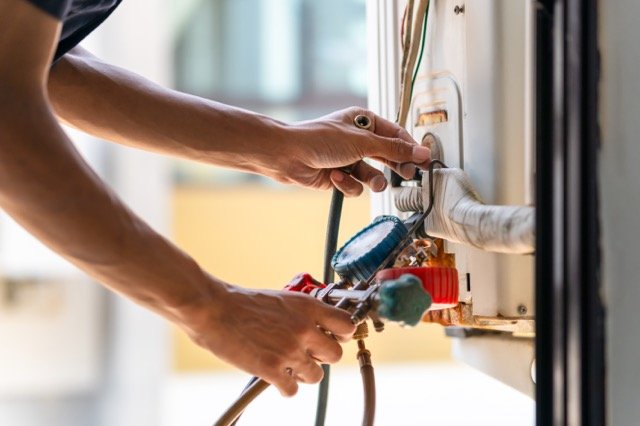
If your air conditioner is running but your house won't cool below 75-76°F even when it's set to 70°F, low refrigerant is a likely culprit.
Refrigerant is the chemical that absorbs heat from inside your home and releases it outside. Your AC system is a closed loop — the same refrigerant circulates continuously. If you're low on refrigerant, it means you have a leak somewhere in the system.
How Low Refrigerant Affects Cooling Capacity
When refrigerant levels drop:
- The evaporator coil can't absorb as much heat — less heat removed per cycle means your house cools more slowly
- The system runs longer cycles trying to compensate, wasting electricity
- The evaporator coil can freeze — low refrigerant causes the coil temperature to drop below freezing, creating ice buildup that blocks airflow completely
- The compressor works harder — low refrigerant forces the compressor to run in conditions it wasn't designed for, which can lead to compressor failure (a $1,500-$3,500 repair)
We explain this in more detail in our article on why your AC isn't blowing cold air.
Finding and Fixing Refrigerant Leaks
Here's what homeowners need to understand: just adding refrigerant without finding the leak is a temporary fix that wastes your money. The refrigerant will leak out again — sometimes in weeks, sometimes in months — and you'll be right back where you started.
Professional refrigerant service involves:
- Leak detection — using electronic leak detectors, UV dye, or nitrogen pressure tests to find the leak location
- Repair — fixing the leak (brazed joints, replaced coils, new fittings, depending on location)
- Evacuation — removing air and moisture from the system
- Recharge — adding the correct amount of refrigerant by weight, not pressure
This requires EPA Section 608 certification and specialized equipment. It's not a DIY job, and it's not something that can be properly diagnosed over the phone.
If your AC is more than 12-15 years old and needs a major refrigerant repair (like a leaking evaporator coil), replacement often makes more financial sense than repair. Modern systems are dramatically more efficient — 16-20 SEER compared to 10-12 SEER for older units — and use refrigerants that aren't being phased out by EPA regulations.
6. Ignition or Flame Sensor Problems (Heating Season)
If your furnace is running but not producing enough heat to reach the set temperature, ignition system problems are often the cause. This is especially common in Michigan during the first cold snap of the season, when furnaces that have been sitting idle since April suddenly need to fire up for a 20°F October morning.
Dirty Flame Sensor
Modern gas furnaces have a flame sensor — a thin metal rod that sits in the flame path. Its job is to confirm that gas is actually burning when the furnace tries to ignite. If the sensor detects flame, the furnace keeps running. If it doesn't detect flame (or if it's too dirty to detect flame), the furnace shuts off the gas valve as a safety measure.
Here's what happens with a dirty flame sensor:
- Your furnace starts a heating cycle
- The draft inducer motor runs (you hear a hum)
- The ignitor glows hot
- Gas flows and ignites
- The dirty flame sensor can't detect the flame
- The furnace shuts off the gas after 3-5 seconds
- The cycle repeats
This is called short-cycling, and it's incredibly frustrating. Your furnace runs constantly, but each cycle only lasts a few seconds — not long enough to heat your home. We wrote an entire guide on furnace short-cycling causes and fixes because it's such a common issue in Southeast Michigan.
Flame sensors get dirty from normal combustion byproducts — carbon, dust, and oxidation. In Michigan, where furnaces run heavily from October through April, sensors need cleaning every 1-2 years as part of regular maintenance.
Failed Ignitor
Older furnaces use standing pilot lights. Most furnaces installed in the last 20 years use hot surface ignitors — ceramic elements that glow orange-hot to ignite the gas.
Hot surface ignitors are fragile. They crack from thermal stress, weaken from repeated heating cycles, and eventually fail. When they fail, your furnace can't light the gas, so it can't produce heat.
Signs of ignitor failure:
- You hear the furnace try to start, but no heat comes out
- The ignitor glows dimly or not at all (you can sometimes see this through the furnace inspection window)
- Your furnace clicks or tries to ignite 3-4 times, then gives up and shuts down
Ignitor replacement is a common repair — the part costs $50-$150, and labor adds another $100-$200. It's a same-day fix for reliable HVAC contractors in Metro Detroit who stock common parts on their trucks.
Gas Valve or Pressure Problems
Less commonly, your furnace might not reach temperature because of gas delivery issues:
- Gas valve failure — the valve that controls gas flow to the burners wears out and doesn't open fully
- Low gas pressure — if your home's gas pressure is below spec (rare, but it happens), the burners don't get enough fuel to produce rated heat output
- Clogged burners — rust, dust, or debris in the burner assembly restricts gas flow and reduces flame intensity
These issues require professional diagnosis with combustion analysis equipment. We measure gas pressure, check flame appearance, test for proper draft, and analyze combustion efficiency to pinpoint the problem.
When to Call a Professional
Some thermostat issues you can troubleshoot yourself. Others require professional diagnosis and repair. Here's how to know the difference.
Try These First (Safe DIY Steps)
- Replace your air filter — this solves the problem 40% of the time
- Check your thermostat batteries — swap in fresh batteries if your thermostat uses them
- Verify the thermostat is set correctly — make sure it's in "heat" or "cool" mode (not "off"), and the fan is set to "auto" (not "on")
- Check your circuit breakers — make sure the breaker for your furnace or AC hasn't tripped
- Look at your outdoor AC unit — clear away leaves, grass clippings, or debris blocking airflow
- Inspect visible ductwork — if you can access your basement or attic ducts, look for obvious disconnections or damage
Call a Professional If:
- The problem persists after replacing the filter — there's a deeper mechanical issue
- You see ice on your AC's evaporator coil or refrigerant lines — this indicates refrigerant or airflow problems
- Your furnace is short-cycling — starting and stopping every few minutes
- You smell gas — leave the house immediately and call your gas company's emergency line, then call us
- Your furnace makes loud banging, squealing, or grinding noises — these indicate mechanical failures
- Your system is 15+ years old and struggling — you likely need a capacity evaluation and replacement recommendation
- Some rooms are always 5-10°F different from others — this suggests ductwork design or balancing issues
When you call NEXT Heating & Cooling for service, here's what happens:
- We schedule a convenient appointment — usually same-day or next-day for heating/cooling emergencies
- A NATE-certified technician arrives on time — with a fully stocked truck and diagnostic equipment
- We diagnose the actual problem — not just the symptom — using systematic testing
- We explain what we found in plain English — showing you the problem when possible
- We give you options — repair vs. replace, with honest pricing and no pressure
- We fix it right the first time — with quality parts and proper procedures
This is the "changing contractor culture" approach that sets us apart. You can learn more about our diagnostic process and service philosophy on our about page, where we detail our certifications, training, and commitment to honest service.
Cost Reality: What Fixes Actually Cost in Southeast Michigan
Michigan homeowners are practical. You want to know what you're looking at financially before you call for service. Here are real-world costs for the most common fixes when your thermostat won't reach the set temperature.
Filter Replacement
- DIY: $8-$20 per filter (1-inch pleated, MERV 8-11)
- Professional service call with filter: $89-$129
Thermostat Replacement
- Basic programmable thermostat: $150-$250 installed
- Wi-Fi smart thermostat (Ecobee, Nest, Honeywell): $300-$450 installed
- Carrier Infinity or Lennox iComfort (high-end): $500-$700 installed
Flame Sensor Cleaning
- As part of tune-up: Included in $89-$129 maintenance visit
- Standalone service call: $129-$179
Ignitor Replacement
- Hot surface ignitor replacement: $200-$350 (parts + labor)
Refrigerant Service (AC)
- Leak detection and diagnosis: $150-$250
- Minor leak repair + recharge: $400-$800
- Major leak repair (coil replacement): $1,200-$2,500
Ductwork Sealing and Repair
- Basic sealing (accessible areas): $400-$800
- Comprehensive duct sealing: $1,200-$2,500
- Duct replacement (sections): $1,500-$4,000 depending on scope
System Replacement
- Gas furnace (80-95% AFUE, Carrier/Lennox/Trane): $3,500-$6,500 installed
- Central AC (14-16 SEER): $3,800-$6,000 installed
- Complete furnace + AC replacement: $7,000-$12,000 installed
We break down furnace replacement costs in detail in our guide on what a new furnace actually costs in Michigan.
Prevention saves money: Homeowners who invest in our Next Care Plan at $5/month get two annual tune-ups (fall and spring), priority scheduling, and 10% off repairs. Regular maintenance catches small problems before they become expensive failures — and keeps your system running at full capacity so it actually reaches the set temperature.
Ready to Get Your Home Comfortable Again?
NEXT Heating & Cooling has been keeping Michigan homes comfortable for over 35 years. Our NATE-certified technicians diagnose the real problem — not just the symptom — and give you honest options without pressure. Serving Macomb County, Oakland County, and St. Clair County with same-day emergency service available.
Schedule Your Service CallFrequently Asked Questions
This usually means your thermostat is reading the temperature accurately in its immediate location, but that location doesn't represent your whole home. Common causes include poor thermostat placement (near a window, exterior wall, or heat source), inadequate air circulation, or ductwork problems causing hot and cold spots. The thermostat might read 72°F in the hallway while your living room is 68°F and your bedroom is 75°F.
The solution is either relocating the thermostat to a more central location on an interior wall, or addressing ductwork balance issues so temperature is more consistent throughout your home.
In a properly functioning system, it should take 20-40 minutes to raise your home's temperature by 5°F under normal conditions. Several factors affect this timing: outdoor temperature (it takes longer when it's colder outside), home insulation quality, furnace size relative to your home, and how long the system has been off.
If it's taking 1-2 hours to raise the temperature 5°F, or if your furnace runs constantly without reaching the set point, you have an efficiency problem — undersized equipment, ductwork leaks, poor insulation, or aging equipment losing capacity.
Absolutely. A severely clogged filter reduces airflow by 50-70%, which means your AC is generating cold air but can't move enough of it through your house to reach the set temperature. Reduced airflow also causes the evaporator coil to get too cold and freeze up, which blocks airflow completely until the ice melts.
In Michigan homes with pets, high pollen counts, or older ductwork that pulls in dust, filters clog faster than the typical 90-day recommendation. We suggest checking your filter monthly during heavy-use seasons (summer and winter) and replacing it when you can't see light through it.
It depends on three factors: the cost of the repair, the system's overall condition, and your long-term plans for the home.
Repair makes sense if: The repair costs less than $500, the system has been well-maintained, and you're planning to sell the home within 2-3 years.
Replacement makes sense if: The repair costs more than $1,500, you've had multiple repairs in the past 2-3 years, your energy bills are climbing, or you're planning to stay in the home for 5+ years. Modern systems are 30-40% more efficient than 15-year-old equipment, so replacement often pays for itself through lower utility bills over time.
We give homeowners honest assessments without pressure. Sometimes repair is the right call. Sometimes it's not. We explain both options with real numbers so you can make an informed decision.
This is one of the most common complaints in two-story Michigan homes, and it's usually caused by a combination of physics and ductwork design issues.
Physics: Hot air rises. Your second floor naturally receives heat from the first floor, plus heat gain from the roof and sun exposure. In summer, this makes the upstairs significantly warmer.
Ductwork design: Many older homes have undersized ducts running to the second floor, or the ductwork wasn't properly balanced during installation. The first-floor registers get plenty of airflow, but by the time air reaches the second floor, there's not enough volume or pressure left.
Solutions include: Installing a zoned HVAC system with separate thermostats for each floor, rebalancing your ductwork by adjusting dampers, adding return air vents upstairs to improve circulation, or upgrading to a two-stage or variable-speed system that provides better airflow control.
Based on 35 years of service calls across Southeast Michigan, the most common cause is a dirty air filter — accounting for about 40% of "thermostat not reaching temperature" complaints. The second most common is undersized or aging equipment that's lost capacity over time (25-30% of cases).
After that, we see thermostat location/calibration issues (15%), ductwork leaks (10%), and refrigerant or ignition problems (the remaining cases).
The good news: the most common cause is also the easiest and cheapest to fix. Always check your filter first before calling for service.
If your current thermostat is accurately maintaining temperature and you're comfortable with manual programming, you don't need to upgrade. But smart thermostats offer real benefits that many Michigan homeowners find valuable:
Remote control: Adjust temperature from your phone if your schedule changes — useful during Michigan's unpredictable weather.
Learning algorithms: Thermostats like Nest and Ecobee learn your patterns and automatically adjust to save energy when you're away.
Energy reports: See exactly how much you're heating and cooling, which helps identify efficiency problems.
Better temperature accuracy: Smart thermostats typically have better sensors and more precise control than older programmable models.
Most homeowners see 10-15% energy savings after installing a smart thermostat, which pays for the $300-$450 installation cost within 2-3 years. But if you're happy with your current setup and it's working properly, there's no urgent need to upgrade.