

Why Is My Air Conditioning Unit So Loud? Michigan HVAC Tech
You're sitting in your living room in Sterling Heights on a humid July evening, and your air conditioner sounds like it's auditioning for a metal band. Maybe it's grinding. Maybe it's squealing. Maybe it just started banging like someone's throwing wrenches inside the outdoor unit.
Here's what 35 years of heating and cooling services in Metro Detroit has taught us: every AC noise means something specific is failing. The sound isn't random. It's your equipment telling you exactly what's wrong — if you know how to listen.
This isn't about "AC units make noise sometimes." This is about the difference between a $200 capacitor replacement and a $4,500 compressor failure. Between catching a problem early and watching your system die during the hottest week of August.
We're going to walk through the seven most common AC noises we diagnose in Southeast Michigan homes, what's actually breaking inside your unit, and when you need to shut it down and call a reliable HVAC contractor in Metro Detroit immediately.
The 7 AC Noises That Mean Trouble
Different sounds point to different component failures. Here's what we're listening for when we diagnose a loud air conditioning unit:
1. Grinding or Metal-on-Metal Scraping
What it sounds like: Like someone's running a belt sander inside your outdoor unit. Metallic, harsh, continuous during operation.
What's failing: Motor bearings in your compressor or condenser fan motor. Bearings are lubricated metal components that allow the motor shaft to spin smoothly. When they wear out — from age, lack of lubrication, or contamination — metal grinds directly against metal.
Why it matters: This is a late-stage failure. The motor is eating itself. If you keep running it, you're looking at complete motor replacement instead of a bearing service. On a compressor, that's often a full system replacement because compressor replacement costs approach new equipment pricing.
Michigan-specific issue: Lake humidity accelerates bearing corrosion, especially in outdoor condenser units. We see this frequently in homes near Lake St. Clair in Macomb County and along the Detroit River in Grosse Pointe. Salt air from winter road treatments doesn't help either.
2. Squealing or Screeching at Startup
What it sounds like: High-pitched squeal when the unit first kicks on, sometimes fading after 10-15 seconds, sometimes continuing.
What's failing: Either a worn blower motor belt (in older systems) or a failing motor bearing that's seizing. Could also be a bad fan motor capacitor causing the motor to struggle during startup.
Why it matters: A belt is cheap — $50-$150 installed. A seized motor is $400-$800 for the blower, $1,200-$2,500 for the condenser fan motor. The difference between catching it early and waiting is significant.

3. Banging or Clanking
What it sounds like: Loud metallic bangs, either rhythmic (with each compressor cycle) or random. Sounds like something's loose and hitting the cabinet.
What's failing: Could be several things:
- Loose fan blade: The condenser fan blade has come loose on its shaft and is wobbling, hitting the fan shroud
- Failed compressor mounts: The compressor sits on rubber isolation mounts. When they fail, the compressor bangs against the base pan
- Broken internal compressor components: Pistons, connecting rods, or valves have failed inside the compressor itself — this is catastrophic
- Loose access panel: Sometimes it's just a panel vibrating loose (the cheap fix)
Why it matters: If it's internal compressor damage, the system is done. You're not repairing that — you're replacing the whole outdoor unit or the entire system. If it's mounts or a blade, we can fix it for a few hundred dollars.
4. Hissing or Bubbling
What it sounds like: Continuous hissing, like air escaping from a tire. Sometimes a bubbling sound near the refrigerant lines.
What's failing: Refrigerant leak. The hissing is refrigerant escaping under pressure through a crack, pinhole, or failed connection. Bubbling usually means the leak is near the evaporator coil where condensate is present.
Why it matters: Your AC cannot cool without refrigerant. It's not like oil in a car — it doesn't "burn off." If it's low, there's a leak. Running the system with low refrigerant destroys the compressor because refrigerant also lubricates and cools the compressor internals.
Refrigerant leaks require EPA-certified technicians to repair. We locate the leak, repair it, vacuum the system to remove moisture and air, and recharge it to manufacturer specifications. Depending on where the leak is, repair costs run $300-$1,500. If the leak is in the evaporator coil and your system uses R-22 (Freon), replacement often makes more financial sense than repair.
We covered this in detail in our post about AC refrigerant leaks for Detroit homeowners.
5. Rapid Clicking
What it sounds like: Fast clicking sound, like a playing card in bicycle spokes. Usually from the outdoor unit.
What's failing: Electrical relay or contactor. The contactor is an electrical switch that connects power to the compressor and condenser fan. When it fails, it rapidly opens and closes, creating the clicking sound. Could also be a failing capacitor or a control board issue.
Why it matters: The compressor isn't getting consistent power. It's trying to start but can't. This can overheat the compressor windings and cause permanent damage. A contactor replacement is $150-$300. A burned-out compressor is $2,000-$4,500.
6. Loud Buzzing or Humming
What it sounds like: Loud electrical buzzing or humming. The unit sounds like it's trying to run but isn't.
What's failing: Usually one of three things:
- Frozen compressor: The compressor is seized and can't turn, but electricity is flowing to it, creating the hum
- Bad capacitor: The start or run capacitor has failed, so the motor can't generate enough torque to start
- Contactor stuck closed: Power is flowing but the motor can't run
Why it matters: If you hear loud buzzing and the unit won't start, shut it off at the breaker immediately. You're sending electricity to a motor that can't move. That creates heat. Enough heat will burn out motor windings, turning a $200 capacitor problem into a $1,500 motor replacement.
7. Rattling
What it sounds like: Loose rattling, like bolts in a can. Might be constant or intermittent.
What's failing: Something is loose:
- Debris in the condenser unit (sticks, leaves, acorns — we find a lot of acorns in Oakland County)
- Loose mounting bolts
- Loose fan blade or motor mount
- Loose ductwork connections (if the rattle is from inside)
Why it matters: Usually the easiest fix. Sometimes it's a $0 repair if we just need to remove debris and tighten bolts. But if a loose fan blade breaks off while spinning, it can destroy the condenser coil — that's a $1,200-$2,000 repair.
What's Actually Failing Inside Your AC Unit
Let's talk about the components that create these noises when they fail. Understanding what's inside your AC helps you make better decisions when a technician gives you repair options.
The Compressor
This is the heart of your AC system. It's a sealed pump that compresses refrigerant vapor, raising its pressure and temperature so it can release heat outside. Compressors in residential AC units are typically scroll compressors (quieter, more efficient) or reciprocating compressors (older, noisier).
Common failure modes:
- Worn internal bearings (grinding noise)
- Failed internal valves or pistons (banging, clanking)
- Seized compressor (loud hum, won't start)
- Failed compressor mounts (banging when it cycles on)
Why they fail: Age, running with low refrigerant (no lubrication), electrical issues, contamination in the refrigerant system, or manufacturing defects. In Michigan, power surges from summer storms are a common killer — we see a spike in compressor failures after severe weather in Macomb and Oakland counties.
Cost to replace: $1,800-$3,500 for the compressor and labor. But here's the reality: if your system is over 10 years old and the compressor fails, replacement often makes more sense than repair. You're putting a $2,500 compressor in an aging system with an old coil, old refrigerant lines, and an old air handler. We'll give you both options with real numbers.
Fan Motors and Blowers
You have two fan motors: one in the outdoor condenser unit (condenser fan motor) and one in the indoor air handler (blower motor). The condenser fan pulls air through the outdoor coil to remove heat. The blower motor circulates air through your ductwork.
Common failure modes:
- Worn bearings (squealing, grinding)
- Seized motor (loud hum, won't spin)
- Failed capacitor (struggles to start, hums)
- Loose fan blade (rattling, wobbling)
Why they fail: Age, lack of lubrication (older motors have oil ports), dirt and debris buildup, electrical issues, or running continuously without maintenance. Michigan humidity accelerates corrosion on outdoor motors.
Cost to replace: Blower motor: $400-$800. Condenser fan motor: $300-$600. Both are straightforward repairs if caught before the motor seizes and damages other components.
Capacitors
Capacitors store and release electrical energy to help motors start and run. Your AC has two types: start capacitors (give the motor a boost to start spinning) and run capacitors (keep it running efficiently). They look like small metal cylinders mounted near the motors.
Common failure modes:
- Bulging or leaking (visible physical damage)
- Weak or dead (motor hums but won't start)
- Failed internally (motor runs but struggles, higher amp draw)
Why they fail: Heat, age, voltage spikes, or just normal wear. Capacitors are wear items — they typically last 10-20 years, but Michigan's temperature extremes (below zero in winter, 95°F+ in summer) stress them. We replace a lot of capacitors in July and August when they've been working hard for weeks straight.
Cost to replace: $150-$300 installed. This is one of the cheapest AC repairs, but ignoring a bad capacitor destroys the motor it's supposed to help. We carry capacitors on every truck because they're so common.
Refrigerant Lines and Coils
Refrigerant flows through copper lines between your outdoor condenser and indoor evaporator coil. The evaporator coil (inside) absorbs heat from your home's air. The condenser coil (outside) releases that heat to the outdoor air.
Common failure modes:
- Refrigerant leaks from corrosion, vibration, or physical damage (hissing sound)
- Pinhole leaks in the evaporator coil from formaldehyde off-gassing (common in newer homes)
- Cracked or damaged refrigerant lines from poor installation or settling foundations
Why they fail: Corrosion (especially on evaporator coils in humid environments), physical damage, vibration from a failing compressor, or manufacturing defects. Older R-22 systems are particularly prone to coil leaks as the refrigerant becomes acidic over time.
Cost to repair: Depends entirely on where the leak is. Accessible refrigerant line repair: $300-$600. Evaporator coil replacement: $1,200-$2,500. Condenser coil replacement: $1,000-$2,000. If your system uses R-22 and needs a coil, we usually recommend full system replacement because R-22 is expensive and being phased out.
Ductwork
Not technically part of the AC unit, but loose or damaged ductwork creates noise — rattling, banging, or whistling sounds when air flows through it.
Common failure modes:
- Loose duct connections (rattling)
- Undersized or poorly designed ducts (whistling, high air velocity noise)
- Disconnected or collapsed ducts (loud rushing air, poor cooling)
Why they fail: Poor installation, age, settling foundations, or physical damage. In Michigan, we see a lot of ductwork issues in older homes — 1960s and 1970s ranches with original ductwork that was never properly sealed or sized for modern high-efficiency equipment.
Cost to repair: Sealing and reconnecting ducts: $200-$500. Full duct replacement or redesign: $2,000-$5,000+ depending on home size and accessibility. We covered ductwork issues in depth in our HVAC maintenance guide for Clinton Township.
Why Michigan AC Units Get Louder Over Time
AC units don't just get loud randomly. Specific conditions in Southeast Michigan accelerate wear on HVAC equipment. Here's what we see after decades of service calls in Macomb, Oakland, and St. Clair counties:
Lake Humidity and Corrosion
Southeast Michigan sits between Lake St. Clair, Lake Erie, and Lake Huron. Summer humidity regularly hits 70-80%. That moisture accelerates corrosion on outdoor condenser units — coils, fan motors, electrical components, and mounting hardware all rust faster here than in drier climates.
We see this especially in homes near the water in St. Clair Shores, Grosse Pointe, and along the Clinton River in Mount Clemens. Outdoor units develop surface rust, then deeper corrosion that weakens mounting brackets, corrodes electrical connections, and eats through coil fins.
Temperature Extremes
Michigan AC units sit outside through polar vortex winters (below zero for days) and humid 95°F summers. That's a 120+ degree temperature swing. Metal expands and contracts. Rubber mounts harden and crack. Electrical connections loosen. Refrigerant pressures swing wildly.
Equipment rated for 15-20 years in moderate climates often lasts 12-15 years here because of the stress. We're not selling you — we're telling you what the service data shows.
Lack of Maintenance
Most homeowners don't think about their AC until it stops working. But maintenance prevents noise issues:
- Dirty coils: Reduce airflow, make the system work harder, stress the compressor and fan motors
- Low refrigerant: From slow leaks that go undetected for years, eventually killing the compressor
- Loose electrical connections: Create arcing, heat, and component failures
- Worn belts and bearings: Caught early during maintenance, they're cheap fixes; ignored, they destroy motors
Our $5/month HVAC maintenance plan includes two annual visits — spring AC tune-up and fall furnace check. We catch these issues before they become loud, expensive failures. The plan also includes priority scheduling and 10% off repairs, which pays for itself if you need even one service call.
Age and Normal Wear
AC units have moving parts. Moving parts wear out. Here's the typical lifespan we see on major components in Southeast Michigan:
- Capacitors: 10-20 years
- Fan motors: 12-18 years
- Compressor: 12-20 years
- Contactors and relays: 15-25 years
- Overall system: 15-20 years with maintenance, 10-15 without
If your AC is 12+ years old and getting loud, it's not surprising. It's reaching the end of its design life. We'll diagnose what's failing and give you honest numbers on repair vs. replacement.
When Loud AC Noise Is an Emergency
Some AC noises mean "call for service this week." Others mean "shut it down right now and call for emergency service." Here's how to tell the difference:
Shut It Down Immediately If You Hear:
- Loud electrical buzzing with burning smell: Electrical failure in progress. Risk of fire. Shut off the breaker and call us.
- Violent banging or clanking from the compressor: Internal compressor failure. Continuing to run it can damage refrigerant lines or other components.
- Continuous loud hissing near refrigerant lines: Major refrigerant leak. Not a fire risk, but you're venting expensive refrigerant and the system won't cool anyway.
- Grinding metal-on-metal that gets louder: Motor bearing failure in progress. The motor is about to seize. Shut it down before it does.
Emergency HVAC service: NEXT Heating & Cooling offers 24-hour emergency HVAC service throughout Southeast Michigan. If your AC fails during a heat wave, we'll get someone to your home. We keep trucks stocked with common parts (capacitors, contactors, fan motors) so we can often fix it on the first visit.
Schedule Service Soon If You Hear:
- Squealing at startup that fades: Worn belt or bearing, but not failed yet
- Intermittent clicking: Contactor or relay starting to fail
- Rattling from loose parts: Won't damage anything immediately, but will get worse
- Slight hissing (not loud): Small refrigerant leak — schedule diagnosis before it gets worse
Cost of Waiting
Here's what happens when homeowners ignore AC noise:
Example 1: Homeowner in Troy hears squealing from the condenser fan motor. Ignores it for three weeks. Motor bearing seizes. Fan blade stops spinning. Compressor overheats because there's no airflow through the condenser coil. Compressor fails. What should have been a $450 fan motor replacement becomes a $3,200 compressor replacement.
Example 2: Homeowner in Warren hears clicking from the contactor. Waits until the system stops cooling. Contactor failed, but the compressor kept trying to start, overheating the windings. Now the compressor is damaged. What should have been a $200 contactor replacement becomes a $2,800 compressor replacement.
Example 3: Homeowner in Shelby Township hears slight hissing. Waits six months. Refrigerant level drops to 40% of capacity. Compressor runs without proper lubrication and cooling. Compressor fails. What should have been a $600 leak repair becomes a $4,000 system replacement because the compressor and coil both failed.
We're not trying to scare you. We're telling you what we see every summer. Catching problems early saves money. That's why we push maintenance so hard.
What Your HVAC Tech Checks During a Noise Diagnosis
When you call us about a loud AC, here's what happens on the service call. We're showing you our process so you know what to expect and what questions to ask if you're comparing contractors.
Step 1: Listen and Locate
First, we run the system and listen. We're identifying:
- What type of noise (grinding, squealing, banging, hissing, clicking, buzzing, rattling)
- Where it's coming from (outdoor condenser, indoor air handler, ductwork)
- When it occurs (startup, continuous, shutdown, intermittent)
This narrows down the possible causes immediately. A grinding noise from the outdoor unit during operation points to the condenser fan motor or compressor. A squealing noise at startup from the indoor unit points to the blower motor.
Step 2: Visual Inspection
We inspect the unit with power off:
- Check for obvious damage, loose parts, debris
- Inspect fan blades for cracks, looseness, or damage
- Check mounting bolts and brackets
- Look for refrigerant oil residue (indicates a leak)
- Inspect electrical connections for corrosion or burning
- Check capacitors for bulging or leaking

Step 3: Electrical Testing
We use a multimeter to test:
- Voltage: Confirm proper voltage to the unit (should be 220-240V for most residential AC units)
- Capacitor microfarads: Test if capacitors are within spec (weak capacitors cause motor problems)
- Amp draw: Measure current draw on motors and compressor (high amp draw indicates mechanical problems or electrical issues)
- Continuity: Test contactors, relays, and safety switches
This tells us if the problem is electrical (capacitor, contactor, wiring) or mechanical (motor, compressor, bearings).
Step 4: Refrigerant and Pressure Testing
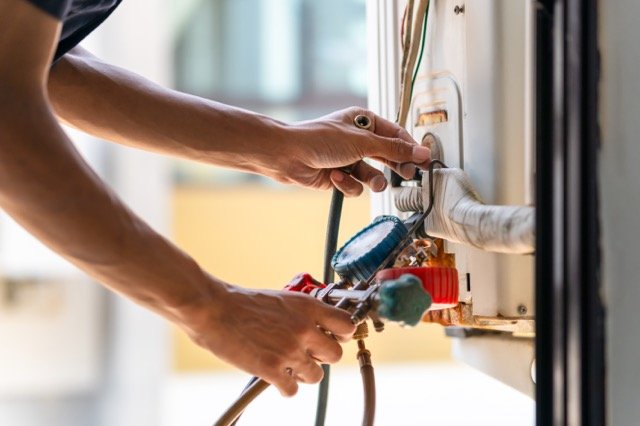
If we suspect a refrigerant issue, we connect gauges to the service ports and check:
- Suction pressure: Low-pressure side (should match manufacturer specs for current outdoor temperature)
- Discharge pressure: High-pressure side (indicates compressor performance)
- Subcooling and superheat: Calculations that tell us if refrigerant charge is correct
If pressures are off, we use an electronic leak detector to find the leak. Small leaks are hard to find — sometimes we inject UV dye and come back in a week to locate it with a UV light.
Step 5: Diagnosis and Options
Once we've identified the problem, we give you options:
- The repair: What needs to be fixed, parts required, labor time, total cost
- The timeline: How long until we can get parts and complete the repair
- The prognosis: Honest assessment of the system's remaining lifespan
- Replacement option: If the system is old or the repair is expensive, we'll give you a replacement quote for comparison
We don't upsell. If your 8-year-old Carrier needs a $350 fan motor and the rest of the system is solid, we'll tell you to fix it. If your 18-year-old Goodman with R-22 refrigerant needs a $2,500 compressor, we'll tell you replacement makes more sense. You get the information you need to make the right decision for your home and budget.
What to Ask Your HVAC Contractor
If you're comparing contractors for AC noise diagnosis, ask these questions:
- "What diagnostic equipment do you use?" They should have a multimeter, refrigerant gauges, leak detector, and amp clamp at minimum.
- "Do you provide written estimates?" You should get a written quote before any repair work begins.
- "What's your diagnostic fee, and does it apply to the repair?" Most contractors charge $75-$150 for diagnosis. Some waive it if you approve the repair.
- "Are you EPA 608 certified?" Required by federal law to handle refrigerant. If they're not certified, they can't legally work on your AC.
- "What's the warranty on parts and labor?" Manufacturer parts warranties vary (1-10 years). Labor warranties should be at least 1 year.
At NEXT Heating & Cooling, our technicians are NATE-certified HVAC technicians with EPA 608 certification. We provide written estimates before starting work, and we warranty our labor for one year on all repairs.
How to Prevent Your AC From Getting Louder
You can't prevent every AC failure, but you can significantly extend equipment life and catch problems early with proper maintenance. Here's what actually works:
Change Your Air Filter Every 1-3 Months
This is the single most important thing you can do. A dirty filter restricts airflow, making the blower motor work harder, increasing noise, and stressing the entire system. In Michigan homes with pets or during high pollen season, change it monthly. Minimum every three months.
Use the filter size and MERV rating recommended by your equipment manufacturer. Higher MERV isn't always better — too restrictive and you're choking the system.
Keep the Outdoor Unit Clear
Your condenser needs airflow. Keep these clear:
- Remove leaves, grass clippings, and debris from around the unit
- Trim bushes and vegetation back at least 2 feet on all sides
- Don't stack firewood, store lawn equipment, or park vehicles near it
- After storms, check for branches or debris on top of the unit
Restricted airflow makes the compressor work harder, run hotter, and fail sooner. It also reduces cooling capacity — your AC runs longer to cool the house, wearing out components faster.
Schedule Annual Maintenance
Professional maintenance catches problems before they become failures. During a proper AC tune-up, we:
- Clean the condenser coil (removes dirt and debris that restrict airflow)
- Clean the evaporator coil (improves heat transfer, reduces run time)
- Check refrigerant pressures (catches slow leaks early)
- Test capacitors (replace weak ones before they fail)
- Inspect and tighten electrical connections (prevents arcing and failures)
- Lubricate motors (if applicable — many modern motors are sealed)
- Check and tighten fan blades and mounting hardware (prevents rattling and vibration damage)
- Test safety controls and thermostat operation
- Measure amp draw on motors and compressor (detects mechanical problems early)
This is what's included in our affordable HVAC maintenance plan. For $5/month, you get two visits per year (spring AC tune-up, fall furnace tune-up), priority scheduling, 10% off repairs, and no service call fees. It pays for itself if you need even one repair.
The data backs this up: systems with annual maintenance last 30-40% longer than systems without maintenance. Repair costs are lower because we catch small problems before they cascade into major failures.
Don't Ignore Small Problems
If you hear a new noise, notice reduced cooling, or see ice on refrigerant lines, call for service. Small problems become big problems. A $200 repair today prevents a $2,000 failure next month.
Replace Your System Before It Dies
If your AC is 15+ years old, start planning for replacement. Don't wait until it dies during a July heat wave when contractors are slammed and you're paying emergency pricing. Replace it on your schedule in spring or fall when you have time to compare options and get better pricing.
We covered the cost and timing in detail in our post about when to replace your furnace before winter in Michigan — the same logic applies to AC replacement.
Cost Reality: Repair vs. Replace
Let's talk numbers. Here's what common AC noise-related repairs actually cost in Southeast Michigan in 2026, and when replacement makes more sense than repair.
Common Repair Costs
These are real numbers from actual service calls in Macomb, Oakland, and St. Clair counties. Your specific cost depends on equipment brand, accessibility, and whether we need to order parts:
- Capacitor replacement: $150-$300
- Contactor replacement: $150-$300
- Condenser fan motor: $400-$700
- Blower motor: $500-$900
- Refrigerant leak repair (accessible line): $300-$600 plus refrigerant
- Refrigerant recharge (R-410A): $200-$400 per pound
- Evaporator coil replacement: $1,200-$2,500
- Condenser coil replacement: $1,000-$2,000
- Compressor replacement: $1,800-$3,500
These prices include parts, labor, and any refrigerant needed. We don't charge separately for "diagnosis" if you approve the repair — the service call fee applies to the work.
The $1,500 Rule
Here's a guideline we use: if the repair cost exceeds $1,500 and your system is over 10 years old, consider replacement instead of repair. Here's why:
Let's say your 12-year-old AC needs a $2,500 compressor. You pay for the repair. The compressor is new, but everything else is 12 years old — the coils, the refrigerant lines, the air handler, the ductwork connections. What happens when the evaporator coil develops a leak two years later? Or the blower motor fails? You're putting major money into aging equipment.
A new system costs $4,000-$8,000 depending on size and efficiency. You get:
- New compressor, coils, air handler, and condenser
- 10-year parts warranty (some manufacturers offer lifetime compressor warranties)
- Higher efficiency (14-16 SEER minimum vs. 10-13 SEER on older units) — lower electric bills
- Quieter operation (modern compressors and fan motors are much quieter)
- No repair bills for years
We're not pushing replacement to make a sale. We're giving you the same advice we'd give our own family. Sometimes repair makes sense. Sometimes it doesn't. We'll give you both options with real numbers so you can decide.
What New AC Systems Cost in Southeast Michigan
Full system replacement costs in 2026:
- Basic 14 SEER system (Goodman, Amana, York): $4,000-$5,500 installed
- Mid-range 15-16 SEER system (Carrier, Lennox, Trane, Rheem, Bryant): $5,500-$7,500 installed
- High-efficiency 17-20 SEER system (Carrier Infinity, Lennox Signature, Trane XV): $7,500-$10,000+ installed
These prices include the outdoor condenser, indoor evaporator coil, refrigerant lines, thermostat (if needed), permits, and labor. They assume your existing ductwork is in good condition. If you need ductwork modifications or a new air handler, add $1,000-$3,000.
We covered system replacement costs in detail in our post about furnace replacement costs in Troy, Michigan — AC pricing follows similar patterns.
Financing Options
Most homeowners don't have $6,000 sitting around for an AC replacement. We get it. That's why we offer financing options through approved lenders. You can spread the cost over 12-60 months depending on your credit and the financing terms.
Sometimes a $150/month payment for a new system makes more sense than a $2,500 repair on a 15-year-old unit that might fail again next summer. We'll walk you through the numbers so you can make the right decision for your budget.
Ready to Get Started?
NEXT Heating & Cooling has been keeping Michigan homes comfortable for over 35 years. Get honest diagnostics and fair pricing from NATE-certified technicians who show up on time. We'll tell you what's wrong, what it costs to fix, and whether repair or replacement makes more sense for your situation.
Schedule Your ServiceFrequently Asked Questions
A sudden increase in AC noise usually means a component has failed or is failing. Common causes include a worn compressor bearing (grinding noise), a failing fan motor (squealing or grinding), a loose fan blade or panel (rattling or banging), a bad capacitor causing the motor to struggle (loud humming), or a refrigerant leak (hissing). If the noise is sudden and loud, shut the system off and call for service — continuing to run it can turn a small repair into a major failure.
Some noise is normal — a low hum from the compressor, gentle whooshing from airflow, and a soft click when the thermostat calls for cooling. But loud grinding, squealing, banging, hissing, or buzzing is not normal. These sounds indicate specific component failures. Modern high-efficiency AC systems (15+ SEER) are significantly quieter than older units. If your system is getting louder over time or making new noises, have it inspected by a licensed HVAC technician.
Repair costs depend on what's causing the noise. Simple fixes like a capacitor or contactor replacement run $150-$300. Fan motor replacements cost $400-$900. Compressor replacements run $1,800-$3,500. Refrigerant leak repairs range from $300-$2,500 depending on location and whether coil replacement is needed. A diagnostic service call to identify the problem typically costs $75-$150, which usually applies to the repair if you approve the work. If your system is over 10 years old and needs expensive repairs, replacement may make more financial sense.
It depends on the noise. If you hear loud electrical buzzing, violent banging from the compressor, or continuous loud hissing, shut the system off immediately — these indicate failures that can cause further damage or safety issues. If you hear squealing, clicking, or rattling, you can usually keep running it until you can schedule service, but don't wait long. Ignoring AC noise problems typically turns a $300 repair into a $2,000+ failure. Small problems cascade into big ones when components fail under stress.
Loud noise at startup usually indicates a failing capacitor or worn motor bearing. The capacitor provides extra electrical boost to start the motor spinning — when it's weak, the