

Why Is My Air Conditioning Unit So Loud? Michigan HVAC Tech Explains

Why Your AC Shouldn't Sound Like That
You're sitting in your living room in Sterling Heights on a humid July evening when you notice it: your air conditioning unit is making a noise it definitely wasn't making last week. Maybe it's a high-pitched squeal. Maybe it's a rhythmic banging. Maybe it sounds like something is grinding metal inside the outdoor unit.
Whatever the sound, your instinct is right — something has changed, and ignoring it usually makes the problem worse and more expensive.
After 35 years of furnace and AC installation services across Southeast Michigan, we've diagnosed thousands of noisy air conditioners. Most fall into seven categories, and understanding what you're hearing can help you decide whether to shut the system down immediately or schedule service in the next few days.
This guide walks through the most common AC noises we hear about in Macomb, Oakland, and St. Clair counties, what causes them, and what happens if you wait too long to address them. We'll also cover the Michigan-specific conditions that make AC noise problems worse — humidity, temperature swings, and the debris that accumulates around outdoor units in our climate.
Quick Answer: If your air conditioning unit is so loud that you can hear it clearly from inside your home, it's usually caused by worn bearings in the blower motor or condenser fan, loose mounting hardware, refrigerant leaks creating hissing sounds, failing compressors, or debris trapped in the outdoor unit. Most of these problems get worse over time and can lead to complete system failure if ignored.
The 7 Most Common AC Noises (And What They Mean)
Not all AC noises mean the same thing. Here's what we listen for when diagnosing a loud air conditioning unit, listed from most common to least common in Michigan homes.
1. Squealing or Screeching (Blower Motor or Belt Issues)
A high-pitched squeal usually comes from the indoor air handler, not the outdoor condenser. It's almost always caused by worn bearings in the blower motor or — on older systems — a loose or worn blower belt.
Modern direct-drive blower motors don't use belts, but many homes in Troy and Warren still have belt-driven systems installed in the 1990s and early 2000s. When the belt starts to crack or slip, it creates a loud squealing noise that gets worse as the system runs.
Blower motor bearings wear out over time, especially on systems that run constantly during Michigan summers. The noise starts intermittently and gradually becomes constant. If you hear squealing when the AC first kicks on, then it fades, that's a classic sign of bearing wear.
What happens if you ignore it: The blower motor will eventually seize, and you'll have no airflow. The system will run, but no cold air will reach your living space. Replacing a seized blower motor costs more than replacing worn bearings early.
2. Banging or Clanking (Loose Components or Failed Compressor Mounts)
A loud banging noise — especially one that happens in rhythm with the compressor cycling — usually means something has come loose inside the outdoor condenser unit. This could be a loose fan blade, a failed compressor mount, or debris trapped in the fan housing.
We see this frequently in Shelby Township and Clinton Township after wind storms. A branch or piece of siding gets sucked into the condenser fan, bends a blade, and creates an unbalanced rotation that bangs against the housing.
Internal banging from the compressor itself is more serious. It can indicate a failing compressor piston, broken valve plates, or internal mechanical failure. This noise is usually accompanied by reduced cooling performance.
What happens if you ignore it: A loose fan blade can destroy the motor. A failing compressor will eventually lock up and require full replacement, which is often 50-70% of the cost of a new outdoor unit.
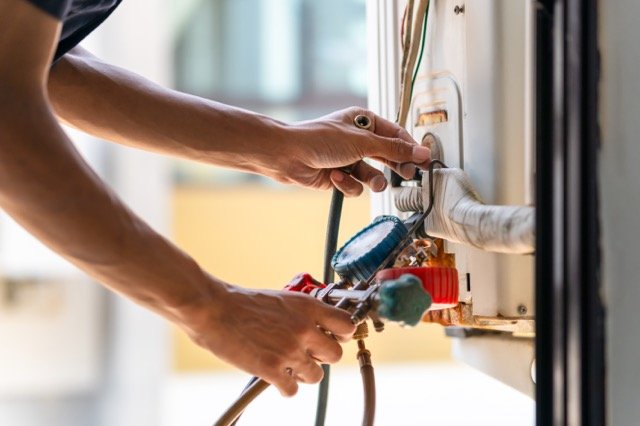
3. Hissing (Refrigerant Leak or Expansion Valve Issue)
A hissing sound — especially one that's constant and comes from the outdoor unit or refrigerant lines — usually indicates a refrigerant leak. You might also hear hissing from the indoor evaporator coil if the leak is inside the air handler.
Refrigerant leaks are serious. They reduce cooling capacity, force the compressor to work harder, and can eventually cause compressor failure. In Michigan, where we deal with temperature swings from below zero in winter to 90+ degrees in summer, refrigerant line connections expand and contract repeatedly, which can cause leaks at flare fittings and brazed joints.
A different type of hissing — one that sounds like air escaping under pressure — can come from the expansion valve or metering device. This is normal during operation, but if it's louder than usual, it could indicate a restriction in the refrigerant flow.
What happens if you ignore it: The system will lose refrigerant, cooling performance will drop, and the compressor will eventually fail from running low on refrigerant charge. Repairing a compressor that failed due to low refrigerant is significantly more expensive than fixing the leak early.
4. Buzzing or Humming (Electrical Issues or Failing Contactor)
A loud buzzing noise from the outdoor unit — especially if the fan isn't spinning — usually means an electrical problem. The most common culprits are a failing contactor, a bad capacitor, or a compressor that's trying to start but can't.
The contactor is the electrical relay that sends power to the compressor and condenser fan. When it starts to fail, the contacts can arc and buzz loudly. You'll hear the buzzing, but the compressor won't start.
A failing start capacitor creates a similar symptom. The compressor hums but doesn't start, and you might notice the lights in your house dimming slightly when the AC tries to kick on.
We see a lot of capacitor failures in Michigan because of voltage fluctuations during summer storms. A lightning strike doesn't have to hit your house directly — a surge on the power grid is enough to damage capacitors.
What happens if you ignore it: A compressor that tries to start repeatedly but can't will overheat and fail. Replacing a compressor costs $1,500-$3,000 depending on the system. Replacing a contactor or capacitor costs $150-$350.
5. Clicking (Normal Cycling or Failing Relay)
Some clicking is normal. You should hear a single click when the thermostat calls for cooling and the contactor engages. You'll hear another click when the system shuts off.
Rapid, repetitive clicking is not normal. It usually indicates a failing relay, a bad thermostat, or a control board issue. If you hear clicking every few seconds, the system is trying to start but something is preventing it from completing the startup sequence.
What happens if you ignore it: The system won't run consistently, and whatever component is causing the clicking will eventually fail completely.
6. Grinding (Worn Bearings or Motor Failure)
A grinding noise — metal on metal — is one of the worst sounds an AC can make. It almost always means a motor bearing has failed completely and the motor shaft is grinding against the housing.
This can happen in the condenser fan motor or the blower motor. Either way, the motor needs to be replaced immediately. Running the system with a grinding motor will cause catastrophic failure and potentially damage other components.
What happens if you ignore it: The motor will seize, the system will stop working, and you might damage the control board or other electrical components when the motor locks up.
7. Rattling (Loose Panels, Debris, or Mounting Hardware)
Rattling is usually the least serious noise, but it's also the most annoying. It's typically caused by loose panels on the outdoor unit, debris inside the condenser cabinet, or mounting hardware that's vibrated loose over time.
We see a lot of rattling in homes with older Carrier, Goodman, and Rheem units where the sheet metal panels have fatigued and no longer fit tightly. A few self-tapping screws usually solve the problem.
Rattling can also come from loose ductwork in the basement or attic. If the noise seems to be coming from the vents rather than the equipment itself, the problem is probably in the duct system.
What happens if you ignore it: Loose panels can vibrate off completely, exposing live electrical components. Debris inside the unit can damage the fan blade or motor.
Michigan-Specific AC Noise Triggers
Living in Southeast Michigan creates specific conditions that make AC noise problems more common than in other parts of the country. Here's what we see that homeowners in Arizona or Texas don't deal with.
Temperature Swings and Thermal Expansion
Michigan air conditioners sit outside through polar vortex winters where temperatures drop to -10°F, then run in 95°F summer heat. That's a 105-degree temperature swing.
Every time the temperature changes, metal components expand and contract. Refrigerant lines, mounting brackets, and electrical connections all move slightly. Over time, this causes connections to loosen and joints to develop leaks.
We see more refrigerant leaks at flare fittings in Michigan than our colleagues in milder climates report. The repeated expansion and contraction eventually works the fittings loose.
Humidity and Condenser Coil Corrosion
Michigan summers are humid — dew points in the 60s and 70s are common in July and August. That moisture accelerates corrosion on condenser coils, especially on units that sit in shaded areas where the coils don't dry out completely between cooling cycles.
Corroded coils reduce airflow, which makes the compressor work harder and creates more noise. In severe cases, corrosion can cause refrigerant leaks.
We recommend checking condenser coils annually as part of a $5/month HVAC maintenance plan to catch corrosion before it causes leaks.
Cottonwood Seeds, Maple Helicopters, and Debris
If you live in Rochester Hills, Lake Orion, or any wooded area in Oakland County, you know about cottonwood seeds. They accumulate around outdoor AC units like snow, clogging condenser coils and getting sucked into fan blades.
Maple helicopters do the same thing in spring. We've pulled handfuls of them out of condenser units during service calls in Grosse Pointe Farms and Royal Oak.
When debris gets into the fan, it creates rattling and clicking noises. If a twig or piece of bark gets wedged between the fan blade and housing, it can bend the blade and create a banging noise.
Concrete Pad Settling
Many Michigan homes have outdoor AC units sitting on concrete pads that were poured 20-30 years ago. Frost heave and soil settling cause these pads to shift over time.
When the pad tilts, the unit tilts with it. This puts stress on the compressor mounts and refrigerant lines, which can cause noise and eventually lead to mechanical failure.
A properly leveled outdoor unit runs quieter and lasts longer. We check pad level during every maintenance visit and recommend shimming or re-leveling when necessary.
When AC Noise Means Emergency Service
Not every loud AC requires immediate shutdown, but some noises indicate problems that will cause expensive damage if you keep running the system. Here's when to turn the AC off at the thermostat and call for 24-hour emergency HVAC service.
Shut It Down Immediately If You Hear:
- Grinding or metal-on-metal scraping: This means a bearing has failed completely. Running the system will destroy the motor and potentially damage other components.
- Loud hissing with visible refrigerant vapor: If you see a white mist or frost forming on refrigerant lines, you have a significant leak. Shut the system down and call a licensed technician. Refrigerant is regulated by the EPA, and only certified techs can legally handle it.
- Buzzing with a burning smell: This indicates electrical arcing or a motor that's overheating. Turn off the system at the breaker, not just the thermostat.
- Loud banging from the compressor with no cooling: The compressor is failing internally. Continuing to run it will cause complete failure.
Schedule Service Within 24-48 Hours If You Hear:
- Squealing that gets worse over time: Bearings are wearing out, but you have a few days before failure.
- Rattling from loose panels: Annoying but not immediately dangerous. Tighten the panels before they vibrate off completely.
- Clicking that prevents the system from starting: The system won't run properly, but it's not causing damage by sitting idle.
If you're not sure whether to shut the system down, err on the side of caution. Running a failing AC for a few more hours can turn a $300 repair into a $2,000 replacement.
What Your HVAC Tech Checks During a Noise Diagnosis
When a NATE-certified HVAC technician shows up to diagnose a noisy AC, here's the process we follow. Understanding this helps you know what to expect and why the diagnosis sometimes takes 30-45 minutes.
Step 1: Listen and Locate
The first thing we do is listen. We'll ask you to describe the noise and when it happens — does it occur when the system first starts, or after it's been running for a while? Does it come from inside the house or outside?
Then we'll run the system and listen ourselves. We're trained to distinguish between normal operating sounds and mechanical failure. A homeowner might describe a noise as "grinding," but it could actually be a loose fan blade or a failing capacitor.
Step 2: Inspect the Outdoor Unit
Most AC noise problems originate at the outdoor condenser unit, so we start there. We'll check:
- Condenser fan blade: Is it bent, cracked, or unbalanced?
- Fan motor bearings: Do they spin freely, or is there resistance and grinding?
- Compressor mounting: Are the rubber isolation mounts intact, or have they deteriorated?
- Panel security: Are all panels tight, or are screws missing?
- Debris: Is there anything trapped in the fan housing or clogging the coils?
- Pad level: Is the unit sitting level, or has the concrete pad shifted?
Step 3: Check Electrical Components
Buzzing and humming noises are almost always electrical. We'll test:
- Contactor: Are the contacts pitted or burned? Does it engage cleanly?
- Capacitors: We use a multimeter to check capacitance. A failing capacitor will read below its rated microfarad value.
- Compressor amperage: We measure how much current the compressor draws during operation. High amperage indicates mechanical resistance inside the compressor.
Step 4: Inspect the Indoor Air Handler
If the noise is coming from inside the house, we'll open the air handler and check:
- Blower motor bearings: We'll spin the blower wheel by hand to feel for resistance.
- Blower wheel balance: An unbalanced blower wheel creates vibration and noise.
- Mounting hardware: Are all bolts tight, or has vibration loosened them?
- Belt condition (if applicable): On older belt-driven systems, we check for cracks, glazing, and proper tension.
Step 5: Measure Refrigerant Pressures
If we suspect a refrigerant leak or compressor issue, we'll connect manifold gauges to the service ports and measure suction and discharge pressures. This tells us whether the system is low on refrigerant, overcharged, or experiencing compressor valve failure.
Low suction pressure with normal discharge pressure usually indicates a refrigerant leak. High discharge pressure can indicate a restriction in the system or a failing compressor valve.
Step 6: Provide Options and Pricing
Once we've identified the problem, we'll explain what we found in plain language — no jargon, no upselling. We'll give you options with upfront pricing:
- Repair: What needs to be replaced, how much it costs, and how long it will last.
- Replace: If the repair costs more than 50% of a new system, we'll recommend replacement and explain why.
- Do nothing: If the problem isn't urgent, we'll tell you what will happen if you wait and when you'll need to address it.
We don't work on commission. Our techs get paid the same whether you repair or replace, so the recommendation is based on what makes sense for your situation, not what makes us the most money.
Cost Reality: Fixing a Noisy AC in Southeast Michigan
Here's what common AC noise repairs actually cost in Metro Detroit as of 2026. These are real numbers from service calls in Macomb, Oakland, and St. Clair counties.
Minor Repairs ($150-$400)
- Tighten loose panels or mounting hardware: $150-$200 (usually part of a service call)
- Replace contactor: $180-$300
- Replace capacitor: $150-$350 depending on capacitor type (single or dual)
- Clean condenser coils and remove debris: $150-$250
- Lubricate blower motor bearings (if accessible): $150-$200
Moderate Repairs ($400-$1,200)
- Replace condenser fan motor: $400-$700
- Replace blower motor: $500-$900
- Repair refrigerant leak and recharge system: $500-$1,200 (depends on leak location and refrigerant type — R-410A is cheaper than R-22)
- Replace blower wheel: $400-$600
- Re-level outdoor unit and reinforce concrete pad: $300-$600
Major Repairs ($1,200-$3,500)
- Replace compressor: $1,500-$3,000 (often not worth it on systems older than 10 years)
- Replace outdoor condenser unit: $2,000-$4,500 depending on tonnage and efficiency
- Replace entire AC system (indoor and outdoor): $4,500-$8,500 for a complete installation
These prices include labor, parts, and refrigerant where applicable. We provide written estimates before starting any work, and there are no surprises when the job is done.
Cost Prevention Tip: Most of the expensive repairs we do could have been avoided with regular maintenance. A $60/year maintenance plan catches worn bearings, dirty coils, and failing capacitors before they cause major damage. We've seen systems last 20+ years with consistent maintenance, while neglected systems fail at 10-12 years.
How to Prevent AC Noise Before It Starts
Most AC noise problems develop gradually over months or years. Here's how to catch them early and avoid expensive repairs.
Schedule Annual Maintenance Before Cooling Season
The single most effective way to prevent AC noise is to have the system professionally maintained every spring before you need it. Our Next Care Plan includes two annual visits — one in fall for your furnace and one in spring for your AC.
During the spring visit, we:
- Clean condenser coils to maintain airflow and reduce compressor strain
- Check refrigerant pressures and look for leaks
- Lubricate motors and check bearing condition
- Tighten electrical connections and test capacitors
- Inspect fan blades for damage or imbalance
- Verify proper drainage from the evaporator coil
- Test system startup and shutdown sequences
This catches 90% of problems before they cause noise or failure.
Keep the Area Around Your Outdoor Unit Clear
The outdoor condenser needs at least 24 inches of clearance on all sides for proper airflow. We see a lot of units in Bloomfield Hills and Grosse Pointe Farms surrounded by landscaping that's grown too close.
Trim back bushes, remove leaves and debris, and don't store anything against the unit. Better airflow means less strain on the compressor and quieter operation.
Change Your Air Filter Every 1-3 Months
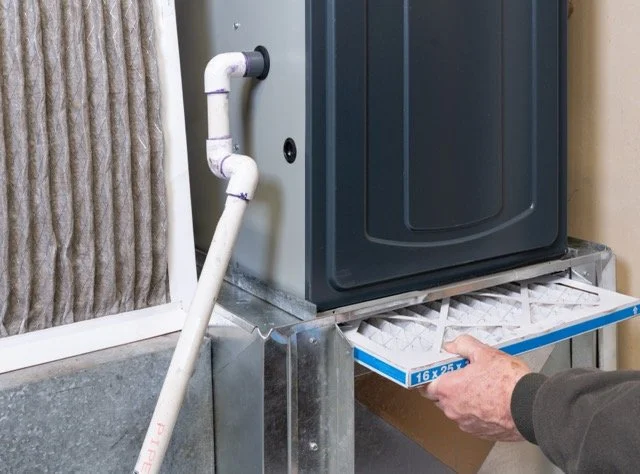
A clogged air filter restricts airflow, which makes the blower motor work harder and creates more noise. It also reduces cooling efficiency and can cause the evaporator coil to freeze.
Check your filter monthly during cooling season. If it looks dirty, replace it. Standard fiberglass filters are cheap — there's no reason to run a clogged filter.
Listen for Changes in Operating Sound
You know what your AC normally sounds like. If it starts making a new noise — even a subtle one — don't ignore it. Small problems become big problems when you wait.
A slight squeal that only happens on startup will eventually become constant squealing, then a seized motor. A minor rattling noise from a loose panel will eventually vibrate the panel off completely.
Catching problems early is always cheaper than waiting until something breaks.
Don't Run the System If Something Sounds Wrong
If your AC starts making a loud, unusual noise — especially grinding, banging, or hissing — turn it off and call for service. Running a failing system causes more damage and turns a $300 repair into a $2,000 replacement.
Michigan summers are hot, but a few hours without AC won't hurt you. A destroyed compressor will hurt your wallet.
Loud AC? We'll Diagnose It Honestly
NEXT Heating & Cooling has been keeping Michigan homes comfortable for over 35 years. Our NATE-certified technicians show up on time, explain what's wrong in plain language, and give you options without pressure. No commission-based sales. Just honest diagnostics and fair pricing.
Schedule Your Service CallFrequently Asked Questions About Loud Air Conditioning Units
A sudden increase in AC noise usually means something has changed mechanically. The most common causes are a worn blower motor bearing, a loose condenser fan blade, a failing compressor mount, debris trapped in the outdoor unit, or a refrigerant leak. If the noise appeared suddenly rather than gradually, it's more likely to be a loose component or debris rather than normal wear and tear.
Modern AC systems should run relatively quietly — you should hear a low hum from the outdoor unit and gentle airflow from the indoor vents, but nothing loud enough to be disruptive. Older systems (15+ years) are naturally louder than newer variable-speed models, but you shouldn't hear squealing, banging, grinding, or hissing. If the noise is loud enough that you're asking whether it's normal, it probably isn't.
Some noise problems are DIY-friendly: tightening loose panels, removing debris from the outdoor unit, changing a clogged air filter, or clearing vegetation around the condenser. However, most noise problems involve components that require professional diagnosis and repair — blower motors, compressors, refrigerant leaks, and electrical components. Attempting to repair these yourself can void manufacturer warranties and violate EPA regulations (for refrigerant work). If you're not sure what's causing the noise, call a licensed HVAC technician.
Simple repairs like tightening panels or replacing a capacitor typically cost $150-$350. Moderate repairs like replacing a fan motor or blower motor run $400-$900. Major repairs like compressor replacement cost $1,500-$3,000. The exact cost depends on what's causing the noise, the age of your system, and whether parts are still available. A diagnostic service call in Southeast Michigan typically costs $80-$150, and that fee is usually applied toward the repair if you proceed with the work.
If you hear grinding, metal-on-metal scraping, loud banging from the compressor, or buzzing with a burning smell, turn the system off immediately — these indicate serious mechanical or electrical problems that will cause expensive damage if you keep running the system. For squealing, rattling, or clicking noises, you can usually keep the system running until a technician can diagnose it, but don't wait more than a few days. When in doubt, shut it down and call for service.
A brief clicking sound when the AC starts is normal — that's the contactor engaging. A squealing noise on startup that fades after a few seconds usually indicates worn blower motor bearings that need lubrication or replacement. Banging or clanking on startup can mean loose components in the outdoor unit. If the startup noise is getting louder or lasting longer, have it checked before the component fails completely.
Annual maintenance before cooling season is the standard recommendation. A spring tune-up catches worn bearings, dirty coils, loose hardware, and failing capacitors before they cause noise or breakdowns. Systems that receive annual maintenance last 5-10 years longer than neglected systems and run quieter throughout their lifespan. In Michigan's climate with extreme temperature swings, annual maintenance is especially important for catching problems early.