

Fan Running But AC Outside Unit Won't Start? Fix Guide

You walk over to the thermostat on a humid July afternoon in Sterling Heights, crank the temperature down to 68, and hear the familiar whoosh of air coming from the vents. But twenty minutes later, the house is still 78 degrees. You step outside and put your hand near the condenser unit sitting next to your house—the big metal box that's supposed to be humming and blowing hot air. Nothing. Silent. Not running.
This is one of the most common service calls we get at NEXT Heating & Cooling during Michigan summers. The indoor fan is blowing air through your vents, but the outdoor condenser unit—the part that actually does the cooling—won't start. No cooling happens. Just warm air circulating through your house.
The good news? Some of these issues are simple. A few you can check yourself. Others require a licensed HVAC contractor with the right tools and certifications. This guide walks you through the diagnostic process our NATE-certified technicians use when we get this call, what you can safely check on your own, and when it's time to pick up the phone.
How Your AC System Actually Works
Before we diagnose why your outside unit isn't running, let's clarify how a central air conditioning system actually works. This matters because the symptom you're experiencing—indoor fan running, outdoor unit silent—tells us exactly where in the system the breakdown is happening.
Your AC is a split system with two main components:
- Indoor air handler: Located in your basement, attic, or utility closet. Contains the evaporator coil and the blower fan. This is what pushes air through your ductwork and vents.
- Outdoor condenser unit: The metal box sitting outside your house. Contains the compressor, condenser coil, and condenser fan. This is what removes heat from your home and releases it outside.
When you set your thermostat to cool, it sends a low-voltage signal (24 volts) to both units. The indoor blower starts moving air across the cold evaporator coil. At the same time, the outdoor compressor and fan start running to pump refrigerant through the system and release heat outside.
Both parts must run for cooling to happen. If only the indoor fan runs, you're just circulating warm air. No refrigerant is being pumped. No heat is being removed. The system is half-working—which in practical terms means it's not working at all.
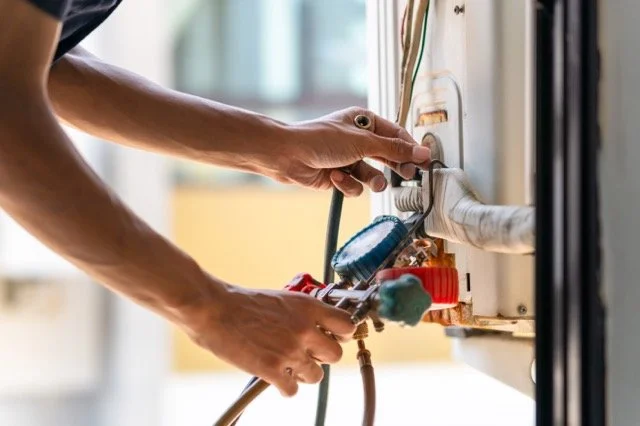
7 Common Reasons Your Outside AC Unit Won't Start
After 35+ years servicing HVAC systems across Macomb, Oakland, and St. Clair counties, we've narrowed down the most common culprits when the outdoor condenser won't fire up. Here's what we check, in order of likelihood.
1. Thermostat Settings or Wiring Issues
It sounds basic, but we've driven to homes in Troy and Rochester Hills where the thermostat was set to ON instead of AUTO, or the mode switch was between COOL and OFF. If the fan setting is ON, the indoor blower runs constantly regardless of whether the system is calling for cooling. The outdoor unit only runs when the thermostat actually calls for cooling.
Less obvious: loose or corroded thermostat wiring. The 24-volt signal that tells your outdoor unit to start travels through thin wires from the thermostat to the air handler to the condenser. If one of those wires is loose, corroded, or damaged by a mouse in your basement, the signal never reaches the outdoor unit.
2. Tripped Breaker or Blown Fuse
Your AC system has two separate electrical circuits: one for the indoor air handler and one for the outdoor condenser. Each has its own breaker in your electrical panel. If the outdoor unit's breaker trips—often due to a power surge during a summer storm—the condenser won't start, but the indoor fan will keep running on its own circuit.
Check your breaker panel. Look for a breaker labeled "AC Condenser," "Outside Unit," or something similar. If it's in the middle position (tripped), flip it all the way OFF, then back ON. If it trips again immediately, do not keep resetting it. That's a sign of a short circuit or compressor failure, and you need professional diagnosis.
3. Failed Capacitor (Most Common)
This is the single most common cause we find when diagnosing this exact symptom. The capacitor is a small cylindrical component inside your outdoor unit that stores electrical energy and gives the compressor and fan motor the jolt they need to start. Think of it like a battery that helps your car's starter motor turn over the engine.
Capacitors fail frequently in Michigan because of our temperature swings—hot summers, freezing winters, and the constant cycling on and off. A failed capacitor means the compressor tries to start but can't. You might hear a humming or buzzing sound from the outdoor unit, but nothing moves.
Capacitor replacement is straightforward for a licensed tech but dangerous for homeowners. Capacitors store high voltage even when the power is off and can deliver a serious shock. This is not a DIY repair unless you have electrical training.
4. Contactor Problems
The contactor is an electrical relay inside the outdoor unit that physically closes the circuit to send power to the compressor and fan motor. When the thermostat calls for cooling, it sends that 24-volt signal to energize the contactor coil, which pulls two metal contacts together, completing the high-voltage circuit.
Contactors fail when the contacts get pitted or welded from repeated arcing, or when the coil burns out. A failed contactor means the thermostat is calling for cooling, but the outdoor unit never receives power. You'll hear nothing—no hum, no buzz, just silence.
We replace contactors on nearly every AC service call where the unit is more than 10 years old. They're wear items. If your system has been running strong for a decade and suddenly the outdoor unit won't start, the contactor is high on the list.
5. Compressor Failure
The compressor is the heart of your AC system. It's the component that pumps refrigerant through the system under high pressure. It's also the most expensive part to replace—often $1,200 to $2,800 installed, depending on the unit size and refrigerant type.
Compressors fail due to age, lack of maintenance, refrigerant leaks (which cause the compressor to overheat), or electrical issues. When a compressor fails, you might hear a humming sound as it tries to start, or you might hear nothing at all if the internal windings are open.
If your outdoor unit is more than 12-15 years old and the compressor has failed, replacement of the entire outdoor unit is often more cost-effective than replacing just the compressor. We'll walk through that decision with you based on the age of your system, refrigerant type, and overall condition. Our article on AC condenser unit replacement costs in Southeast Michigan covers the full financial picture.
6. Low Refrigerant / Pressure Switch Lockout
Modern AC systems have safety switches that prevent the compressor from running if refrigerant pressure is too low or too high. Low refrigerant usually means there's a leak somewhere in the system—most commonly at a brazed joint, a service port, or the evaporator coil.
When refrigerant leaks out, the low-pressure switch opens the circuit to protect the compressor from running without enough lubricant (which is carried in the refrigerant). The outdoor unit won't start even though everything else is working fine.
You can't check refrigerant levels yourself. That requires EPA 608 certification and specialized gauges. If a tech finds low refrigerant, they'll need to locate the leak, repair it, pull a vacuum on the system, and recharge it to the manufacturer's specifications. Just adding refrigerant without fixing the leak is a band-aid that'll fail again within weeks. For more on refrigerant-related issues, see our guide on what to do when your AC unit freezes.
7. Disconnected or Failed Condenser Fan Motor
The condenser fan motor is the component that spins the fan blade on top of your outdoor unit, pulling air through the condenser coil to release heat. If the fan motor fails, some systems have a safety interlock that prevents the compressor from running to avoid overheating.
Fan motors fail due to worn bearings, capacitor issues, or electrical problems. You might hear the compressor humming but see the fan blade not spinning. Or the whole unit might be silent because the safety switch has locked it out.
Fan motor replacement typically runs $300 to $600 installed, depending on the motor size and whether the capacitor also needs replacement.
What You Can Check Before Calling a Tech
There are a few things you can safely check yourself before calling for professional AC repair service. These won't fix electrical or mechanical failures, but they'll rule out the simple stuff and give you useful information to share with your technician.
Safety first: Do not open the electrical panel on your outdoor condenser unit. Do not touch any wiring. Do not attempt to bypass safety switches. AC systems run on 240 volts, which can be lethal. The checks below are visual and non-invasive.
Check #1: Verify Thermostat Settings
Make sure your thermostat is set to COOL mode (not HEAT or OFF). Set the temperature at least 5 degrees below the current room temperature. Make sure the fan setting is on AUTO, not ON. If you have a programmable or smart thermostat, check that it's not in a schedule override or vacation mode.
Check #2: Inspect the Breaker Panel
Go to your electrical panel and locate the breakers for your AC system. You should see two labeled for air conditioning—one for the air handler and one for the condenser. Check if either is tripped (in the middle position). If the condenser breaker is tripped, reset it once. If it trips again, stop and call a technician.
Check #3: Check the Outdoor Disconnect Switch
Next to your outdoor condenser unit, mounted on the exterior wall, there's usually a metal box with a pull-out disconnect or a flip switch. This is a safety shutoff required by electrical code. Make sure it's in the ON position. Sometimes landscapers or homeowners accidentally flip it off.
Check #4: Visually Inspect the Condenser Unit
Stand next to your outdoor unit and look for obvious problems:
- Is there debris blocking the fan or coils? (Leaves, grass clippings, cottonwood seeds)
- Do you see any physical damage to the unit?
- Do you hear any humming, buzzing, or clicking sounds when the thermostat calls for cooling?
- Is there ice forming on the refrigerant lines or coils? (This indicates a different problem—likely low refrigerant or airflow issues)
If everything looks normal and you've ruled out the simple stuff, it's time to call a licensed HVAC technician.

When to Call a Licensed HVAC Technician
Here's where we need to be straight with you: most of the repairs that cause this symptom require a licensed professional. Not because we're trying to protect our business, but because Michigan law and safety regulations require it.
Electrical work requires a license. Diagnosing and repairing AC electrical components—capacitors, contactors, compressors, fan motors—falls under Michigan's electrical and mechanical contractor licensing requirements. Homeowners can perform basic maintenance (changing filters, cleaning coils), but working on live electrical circuits or replacing components requires proper licensing and insurance.
Refrigerant work requires EPA 608 certification. If the problem involves refrigerant—leaks, recharging, pressure testing—federal EPA regulations require the technician to hold Section 608 certification for handling refrigerants. This isn't optional. It's federal law, and violations carry serious fines.
Compressor diagnosis requires specialized tools. Determining whether a compressor has failed requires a multimeter, amp clamp, and refrigerant gauges. A tech will check the compressor windings for continuity, measure the starting and running amperage, and test system pressures. You can't do this with a hardware store multimeter and a YouTube video.
Call a technician if:
- You've checked the thermostat, breakers, and disconnect switch and everything looks correct
- The outdoor unit makes a humming or buzzing sound but doesn't start
- The breaker trips repeatedly when you reset it
- You see ice forming on the refrigerant lines or outdoor coils
- The system is more than 10 years old and has never had the capacitor or contactor replaced
- You're not comfortable working around high-voltage electrical equipment
At NEXT Heating & Cooling, our NATE-certified technicians carry the diagnostic tools, replacement parts, and licensing to diagnose and repair these issues on the first visit. We show up on time, explain what we find in plain language, and give you options—not pressure. That's the contractor culture we're changing. Learn more about our credentials and approach.
Cost Reality: What These Repairs Actually Run in Southeast Michigan
Let's talk numbers. Michigan homeowners are practical and budget-conscious, and you deserve to know what you're looking at before a tech even shows up. Here's what these common repairs typically cost in the Metro Detroit area as of 2026, based on our service data and regional pricing.
Capacitor Replacement: $150–$300
This includes the service call, diagnosis, the capacitor itself (usually a dual-run capacitor for both the compressor and fan motor), and labor. Higher-end units or hard-to-access installations may run toward the upper end. This is one of the most common and cost-effective repairs.
Contactor Replacement: $150–$350
Similar to a capacitor replacement. The part itself is inexpensive ($20–$50), but you're paying for the technician's time, expertise, and the service call. If both the capacitor and contactor need replacement at the same time, expect $250–$450 total.
Condenser Fan Motor Replacement: $300–$600
This depends on motor size, brand, and whether the capacitor also needs replacement. High-efficiency variable-speed motors cost more than single-speed motors. Labor is more involved because the fan blade must be removed and reinstalled, and the motor must be properly wired and secured.
Compressor Replacement: $1,200–$2,800
This is the big one. Compressor replacement is labor-intensive and requires refrigerant recovery, vacuum pump work, brazing, and recharging the system. The cost varies widely based on:
- Compressor size (tonnage of your AC unit)
- Refrigerant type (R-410A is still common; R-22 systems are obsolete and expensive)
- Whether the system is still under parts warranty (labor is still charged)
- Accessibility of the unit
If your outdoor unit is more than 12–15 years old and the compressor fails, we'll have an honest conversation about whether replacing the entire condenser unit makes more sense. A new condenser unit (outdoor unit only) typically runs $2,500–$5,000 installed, depending on efficiency and brand. If you're already spending $2,000+ on a compressor in an aging system, investing a bit more for a brand-new unit with a 10-year parts warranty often makes better financial sense.
Full System Replacement (Indoor + Outdoor): $4,500–$9,000+
If both your furnace and AC are aging, or if your indoor evaporator coil is also failing, a complete system replacement might be the right move. This gives you a matched, high-efficiency system with full warranties and modern features like variable-speed blowers and two-stage cooling. We break down the full cost picture in our article on furnace replacement costs in Michigan, which applies to AC replacement as well.
Warranty note: If your outdoor unit is still under manufacturer warranty (typically 10 years on parts), the compressor or other failed component may be covered. You'll still pay for labor, refrigerant, and the service call, but the part itself is free. Always check your warranty status before approving repairs.
How Preventive Maintenance Catches These Issues Early
Here's what frustrates us as technicians: most of the failures we just described are preventable. A capacitor doesn't fail overnight. It weakens gradually. A contactor doesn't suddenly stop working—the contacts pit and arc over months. A compressor doesn't seize up without warning signs like higher amp draw or unusual noises.
This is why we built the Next Care Plan—a $5/month preventive maintenance subscription that includes two annual home visits: a fall furnace tune-up and a spring AC tune-up. During the spring AC visit, our technicians check every component that causes the "fan runs but outdoor unit won't start" symptom:
- Capacitor testing: We measure capacitance with a multimeter. If it's reading below spec, we recommend replacement before it fails on the hottest day of summer.
- Contactor inspection: We visually inspect the contacts for pitting or wear and test the coil. If we see signs of failure, we replace it during the tune-up—not during an emergency service call in July.
- Amp draw testing: We measure the compressor's starting and running amperage to detect early signs of mechanical failure or refrigerant issues.
- Refrigerant pressure check: We verify that pressures are within manufacturer specs, which tells us if there's a leak or airflow problem developing.
- Electrical connections: We tighten and inspect all electrical connections at the contactor, capacitor, and disconnect to prevent arcing and voltage drop.
- Thermostat calibration: We verify the thermostat is sending the correct signals and the wiring is secure.
The Next Care Plan costs $60 per year. A single emergency capacitor replacement costs $150–$300. A compressor failure avoided through early refrigerant leak detection can save you $1,500–$2,800. The math is straightforward.
Beyond cost avoidance, plan members get priority scheduling (no waiting three days in a heat wave), 10% off all repairs, and no service call fees. For Southeast Michigan homeowners who want to avoid the "my AC died on the hottest day of the year" panic call, it's the most cost-effective insurance you can buy. Learn more about the benefits of an HVAC maintenance plan.
Ready to Get Your AC Running Again?
NEXT Heating & Cooling has been keeping Michigan homes comfortable for over 35 years. Our NATE-certified technicians show up on time, diagnose the problem honestly, and give you options without pressure. No commission-based sales. No upselling unnecessary equipment. Just straight answers and quality work.
Schedule Your Service CallFrequently Asked Questions
This symptom indicates that your indoor air handler is receiving power and the thermostat signal, but the outdoor condenser unit is not. The most common causes are a failed capacitor, tripped breaker, bad contactor, compressor failure, or low refrigerant triggering a safety lockout. The indoor and outdoor units operate on separate electrical circuits and components, so one can run while the other doesn't.
No, you should not continue running your AC if the outdoor unit isn't starting. Running just the indoor fan circulates warm air without any cooling effect, which wastes energy and can strain the system. If the outdoor unit isn't running due to a compressor or refrigerant issue, continued operation could cause further damage. Turn the system off at the thermostat and call a licensed HVAC technician for diagnosis.
Common signs of a failing capacitor include: the outdoor unit hums or buzzes but doesn't start, the fan blade spins slowly or not at all, the unit takes a long time to start after the thermostat calls for cooling, or the system randomly shuts off. You may also notice a bulging or leaking capacitor if you visually inspect the unit (with power off). However, proper diagnosis requires a multimeter to measure capacitance. Do not attempt to replace a capacitor yourself—they store high voltage even when power is off and can cause serious injury.
A failed capacitor and a failed compressor can produce similar symptoms—the outdoor unit won't start or hums without running. A technician will test the capacitor first since it's the most common failure and the easiest to replace. If the capacitor tests good, they'll check the compressor windings for continuity, measure amp draw, and test refrigerant pressures. A compressor that's locked up, has open windings, or draws excessive amperage indicates compressor failure. The only way to know for certain is professional diagnosis with the proper tools.
This depends on the age of your system, the cost of the repair, and the refrigerant type. If your outdoor unit is less than 8 years old and the repair is under $800, repair usually makes sense. If the unit is 12–15 years old and you're facing a $1,500+ compressor replacement, replacing the entire condenser unit often provides better long-term value—you get a new unit with a 10-year parts warranty, improved efficiency, and compatibility with modern refrigerants. A good technician will walk through both options with you and show you the cost-benefit analysis based on your specific situation. For more guidance, see our article on AC condenser unit replacement costs.
In Southeast Michigan, a well-maintained AC condenser typically lasts 12–18 years. Factors that affect lifespan include maintenance frequency (annual tune-ups extend life significantly), installation quality, brand and build quality, exposure to the elements, and how hard the system works during humid Michigan summers. Units that are oversized or undersized for the home, or that run constantly due to poor insulation or ductwork issues, tend to fail earlier. Regular maintenance through a program like the Next Care Plan can add 3–5 years to the lifespan of your condenser by catching small issues before they cause major failures.
Standard homeowners insurance policies typically do not cover AC compressor failure due to normal wear and tear, age, or lack of maintenance. However, if the compressor fails due to a covered peril—such as damage from a lightning strike, power surge during a storm, or a falling tree—your policy may cover the repair or replacement. Some homeowners purchase optional home warranty or equipment breakdown coverage that covers mechanical failures. Always check with your insurance provider and review your policy. Keep maintenance records from your HVAC contractor, as insurers may deny claims if they determine the failure was due to neglect.