

How to Prep Your Heating System for Michigan Winter | NEXT
Why Michigan Winters Demand Proper Heating System Maintenance
Every November, our service trucks roll through Sterling Heights, Troy, and Warren responding to the same emergency: furnaces that quit on the coldest night of the year. The homeowner thought it was running fine. Then the polar vortex hits, the furnace can't keep up, and by midnight the house is 48 degrees with a cracked heat exchanger.
Here's what 35 years in Southeast Michigan has taught us: your furnace doesn't care that it's 15 below zero. It doesn't work harder because your kids are home from school due to wind chill. It either works or it doesn't. And if it hasn't been maintained, it won't work when you need it most.
The difference between a $150 tune-up in October and a $3,500 emergency furnace replacement in January is preventive maintenance. That's not a sales pitch — that's what we see every winter in Macomb County. When you schedule heating and cooling services in Metro Detroit before the first freeze, you're not just checking a box. You're making sure your family stays warm when the lake-effect cold settles in for weeks.
Michigan Reality Check: The average furnace in Southeast Michigan runs 2,000-3,000 hours per heating season. That's equivalent to driving your car 100,000 miles. Would you skip oil changes for five years? Your furnace deserves the same attention.
The Fall Furnace Inspection Checklist
Before we talk about what NATE-certified HVAC technicians check during a professional tune-up, let's cover what you can inspect yourself. This isn't about DIY furnace repair — it's about catching obvious problems before they become expensive emergencies.
What Homeowners Can Check
Visual inspection around the furnace: Look for rust stains, water pooling, or soot marks near the cabinet. These are signs of condensate leaks, flue problems, or combustion issues. If you see any of these, don't run the furnace — call for service immediately.
Listen for unusual sounds: A properly running furnace makes a low hum and the whoosh of air through ducts. Banging, squealing, or grinding means something is loose, worn, or failing. The most common culprit in older furnaces? Blower motor bearings that haven't been lubricated in years.
Check the flame color: If you have a gas furnace, look through the observation window when the burners ignite. The flame should be steady and blue. Yellow or flickering flames indicate incomplete combustion — a carbon monoxide risk that requires immediate professional attention.
What NATE-Certified Technicians Check
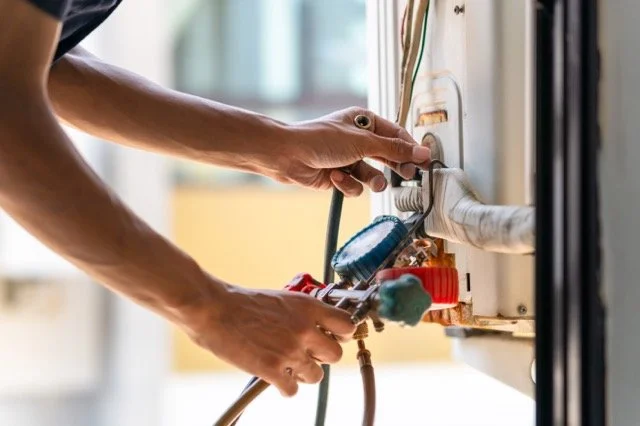
When our technicians arrive for a pre-winter tune-up, they're looking at components you can't safely access or diagnose without proper tools and training. Here's what happens during a professional inspection:
Heat exchanger inspection: This is the most critical safety check. A cracked heat exchanger allows combustion gases — including carbon monoxide — to mix with your home's air. We use mirrors and cameras to inspect the exchanger from multiple angles. In furnaces older than 15 years, cracks are common, especially if the furnace has been short-cycling or running with dirty filters.
Burner cleaning and adjustment: Gas burners accumulate dust and debris that restrict airflow and cause incomplete combustion. We vacuum the burner assembly, check the igniter, and measure the flame with a combustion analyzer to ensure proper air-fuel mixture. This step alone can improve efficiency by 5-10%.
Blower motor and capacitor testing: The blower motor is the workhorse of your furnace. We measure amp draw, check capacitor voltage, and lubricate bearings if applicable. Capacitors weaken over time — a $40 part that, if it fails, leaves you without heat and potentially damages a $600 blower motor.
Safety controls verification: Modern furnaces have multiple safety switches: limit switches, pressure switches, flame sensors. We test each one to ensure the furnace shuts down properly if something goes wrong. This is especially important in Michigan, where power outages during ice storms can cause voltage spikes that fry control boards.
If you're wondering whether a furnace tune-up is really necessary every year, consider this: the average emergency service call in January costs $400-$800 just for the diagnosis and trip charge. A pre-season tune-up costs $150-$200 and prevents most of those emergencies.
Filter Changes and Air Quality
Let's talk about the cheapest, most effective maintenance task that 70% of homeowners neglect: changing the furnace filter. We've pulled filters out of furnaces in Rochester Hills that haven't been changed in three years. They're black, rigid, and completely blocking airflow. The furnace is working three times harder than it should, the house has hot and cold spots, and the homeowner is wondering why their gas bill is $400 in January.
Understanding Filter Ratings
Furnace filters are rated by MERV (Minimum Efficiency Reporting Value), which measures how well they capture particles. Here's what matters for Michigan homes:
MERV 8: Standard fiberglass filter. Captures dust, pollen, and larger particles. Good for most homes without specific air quality concerns. Change every 1-2 months during heating season.
MERV 11-13: Pleated filter that captures smaller particles including mold spores, pet dander, and some bacteria. Recommended for homes with allergies or pets. Change every 2-3 months, but check monthly — these filters load up faster because they're catching more.
MERV 16+: HEPA-grade filtration. Unless your furnace is specifically designed for high-resistance filters, don't use these. They restrict airflow so much that the blower motor overheats and the heat exchanger cracks from insufficient cooling. We've replaced furnaces damaged by well-meaning homeowners who installed HEPA filters without checking their system's specs.
Michigan Filter Rule: During heating season (November through March), check your filter monthly. Homes with pets, multiple occupants, or located near construction sites should change filters every 30 days regardless of MERV rating.
The Cost of Dirty Filters
A dirty filter doesn't just reduce air quality — it damages your furnace and costs you money. Here's how:
Reduced airflow: When the blower can't pull enough air through the filter, the furnace overheats. The limit switch trips repeatedly, the furnace short-cycles, and the heat exchanger expands and contracts more than it's designed to. This is how heat exchangers crack prematurely.
Higher energy bills: A furnace running with a clogged filter uses 15-20% more energy to heat your home. For a house in Shelby Township with a $250 monthly gas bill, that's $50 wasted every month — $200 over the heating season. A box of filters costs $40.
Blower motor failure: When the motor has to work harder to push air through a blocked filter, it draws more amps and runs hotter. Blower motors are designed for a specific load. Exceed that load consistently, and you'll burn out the motor. That's a $500-$800 repair that a $4 filter would have prevented.
If you're experiencing uneven heating or frequent furnace cycling, the problem might be as simple as airflow restriction. This is one of the issues we address during short-cycling diagnostics in Metro Detroit homes.
Thermostat Settings and Smart Upgrades
Your thermostat is the brain of your heating system, but most homeowners are using it wrong. We see thermostats in Clinton Township set to 74 degrees 24/7, then the homeowner complains about high gas bills. We see programmable thermostats still using the factory settings from 2015. And we see smart thermostats installed incorrectly, calling for heat when the system isn't compatible.
Optimal Winter Settings for Michigan Homes
The Department of Energy recommends 68°F when you're home and awake, 60-62°F when you're asleep or away. That's the national recommendation. In Michigan, where we're heating against 10-20 degree outdoor temps for months, those settings make sense if you want to balance comfort and cost.
Here's what we tell homeowners in Macomb County: every degree you lower your thermostat saves about 3% on heating costs. If your winter gas bills average $300/month and you drop from 72°F to 68°F, you'll save about $36/month — $144 over the heating season. That pays for a programmable thermostat in one winter.
The setback debate: Some homeowners think it's more efficient to keep the house at a constant temperature rather than letting it cool down when they're gone. That's not how thermodynamics works. Your furnace doesn't "work harder" to reheat the house — it works the same. It just runs longer. But while the house was cooler, you weren't losing heat through the walls, windows, and attic. The total energy used is less.
When to Upgrade Your Thermostat
If your thermostat is more than 10 years old, it's probably costing you money. Here's when to upgrade:
You have a manual thermostat: Round dial or slider thermostats from the 1980s-90s have a 3-5 degree temperature swing. They're inaccurate, and they cause your furnace to short-cycle. A basic programmable thermostat costs $50 and will pay for itself in one season through reduced runtime.
You have a programmable thermostat you never programmed: If you're manually adjusting your thermostat every day, you're not saving energy. Modern programmable thermostats with 7-day scheduling let you set different temperatures for weekdays, weekends, mornings, and nights. Set it once and forget it.
You want remote control and usage data: Smart thermostats like the Nest, Ecobee, and Honeywell Home connect to Wi-Fi and let you adjust temperature from your phone. More importantly, they track your heating patterns and show you exactly when and why your furnace is running. This data is invaluable for diagnosing efficiency problems.

One caveat: not all furnaces are compatible with smart thermostats. If you have an older system without a C-wire (common wire for continuous power), you'll need an adapter or professional installation. We've fixed multiple furnaces in Troy where homeowners installed smart thermostats themselves and fried the control board because of incompatible wiring.
Ductwork and Airflow Issues
Your furnace might be running perfectly, but if the ductwork is leaking, poorly insulated, or undersized, you're heating your basement and attic instead of your living space. This is especially common in older homes throughout Metro Detroit — 1960s ranches with original ductwork that was barely adequate when installed and is now falling apart.
Signs Your Ductwork Needs Attention
Hot and cold rooms: If your master bedroom is 72 degrees and the kids' rooms are 64, you have an airflow imbalance. This could be closed dampers, disconnected ducts, or undersized supply runs. We find this constantly in homes where previous owners finished basements or added rooms without extending the ductwork properly.
High dust levels: If you're dusting every week and the house still feels dirty, your return ducts are probably leaking. They're pulling air from the attic, crawl space, or wall cavities — bringing dust, insulation fibers, and allergens into your living space.
Visible gaps or disconnected sections: Go down to your basement with a flashlight and look at the ductwork. If you see gaps at the seams, sections held together with duct tape (which fails after a few years), or ducts that have fallen off the plenum, you're losing 20-40% of your heated air before it reaches the rooms.
High energy bills with no explanation: If your furnace is running constantly but the house isn't getting warmer, the heat is going somewhere. In Michigan homes with ductwork in unconditioned spaces (attics, crawl spaces), poorly insulated ducts lose 25-30% of heat before the air reaches the vents.
When to Call for Duct Sealing
Duct sealing isn't a DIY project. Proper sealing requires mastic (a thick adhesive coating) and metal-backed tape, not the fabric "duct tape" you buy at hardware stores. We use aerosol duct sealing for systems where the leaks are inside walls or otherwise inaccessible — a process where we pressurize the ductwork and spray a sealant that finds and plugs leaks from the inside.
If you're experiencing uneven heating despite a functioning furnace, the problem is often in the distribution system. This is one of the most common issues we diagnose during HVAC service calls in Metro Detroit.
When to Replace vs Repair Your Furnace
This is the question we get every November: "My furnace is 18 years old and needs a $900 repair. Should I fix it or replace it?" The answer depends on more than just age — it's about efficiency, reliability, and total cost of ownership.
The Age Factor
Gas furnaces last 15-20 years in Michigan. The actual lifespan depends on maintenance, installation quality, and runtime. A furnace in a 1,200 sq ft ranch runs less than one in a 3,500 sq ft colonial, so it lasts longer. But once you hit 15 years, you're on borrowed time.
Here's the rule we use: if the furnace is more than 15 years old and the repair costs more than 50% of a new furnace, replace it. A mid-efficiency furnace for a typical Metro Detroit home costs $3,500-$5,500 installed. If your 17-year-old furnace needs a $2,000 heat exchanger, you're throwing money at a system that will need another major repair within two years.
Efficiency Upgrades
Furnaces manufactured before 2000 typically have AFUE (Annual Fuel Utilization Efficiency) ratings of 60-80%. That means 20-40% of the gas you're paying for goes up the chimney. Modern furnaces are 95-98% efficient — nearly all the gas is converted to heat.
For a Sterling Heights home with a $2,400 annual heating cost, upgrading from an 80% AFUE furnace to a 96% AFUE furnace saves about $480/year. The furnace pays for itself in 8-10 years through energy savings alone. Factor in avoided repair costs on the old furnace, and the payback is closer to 5-6 years.
Equipment We Install and Why
We're not brand-loyal — we're performance-loyal. We install Carrier, Lennox, Trane, Rheem, Bryant, and Goodman depending on the home's needs and the homeowner's budget. Here's what matters:
Carrier and Trane: Premium brands with excellent warranties and parts availability. We recommend these for larger homes or homeowners who plan to stay in the house 15+ years. The upfront cost is higher, but the reliability is worth it.
Lennox and Rheem: Solid mid-range options with good efficiency ratings and reasonable pricing. These are the workhorses we install in most Metro Detroit homes. Reliable, efficient, and priced fairly.
Bryant and Goodman: Budget-friendly options that still meet modern efficiency standards. Good choice for rental properties, homes being sold soon, or homeowners who need to replace a furnace but don't have $6,000 to spend.
What we don't do: pressure you into the most expensive option. If a single-stage 80% AFUE furnace meets your needs and budget, that's what we'll install. If your home would benefit from a two-stage modulating furnace with variable-speed blower, we'll explain why and let you decide. No commission-based sales. No upselling equipment you don't need.
If you're trying to decide between repair and replacement, read our detailed breakdown of furnace replacement costs and best brands for Troy homes — the same principles apply throughout Southeast Michigan.
The Value of Preventive Maintenance
We launched the Next Care Plan because we were tired of seeing the same pattern: homeowners skip maintenance for years, the furnace fails in January, and they're forced into an emergency replacement at the worst possible time with no ability to compare options or negotiate pricing.
The Next Care Plan costs $5/month — $60/year. For that, you get two service visits: a fall furnace tune-up and a spring AC tune-up. We inspect, clean, and test every component. We catch problems when they're small and cheap to fix. And if something does break, you get priority scheduling and 10% off repairs.
The Math on Preventive Maintenance
Here's what we prevent with regular maintenance:
Heat exchanger cracks: Caused by short-cycling, dirty filters, and blower failures. Replacement cost: $1,500-$2,500 (often more than the furnace is worth). Prevented by: annual cleaning, filter changes, and airflow testing.
Blower motor failure: Caused by lack of lubrication, dirty blower wheels, and capacitor failure. Replacement cost: $500-$800. Prevented by: annual lubrication (if applicable), cleaning, and capacitor testing.
Igniter failure: Hot surface igniters crack from thermal stress and contamination. Replacement cost: $300-$400. Prevented by: keeping the burner assembly clean and checking for proper voltage.
Energy waste: A poorly maintained furnace uses 15-30% more gas than a tuned system. For a home with $250/month winter gas bills, that's $300-$600 wasted per season. Prevented by: annual tune-ups that restore efficiency.
Add it up: the Next Care Plan costs $60/year and prevents $2,000-$4,000 in emergency repairs and wasted energy. Even if you only avoid one major repair every five years, you're ahead.
Real Example: Last November, we serviced a furnace in Warren during a routine Next Care Plan visit. Found a cracked limit switch that would have failed within days — probably during the first cold snap. Replaced it for $180. Two weeks later, the polar vortex hit and temps dropped to -5°F. That homeowner stayed warm while their neighbors were calling for emergency service at $800 just for the after-hours visit.
Ready to Prep Your Heating System for Winter?
NEXT Heating & Cooling has been keeping Michigan homes comfortable for over 35 years. Our NATE-certified technicians provide honest diagnostics, fair pricing, and no-pressure service. Schedule your pre-winter furnace tune-up before the cold arrives.
Schedule Your ServiceFrequently Asked Questions
Check your filter monthly during heating season (November-March) and change it when it looks dirty or every 1-2 months minimum. Homes with pets, multiple occupants, or high dust levels should change filters monthly. Using a higher MERV rating filter (11-13) requires more frequent changes because these filters capture more particles and load up faster.
Schedule your furnace tune-up in September or October, before the first freeze. This gives you time to address any issues before you need heat. Avoid waiting until November — that's when every homeowner calls, and you'll wait longer for service. The Next Care Plan includes priority scheduling so you're not competing for appointments.
Gas furnaces last 15-20 years with proper maintenance. Michigan's long heating season means furnaces run 2,000-3,000 hours per year, which shortens lifespan compared to warmer climates. Furnaces that receive annual tune-ups, regular filter changes, and prompt repairs when needed consistently reach 18-20 years. Neglected furnaces often fail at 12-15 years.
If your current furnace is 15+ years old with an AFUE rating below 80%, upgrading to a 95-98% AFUE furnace typically pays for itself in 8-10 years through energy savings. For a home with $2,400 annual heating costs, upgrading from 80% to 96% efficiency saves about $480/year. Factor in avoided repairs on the old furnace, and the payback is faster. We help you calculate the actual savings for your home during the estimate.
Short-cycling (furnace turning on and off every few minutes) is usually caused by restricted airflow from a dirty filter, a failing blower motor, or an oversized furnace. It can also indicate a cracked heat exchanger or faulty limit switch. Short-cycling wastes energy, increases wear on components, and can crack the heat exchanger. If your furnace is short-cycling, have it inspected immediately. Read more about why short-cycling happens and how we fix it.
If your existing thermostat has a C-wire (common wire for continuous power), installing a smart thermostat is straightforward. If there's no C-wire, you'll need an adapter or professional installation. We've repaired multiple furnaces where DIY smart thermostat installations damaged control boards due to incompatible wiring. If you're unsure, have a technician verify compatibility before purchasing a smart thermostat.
First, check the obvious: thermostat settings, circuit breaker, furnace power switch (often looks like a light switch near the furnace), and the filter. If those are fine and the furnace still won't run, call for service. NEXT Heating & Cooling offers 24/7 emergency HVAC service in Macomb County and throughout Southeast Michigan. Don't let the house drop below 55°F — frozen pipes cause far more damage than a furnace repair costs.