

Lennox Furnace Repair in Southeast Michigan | NEXT HVAC
When your Lennox furnace stops heating in the middle of a Michigan polar vortex, you need answers fast. Lennox makes some of the most reliable gas furnaces on the market, but even the best equipment needs repair eventually. After 35 years of furnace installation and repair across Macomb, Oakland, and St. Clair counties, we've diagnosed and fixed thousands of Lennox furnaces in homes from Sterling Heights to Rochester Hills.
Most Lennox furnace problems fall into predictable categories: ignition failures, pressure switch issues, flame sensor fouling, and blower motor wear. Some repairs cost $150 to $400. Others push $1,500 or more. The key is knowing when to repair and when to replace, especially if your furnace is 15+ years old and facing a second or third expensive fix.
This guide walks through the most common Lennox furnace repairs we handle in Southeast Michigan, what they cost, how to prevent them, and when it makes financial sense to replace instead of repair. We'll also explain why choosing a NATE-certified HVAC technician who knows Lennox equipment inside and out matters more than you might think.
Why Lennox Furnaces Dominate Southeast Michigan Homes
Walk through any subdivision in Troy or Warren, and you'll find Lennox furnaces in at least a third of the homes. There's a reason for that. Lennox has built a reputation for high-efficiency gas furnaces that hold up through decades of Michigan winters. Their SL280V and EL296V models routinely hit 96% to 98% AFUE (Annual Fuel Utilization Efficiency), which means almost every dollar you spend on natural gas goes toward heating your home instead of venting out the chimney.
Lennox also engineers furnaces specifically for cold climates. Their two-stage and modulating burners adjust output based on outdoor temperature, so the furnace doesn't cycle on and off constantly when it's 15°F outside. This matters in Michigan, where heating season runs from October through April and polar vortex events can push wind chills below zero for days at a time.
But even Lennox furnaces need repairs. High-efficiency models use more complex components than older 80% AFUE furnaces: electronic ignition instead of standing pilot lights, pressure switches to monitor exhaust venting, variable-speed blower motors, and flame sensors that shut down the burner if they detect incomplete combustion. These parts improve efficiency and safety, but they also introduce more points of failure.
The good news: most Lennox furnace repairs are straightforward if you catch them early. The bad news: ignoring warning signs like short-cycling, weak airflow, or strange noises can turn a $200 repair into a $2,000 emergency replacement in the middle of January.
Most Common Lennox Furnace Problems We Fix in Macomb County
After three decades of diagnosing Lennox furnaces across Southeast Michigan, we see the same failures repeat year after year. Here are the five most common Lennox furnace repairs we handle, what causes them, and what they mean for your heating system.
1. Ignition System Failures
Lennox furnaces manufactured after 2010 use hot surface ignitors (HSI) or intermittent pilot ignition instead of standing pilot lights. The hot surface ignitor is a ceramic element that glows orange-hot to light the gas burners. Over time, the ignitor becomes brittle and cracks, especially if your furnace short-cycles or experiences power surges. When the ignitor fails, the furnace won't light. You'll hear the blower run, but no heat comes out of the vents.
Replacing a hot surface ignitor takes 30 to 45 minutes and costs $150 to $300 including the service call. It's one of the most common repairs we handle in Sterling Heights and Shelby Township, especially in furnaces 10 to 15 years old. If your ignitor has failed twice in three years, you might have a deeper electrical issue or a furnace that's oversized for your home and cycling too frequently.
2. Pressure Switch Problems
High-efficiency Lennox furnaces use a pressure switch to confirm that the draft inducer motor is pulling combustion gases out of the heat exchanger before the gas valve opens. If the pressure switch doesn't close, the furnace won't ignite. This safety feature prevents carbon monoxide from backing up into your home.
Pressure switch failures happen for several reasons: the draft inducer motor is weak, the exhaust vent is blocked by ice or debris, or the pressure switch hose has a crack or leak. We see a lot of pressure switch issues in Michigan homes where the PVC exhaust vent terminates too close to the ground and gets buried in snow during heavy lake-effect storms. Clearing the vent and replacing the pressure switch costs $200 to $400. If the draft inducer motor itself is failing, that repair jumps to $500 to $800.
3. Flame Sensor Fouling
The flame sensor is a thin metal rod positioned near the burners. It detects the presence of a flame and tells the gas valve to stay open. If the sensor gets coated with carbon buildup or corrosion, it can't detect the flame properly. The furnace lights for a few seconds, then shuts down. This cycle repeats every few minutes, and you're left with no heat.
Cleaning a flame sensor takes 15 minutes and costs $100 to $150 as part of a service call. If you're enrolled in our $5/month HVAC maintenance plan, we clean the flame sensor during your annual fall furnace tune-up, which prevents most of these failures before they happen.
4. Blower Motor and Capacitor Wear
Lennox furnaces use variable-speed or multi-speed ECM (electronically commutated motor) blowers to move heated air through your ductwork. These motors are more efficient than old single-speed blowers, but they're also more expensive to replace. Blower motor failures usually show up as weak airflow, loud squealing noises, or the furnace running constantly without heating the house.
Blower motor capacitors fail more often than the motors themselves. The capacitor stores electrical energy to start the motor. When it wears out, the motor struggles to start or won't run at all. Replacing a capacitor costs $150 to $250. Replacing the entire blower motor assembly costs $600 to $1,200 depending on the model. If your furnace is 15+ years old and the blower motor fails, you're often better off replacing the entire furnace rather than sinking $1,000 into a repair.
5. Heat Exchanger Cracks
The heat exchanger is the metal chamber where combustion gases heat the air that circulates through your home. Over time, the heat exchanger can develop cracks from thermal stress, especially in furnaces that short-cycle or run in oversized, poorly designed systems. A cracked heat exchanger is a serious safety issue because it can leak carbon monoxide into your home.
If we find a cracked heat exchanger during an inspection, we'll red-tag the furnace and shut it down immediately. Heat exchanger replacement costs $1,500 to $3,000, which is rarely worth it on a furnace older than 12 years. Most homeowners choose to replace the entire furnace at that point. Lennox offers a limited lifetime warranty on heat exchangers for the original owner, but the warranty only covers the part itself, not the labor to replace it, which can run $1,000 to $1,500.
When to Repair vs. Replace Your Lennox Furnace
Every furnace repair comes with the same question: should I fix this or replace the whole system? The answer depends on three factors: the age of the furnace, the cost of the repair, and how many repairs you've made in the past few years.
Here's the rule we use with our customers in Rochester Hills and Clinton Township: multiply the age of your furnace by the cost of the repair. If the result is more than $5,000, replacement makes more financial sense. For example, if your furnace is 15 years old and the repair costs $400, that's $6,000 (15 × $400). You're better off putting that money toward a new furnace with a 10-year parts warranty and better efficiency.
Age matters more than you might think. Most Lennox gas furnaces last 18 to 22 years in Southeast Michigan with proper maintenance. If your furnace is 12 to 15 years old and facing its second or third repair, you're entering the danger zone where multiple components start failing in succession. You might fix the ignitor this year, the blower motor next year, and the gas valve the year after that. At some point, you're just throwing money into an aging system.
Quick Decision Guide: Repair if your furnace is under 10 years old and the repair costs less than $800. Consider replacement if your furnace is 15+ years old, the repair costs more than $1,200, or you've had multiple repairs in the past three years. If you're unsure, ask your technician to calculate your furnace's efficiency and compare it to new models. Upgrading from an 80% AFUE furnace to a 96% AFUE model can save $300 to $500 per year on heating bills in a typical Michigan home.
One more factor: if you're planning to replace your furnace and AC together, it often makes sense to do both at the same time. Installing a matched system improves efficiency and reduces long-term maintenance costs. Plus, you'll only pay for one installation instead of two separate service calls.
What Lennox Furnace Repair Actually Costs in Metro Detroit
Lennox furnace repair costs vary depending on the part that failed, the complexity of the repair, and whether the work happens during business hours or after midnight in an emergency. Here's what we charge for the most common repairs across Southeast Michigan, including the service call and labor.
- Flame sensor cleaning: $100 to $150
- Hot surface ignitor replacement: $150 to $300
- Pressure switch replacement: $200 to $400
- Blower motor capacitor replacement: $150 to $250
- Gas valve replacement: $400 to $700
- Draft inducer motor replacement: $500 to $800
- Blower motor assembly replacement: $600 to $1,200
- Control board replacement: $400 to $900
- Heat exchanger replacement: $1,500 to $3,000
Emergency repairs cost more. If your furnace dies at 2 AM on a Saturday during a polar vortex event, expect to pay an additional $150 to $300 for after-hours service. That's why we recommend enrolling in a preventive maintenance plan that includes priority scheduling and discounted repairs. Our Next Care Plan costs $5 per month and includes two annual tune-ups, 10% off all repairs, and no service call fees. Over the life of your furnace, that saves most homeowners $500 to $1,000 in repair costs.
One thing to watch out for: some contractors charge separately for the diagnostic fee, the service call, and the repair itself. We don't do that. Our service call fee covers the diagnostic, and if you approve the repair, we apply the service call fee to the total cost. No surprises, no hidden charges. That's part of the old-school contractor values we brought from NEXT Exteriors to NEXT Heating & Cooling.
How to Prevent Expensive Lennox Furnace Repairs
Most Lennox furnace repairs are preventable if you stay on top of basic maintenance. Here's what you should do every year to keep your furnace running efficiently and avoid expensive breakdowns in the middle of winter.
Schedule Annual Fall Furnace Tune-Ups
The single most important thing you can do is schedule a professional furnace tune-up every fall before heating season starts. A thorough tune-up includes cleaning the burners and flame sensor, inspecting the heat exchanger for cracks, testing the ignition system, checking the pressure switch and exhaust vent, lubricating the blower motor, and measuring combustion efficiency.
We catch 80% of furnace problems during tune-ups before they cause a breakdown. A $150 tune-up in October prevents a $1,500 emergency repair in January. If you're on our affordable HVAC maintenance plan, your fall furnace tune-up is already included.
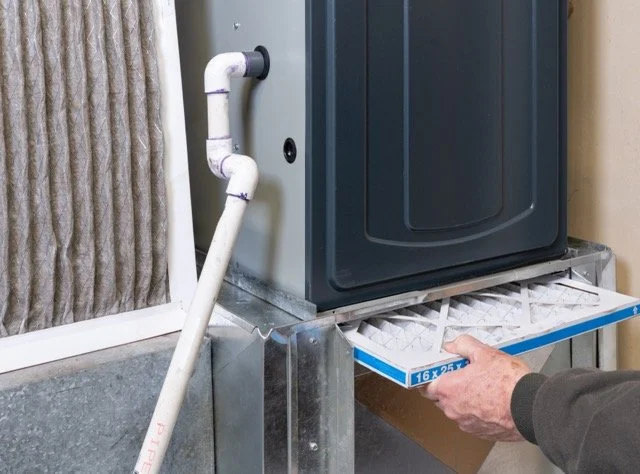
Replace Your Furnace Filter Every 60 to 90 Days
A dirty furnace filter is the number one cause of blower motor failures, pressure switch issues, and heat exchanger cracks. When the filter clogs, airflow drops. The furnace overheats, the blower motor works harder, and the heat exchanger experiences uneven thermal stress. Over time, this leads to expensive repairs.
Check your filter once a month during heating season. If it looks gray or brown, replace it. Most homes in Southeast Michigan need a new filter every 60 to 90 days, depending on whether you have pets, allergies, or a dusty basement. Use a MERV 8 to MERV 11 filter for the best balance of filtration and airflow. Avoid cheap fiberglass filters, they don't filter anything. And don't use MERV 13+ filters unless your furnace is designed for high-resistance media, they'll choke the airflow and damage the blower motor.
Keep Your Exhaust Vent Clear
High-efficiency Lennox furnaces vent through PVC pipes that terminate outside your home, usually on a side wall or through the roof. In Michigan winters, snow, ice, and debris can block these vents and cause pressure switch failures or carbon monoxide buildup. Walk around your house after every heavy snowfall and make sure the exhaust vent is clear. If you see ice forming around the vent, chip it away carefully without damaging the pipe.
Don't Ignore Warning Signs
Most furnace failures give you advance notice. If your furnace is short-cycling (turning on and off every few minutes), making loud banging or squealing noises, blowing lukewarm air, or producing a yellow flame instead of a blue flame, call for service immediately. Waiting until the furnace dies completely usually turns a $200 repair into a $1,000 emergency. Our technicians are trained to diagnose Lennox-specific issues quickly, and we carry most common parts on the truck so we can fix the problem in one visit.
Why You Should Choose a Lennox-Authorized Contractor
Not all HVAC contractors are created equal, especially when it comes to repairing Lennox furnaces. Lennox equipment uses proprietary control boards, ignition modules, and variable-speed blower motors that require specific diagnostic tools and training. A contractor who mostly works on Carrier or Trane systems might not have the experience or parts inventory to fix your Lennox furnace efficiently.
NEXT Heating & Cooling is a Lennox-authorized dealer and service provider. That means our technicians receive factory training on Lennox equipment, we stock genuine Lennox parts, and we have access to Lennox technical support when we encounter unusual problems. We also work with Carrier, Trane, Rheem, Bryant, Goodman, Amana, York, and RUUD, so we're not locked into one brand. But when it comes to Lennox furnace repair, we know the systems inside and out.
Our technicians are NATE-certified (North American Technician Excellence), which is the highest certification standard in the HVAC industry. NATE certification requires passing rigorous exams on heating, cooling, air distribution, and refrigerant handling. It's the difference between hiring someone who learned HVAC on YouTube and hiring a professional who understands building science, Michigan mechanical codes, and manufacturer specifications.
We're also a licensed Michigan HVAC contractor operating under Premier Builder Inc., the same company that's been serving Southeast Michigan since 1991 through NEXT Exteriors. We're BBB A+ accredited, EPA 608 certified for refrigerant handling, and we carry full liability insurance. You won't find us cutting corners or pushing unnecessary equipment upgrades. We diagnose the problem, explain your options, and let you decide.
Need Lennox Furnace Repair in Southeast Michigan?
NEXT Heating & Cooling has been keeping Michigan homes comfortable for over 35 years. Our NATE-certified technicians diagnose and repair Lennox furnaces fast, with honest pricing and no-pressure service. We serve Macomb, Oakland, and St. Clair counties with same-day emergency repairs available.
Schedule Your RepairFrequently Asked Questions About Lennox Furnace Repair
Most Lennox gas furnaces last 18 to 22 years in Southeast Michigan with proper maintenance. High-efficiency models (96% to 98% AFUE) tend to last slightly shorter, around 15 to 20 years, because they use more complex components like variable-speed blowers and electronic controls. Furnaces that receive annual tune-ups and regular filter changes consistently outlast neglected systems by 5 to 7 years. If your Lennox furnace is approaching 15 years old and needs a major repair, it's worth calculating whether replacement makes more financial sense.
It depends on the cost of the repair and the furnace's overall condition. If the repair costs less than $500 and your furnace has been reliable with no other issues, repair makes sense. If the repair costs $1,000+ or you've had multiple repairs in the past few years, replacement is usually the better investment. A new Lennox furnace comes with a 10-year parts warranty, better efficiency (which saves $200 to $400 per year on heating bills), and decades of reliable service. Use the age-times-cost rule: if your furnace age multiplied by the repair cost exceeds $5,000, replace it.
This is usually caused by a dirty flame sensor. The flame sensor detects the burner flame and tells the gas valve to stay open. When the sensor gets coated with carbon buildup or corrosion, it can't detect the flame properly. The furnace lights, runs for 3 to 5 seconds, then shuts down and repeats the cycle. Cleaning the flame sensor takes 15 minutes and costs $100 to $150. Other possible causes include a faulty pressure switch, a weak draft inducer motor, or a clogged exhaust vent. A technician can diagnose the exact issue in one service call.
Replacing a Lennox hot surface ignitor costs $150 to $300 including the service call and labor. The part itself costs $50 to $100, and the repair takes 30 to 45 minutes. Ignitors fail more often in furnaces that short-cycle or experience power surges. If your ignitor has failed twice in three years, you might have an oversized furnace or an electrical issue that's causing premature failure. A technician can test your system and recommend solutions to prevent future ignitor failures.
Lennox offers a 10-year limited parts warranty on most furnaces for the original owner. The warranty covers defective parts but not labor to install them. Heat exchangers carry a limited lifetime warranty, but again, labor is not included. If your furnace is under warranty, you'll pay for the service call and labor (typically $150 to $400) while the defective part is covered. Extended warranties and labor coverage are sometimes available through the installing contractor. Always register your furnace with Lennox within 60 days of installation to activate the full warranty.
Technically yes, but we don't recommend it unless you're comfortable working with gas appliances. The flame sensor is a thin metal rod located near the burners. You can remove it, clean it with fine-grit sandpaper or steel wool, and reinstall it. However, if you damage the sensor, cross-thread the mounting screw, or fail to position it correctly, the furnace won't light. You'll also need to shut off the gas supply and power to the furnace before starting. Most homeowners find it's easier and safer to pay $100 to $150 for a professional cleaning during a service call.
Several issues can cause a Lennox furnace to blow cold air. The most common: the thermostat is set to "fan on" instead of "auto," which runs the blower continuously even when the burners aren't firing. Other causes include a failed ignitor (the burners won't light), a tripped limit switch (the furnace overheated and shut down the burners), a dirty flame sensor (the burners light but shut off after a few seconds), or low gas pressure. If switching the thermostat to "auto" doesn't fix it, call for service. Running the blower without heat wastes energy and can indicate a safety issue that needs immediate attention.