

AC Installation Chesterfield Township MI | 2026 Guide
If you're planning an air conditioner installation in Chesterfield Township, you're probably asking the same questions we hear every spring: What size AC do I actually need? Is a higher SEER rating worth the extra cost in Michigan? Should I replace my furnace at the same time? And why do quotes from different contractors vary by thousands of dollars?
After 35 years installing heating and cooling systems in Metro Detroit, we've seen what works in Chesterfield Township homes—and what doesn't. This guide walks you through the entire process, from load calculations to equipment selection to what happens on installation day. No sales pitch. Just the technical details Michigan homeowners need to make a smart decision.
Why AC Sizing Matters More Than SEER Rating in Michigan
The biggest mistake we see in Chesterfield Township? Homeowners replacing their old 3-ton AC with another 3-ton unit because "that's what was there before." The problem: the original system might have been oversized from day one, or your home has changed—new windows, added insulation, finished basement.
Proper sizing starts with a Manual J load calculation. This room-by-room analysis accounts for your home's square footage, insulation levels, window orientation, ductwork design, and even the number of occupants. In Southeast Michigan's humid summers, an oversized AC short-cycles—it cools the air quickly but shuts off before removing humidity. You end up with a cold, clammy house and higher energy bills.
We've measured the impact: an oversized system can reduce runtime by 40%, which sounds good until you realize it's cycling on and off every 5-7 minutes instead of running steady 15-20 minute cycles. That constant starting and stopping wears out the compressor faster and leaves indoor humidity levels at 60-65% instead of the comfortable 45-50% range.
Michigan-Specific Consideration: Chesterfield Township homes built in the 1960s-1980s often have undersized return air ducts. Even a perfectly sized AC won't perform well if it's starving for airflow. We typically find 14x20 return grilles trying to feed a 3-ton system that needs 400 CFM per ton—1,200 CFM total. That requires roughly 240 square inches of return air, but a single 14x20 grille only provides 168 square inches after you account for the filter and grille resistance.
Before any reliable HVAC contractor in Metro Detroit quotes you a new system, they should evaluate your existing ductwork. Leaky ducts waste 20-30% of cooled air into unconditioned spaces like attics and crawlspaces. We use a duct blaster test to measure total leakage—anything over 10% of system airflow needs sealing.
SEER Ratings: What Actually Makes Sense for Chesterfield Township
SEER (Seasonal Energy Efficiency Ratio) measures how efficiently an air conditioner converts electricity into cooling over an entire season. Higher numbers mean lower operating costs. But here's what the sales brochures don't tell you: SEER ratings are calculated using a national average climate that doesn't match Michigan's weather patterns.
The DOE's SEER test assumes 2,080 hours of annual cooling. In Chesterfield Township, we typically run AC for 800-1,000 hours per year—less than half the national average. That changes the payback math dramatically. A jump from 14 SEER to 18 SEER might cost an extra $2,000-$3,000 upfront but only saves $150-$200 per year in electricity. You're looking at 12-15 years to break even, which is most of the system's expected lifespan.
For most Chesterfield Township homes, a 14-16 SEER system hits the sweet spot. You get modern efficiency without paying for features that don't deliver meaningful savings in Michigan's climate. That said, SEER isn't the only number that matters. Two-stage compressors and variable-speed air handlers improve comfort and humidity control even if the SEER rating stays the same.
Single-Stage vs. Two-Stage vs. Variable-Speed
This is where equipment selection gets interesting. A single-stage AC runs at 100% capacity whenever it's on—full blast or off, nothing in between. That works fine on the hottest days of July when you need maximum cooling. But on mild 75-degree days in June or September, it's overkill.
Two-stage compressors run at about 65% capacity most of the time, ramping up to 100% only when outdoor temperatures hit 85°F or higher. In practice, that means the system runs longer cycles at lower speed, removing more humidity and maintaining more consistent temperatures. We covered the technical details in our guide on single-stage vs two-stage vs modulating systems, and the same principles apply to cooling.
Variable-speed (modulating) systems take it further, adjusting compressor output in 1% increments from 40% to 100%. They're the quietest, most efficient option, but they also cost $1,500-$2,500 more than two-stage equipment. For Chesterfield Township's relatively short cooling season, the payback period stretches beyond what most homeowners find acceptable unless comfort is the top priority over cost.
What a New AC Installation Actually Costs in Macomb County
Let's talk real numbers. A complete central air conditioning installation in Chesterfield Township typically runs $3,500-$8,000 depending on equipment tier, home size, and installation complexity. Here's how that breaks down:
Budget Tier ($3,500-$4,500): Single-stage 14 SEER system from Goodman, Amana, or York. Basic single-speed air handler. Suitable for smaller homes (1,200-1,500 sq ft) with straightforward installations. These are solid, reliable units—we install dozens every year—but they're loud and don't handle humidity as well as higher-tier equipment.
Mid-Tier ($5,000-$6,500): Two-stage 15-16 SEER system from Bryant, Rheem, or Lennox. Variable-speed air handler for better humidity control. This is where most Chesterfield Township homeowners land. The two-stage compressor runs quieter, and the variable-speed blower improves air circulation and filtration even when the AC isn't running.
Premium Tier ($7,000-$8,500+): Variable-speed 17-20 SEER system from Carrier Infinity, Lennox Signature, or Trane XV. Communicating controls that optimize performance across heating and cooling. Quietest operation (as low as 55 dB at low speed). These systems make sense for larger homes, homeowners with specific comfort requirements, or situations where you're replacing both the furnace and AC at the same time.
Those prices assume your existing ductwork is in good shape and the installation is relatively straightforward. Add-ons that increase cost:
- Line set replacement: $400-$800 if the existing copper refrigerant lines are corroded or the wrong size for the new system
- Electrical upgrades: $300-$600 if your panel needs a new 240V circuit or disconnect box
- Duct modifications: $500-$2,000 for return air upgrades, supply register balancing, or sealing major leaks
- Concrete pad or composite base: $200-$400 if the old pad is cracked or settling
- Permits and inspections: $150-$250 in Chesterfield Township (required by code for any system replacement)
One cost-saving option: if your furnace is less than 10 years old and in good condition, you can often reuse the existing air handler or evaporator coil, which saves $800-$1,200. Just make sure the coil is compatible with the new outdoor unit and refrigerant type. Mixing R-410A equipment with an old R-22 coil doesn't work—you need matched components.
Financing Reality: Most HVAC contractors in Macomb County offer financing through third-party lenders at 0% APR for 12-24 months or extended terms at 6-9% APR. Read the fine print—some "0% interest" deals are actually deferred interest, meaning if you don't pay off the balance before the promotional period ends, you owe interest retroactively from day one. We work with straightforward lenders who charge simple interest only on the remaining balance.
Choosing the Right System: Central AC vs. Heat Pump
Here's a decision point most Chesterfield Township homeowners face: should you install a cooling-only air conditioner, or spend a bit more for a heat pump that provides both heating and cooling?
The cost difference is smaller than you might think. A heat pump costs about $500-$1,000 more than a comparable AC because the equipment is nearly identical—the main difference is a reversing valve that switches the refrigerant flow direction. The real question is whether you'll use the heating function.
Modern cold-climate heat pumps work efficiently down to 5°F outdoor temperature, and some models maintain capacity down to -15°F. That covers most Michigan winter days. But during polar vortex events when temperatures drop to -10°F or lower for extended periods, heat pumps struggle to keep up, and electric resistance backup heat kicks in—which is expensive to run.
That's why we often recommend dual-fuel systems for Chesterfield Township homes: a heat pump handles 80-90% of the heating season, and your existing gas furnace takes over when outdoor temps drop below 25-30°F. You get the efficiency of a heat pump during mild weather and the reliable capacity of gas heat when it's brutally cold. We explained the technical details and cost analysis in our heat pump cost guide for Metro Detroit.
If you're keeping your gas furnace and just adding cooling, a standard AC makes more sense. You're not paying for heating capacity you won't use. But if your furnace is 15+ years old and you're planning to replace it anyway, the heat pump conversation becomes more interesting.
The Installation Process: What to Expect from Start to Finish
A professional AC installation in Chesterfield Township typically takes 1-2 days depending on complexity. Here's what actually happens:
Day 1: Removal and Preparation
We start by recovering refrigerant from your old system using EPA-certified equipment—venting R-22 or R-410A to atmosphere is illegal and carries fines up to $37,500. Once the system is depressurized, we disconnect the line set, remove the old condenser, and pull out the indoor coil or air handler.
If we're reusing the existing ductwork, this is when we inspect it carefully. We're looking for disconnected joints, crushed flex duct, missing insulation, and return air leaks that pull unconditioned air from the attic or crawlspace. Any issues get flagged and discussed before we proceed.
The old equipment gets hauled away—we recycle the copper, aluminum, and steel at local scrap yards. Refrigerant goes to an EPA-certified reclamation facility.
Day 2: Installation and Commissioning
The new condenser goes on a level pad outside. We use composite plastic bases instead of concrete—they don't crack, they drain better, and they're easier to level on Michigan's freeze-thaw soil. The unit gets positioned at least 12 inches from the house with clear airflow on all sides.

Inside, we install the new evaporator coil or air handler, connect the line set, and run new electrical wiring if needed. The line set gets vacuum-tested to 500 microns to verify there are no leaks—we hold that vacuum for at least 15 minutes before releasing refrigerant into the system.
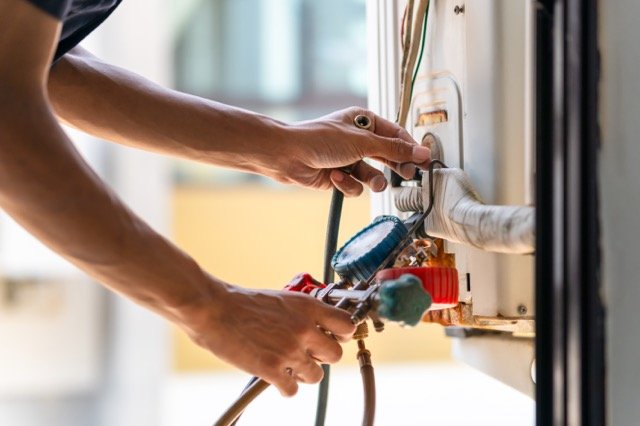
Refrigerant charging is where craftsmanship matters. We don't just "top off" the system and call it good. We measure superheat and subcooling at the outdoor unit, verify airflow at the air handler (should be 400 CFM per ton), and adjust the charge until both numbers fall within manufacturer specs. An overcharged system runs high head pressure and burns out the compressor. An undercharged system freezes the evaporator coil and doesn't cool properly.
Final steps: program the thermostat, verify all safety controls, test the condensate drain, and walk the homeowner through basic operation and maintenance. The entire job gets documented with photos, refrigerant charge data, and airflow measurements for warranty purposes.
Permit and Inspection: Chesterfield Township requires a mechanical permit for AC replacement. The permit costs about $150 and triggers an inspection within 7-10 days of installation. The inspector verifies proper electrical connections, refrigerant line sizing, condensate drain termination, and clearances around the equipment. Any licensed HVAC contractor handles the permit process—you shouldn't have to deal with it.
Signs Your Current AC Can't Make It Another Michigan Summer
Most homeowners wait until their AC dies on the hottest day of July before calling for replacement. That's the worst time to make a decision—you're desperate, contractors are slammed, and you end up paying premium pricing for whatever equipment is in stock. Better to plan ahead if you're seeing these warning signs:
Age Over 15 Years: Air conditioners have an average lifespan of 15-20 years in Michigan. After 15 years, efficiency drops, refrigerant leaks become common, and parts availability gets spotty. If your system is 12+ years old and needs a major repair (compressor, coil, condenser fan motor), replacement usually makes more financial sense than sinking $1,500-$2,500 into aging equipment.
R-22 Refrigerant: If your AC uses R-22 (Freon), you're on borrowed time. R-22 production ended in 2020, and prices have skyrocketed to $100-$150 per pound. A typical recharge costs $600-$1,200 and only lasts 1-3 years before the leak returns. New systems use R-410A or R-32 refrigerant, which is more efficient and environmentally friendly. We covered the phase-out timeline and homeowner implications in our R-410A refrigerant guide.
Frequent Repairs: If you're calling for service every year—capacitor one summer, contactor the next, refrigerant leak the year after—you're throwing good money after bad. Once repair costs exceed 50% of replacement cost, it's time to upgrade. That's usually around the $2,000-$2,500 mark for most systems.
Rising Energy Bills: AC efficiency degrades about 1-2% per year as coils accumulate dirt, refrigerant charge drifts, and motors wear out. A 15-year-old system might be running at 70-80% of its original efficiency even if it's still cooling. Compare your current summer electric bills to what you paid 5 years ago (adjusted for rate increases). If usage is up 20-30% with no other explanation, the AC is likely the culprit.
Uneven Cooling and Humidity Problems: Hot and cold spots throughout the house usually indicate airflow issues—either undersized ductwork, a failing blower motor, or a compressor that's losing capacity. High indoor humidity (over 60%) even when the AC is running suggests the system is short-cycling or oversized. Both problems point toward replacement rather than repair. For more on diagnosing cooling issues, see our article on why your AC isn't cooling your house.
Loud or Unusual Noises: Grinding, squealing, or banging sounds from the outdoor unit often indicate compressor or fan motor problems. We've diagnosed the most common noise issues in our guide to why your AC is making loud noise. Some noises are cheap fixes (loose fan blade, worn contactor). Others (compressor failure) cost more to repair than the system is worth.
Why Local Matters: Choosing a Chesterfield Township HVAC Contractor
You'll find dozens of HVAC companies serving Chesterfield Township. Some are one-truck operations run out of a garage. Others are national franchises with slick marketing and commissioned salespeople. Here's what actually matters when you're choosing who installs your AC:
Michigan Mechanical Contractor License: This is non-negotiable. Michigan requires anyone installing HVAC equipment to hold either a Mechanical Contractor License (the company) or work under a licensed contractor's supervision. You can verify licenses at michigan.gov/lara. Unlicensed work voids equipment warranties and creates liability issues if something goes wrong.
NATE Certification: North American Technician Excellence (NATE) is the industry's leading certification for HVAC technicians. It's voluntary, which means certified techs chose to prove their knowledge through rigorous testing. NATE-certified technicians understand refrigerant charging, airflow calculation, electrical troubleshooting, and combustion analysis—not just how to swap parts. At NEXT Heating & Cooling, every technician is NATE-certified because we believe technical competence matters more than sales skills.
Local Presence and Reputation: A company that's been serving Macomb County for 20+ years has a track record you can verify. Check BBB ratings, Google reviews, and references from neighbors. We've been operating under Premier Builder Inc. since 1991, and the same values that built NEXT Exteriors now guide our HVAC division—honest diagnostics, fair pricing, no upselling unnecessary equipment.
Manufacturer Partnerships: Factory-authorized dealers get better training, technical support, and warranty backing than companies that buy equipment through distributors. We're authorized dealers for Carrier, Lennox, Trane, Rheem, Bryant, Goodman, Amana, York, and RUUD. That means we can access engineering support when we run into unusual installation challenges, and our warranties are backed directly by the manufacturer.
Service After the Sale: What happens when your new AC needs service at 9 PM on a Saturday in July? We offer 24/7 emergency service because equipment failures don't follow business hours. Our Next Care Plan includes two annual tune-ups (fall furnace, spring AC), priority scheduling, 10% repair discounts, and no service call fees—all for $5/month. Preventive maintenance catches small problems before they become expensive emergencies.
No-Pressure Sales: We don't pay technicians on commission. That means when we show up to evaluate your system, we're not incentivized to sell you the most expensive option. If your 10-year-old AC needs a $300 capacitor, we'll tell you that instead of pushing a $6,000 replacement. If you do need a new system, we'll explain the differences between equipment tiers and let you decide what fits your budget and comfort priorities. That's what "changing contractor culture" means to us.
Ready to Get Started?
NEXT Heating & Cooling has been keeping Michigan homes comfortable for over 35 years. Get honest diagnostics and fair pricing from NATE-certified technicians who show up on time. We serve Chesterfield Township, Sterling Heights, Clinton Township, and all of Macomb County with the same old-school values that built our reputation.
Schedule Your ServiceFrequently Asked Questions
Most installations take 1-2 days. A straightforward replacement with existing ductwork in good condition typically completes in 6-8 hours (one day). If we're modifying ductwork, upgrading electrical service, or installing a heat pump with new controls, expect 1.5-2 days. We schedule installations to minimize disruption—you'll have cooling by the end of day one in most cases.
Sizing requires a Manual J load calculation based on your home's specific characteristics—square footage, insulation, windows, ductwork, and orientation. As a rough guideline, Michigan homes typically need 1 ton of cooling per 600-800 square feet, but that varies significantly. A 1,500 sq ft ranch might need 2 tons while a poorly insulated 1,500 sq ft colonial with west-facing windows needs 3 tons. Never rely on "rules of thumb"—get a proper load calculation from a licensed contractor.
If your furnace is 12+ years old, replacing both together usually makes sense. You save on labor costs (we're already there working on the system), you get matched equipment that works more efficiently together, and you avoid a second installation disruption in a few years. Plus, many manufacturers offer better warranties on matched systems. If your furnace is less than 8 years old and running well, you can replace just the AC. The decision point is around 8-12 years—that's when we sit down and run the numbers both ways.
For most Chesterfield Township homes, 14-16 SEER offers the best value. Jumping to 18-20 SEER costs $2,000-$3,000 more but only saves $150-$200 per year in our climate—that's a 12-15 year payback. Two-stage compressors and variable-speed air handlers improve comfort more than high SEER ratings in Michigan because they handle humidity better and run quieter. We usually recommend investing in better humidity control rather than chasing SEER numbers above 16.
We're factory-authorized dealers for Carrier, Lennox, Trane, Rheem, Bryant, Goodman, Amana, York, and RUUD. Each manufacturer has strengths in different price tiers and feature sets. We'll recommend specific models based on your budget, home size, and comfort priorities—not based on what earns us the highest margin. All our equipment comes with manufacturer warranties plus our labor warranty on installation.
Yes. Chesterfield Township requires a mechanical permit for any HVAC system replacement. The permit costs about $150 and includes an inspection to verify proper installation, electrical connections, and safety compliance. We handle the entire permit process—you don't need to visit the building department or schedule the inspection. Any contractor who says "we can skip the permit to save money" is cutting corners that could void your warranty and create liability issues.
Annual preventive maintenance in spring before cooling season starts. A proper tune-up includes cleaning the condenser coil, checking refrigerant charge, testing capacitors and contactors, verifying airflow, cleaning the evaporator coil, and testing all safety controls. This catches small problems before they become expensive failures and keeps the system running at peak efficiency. Our Next Care Plan includes spring AC tune-ups plus fall furnace service for $5/month—cheaper than a single service call and you get priority scheduling when you need emergency service.