

Outdoor AC Unit Shaking? When to Be Concerned | NEXT HVAC
You're standing in your backyard in Sterling Heights on a humid June afternoon, and you notice it: your outdoor AC condenser is shaking. Not just humming—actually vibrating hard enough that you can see it moving. Maybe it's been doing this for a while and you've been ignoring it, or maybe it just started yesterday and now you're wondering if you should shut it down before something expensive breaks.
Here's what you need to know. Some vibration is normal. Every air conditioner has a compressor that cycles on and off, a fan motor spinning at high speed, and refrigerant moving through coils under pressure. All of that creates movement. But excessive shaking—the kind that rattles the unit on its pad, loosens electrical connections, or sounds like metal grinding against metal—is not normal. And in Michigan, where freeze-thaw cycles shift concrete pads and spring storms dump debris into outdoor units, vibration problems get worse faster than they do in other climates.
We've been servicing air conditioners across Macomb, Oakland, and St. Clair counties for over 35 years. We've seen units walk themselves off their pads, compressor mounts fail catastrophically, and fan blades bent so badly they sound like helicopter rotors. This post will walk you through what causes normal vibration, what causes dangerous shaking, and when you need to call a technician before a $300 repair turns into a $4,000 compressor replacement.
What Causes Normal AC Unit Vibration
Let's start with what's supposed to happen. Your outdoor condenser unit has three main moving parts: the compressor, the condenser fan motor, and refrigerant flowing through the coils. Each one creates vibration.
Compressor startup: When your thermostat calls for cooling, the compressor kicks on. For the first 3-5 seconds, you'll feel a noticeable vibration as the motor spins up and refrigerant pressure builds. This is normal. On a single-stage compressor (the most common type in residential units), you'll feel this every time the unit cycles. On a two-stage or variable-speed compressor, the startup is smoother because the motor ramps up gradually instead of slamming on at full power.
Fan motor operation: The condenser fan pulls air through the coils to dissipate heat. The fan blade spins at 800-1,200 RPM depending on the unit. If the blade is balanced and the motor bearings are in good condition, you'll feel a slight hum. If the blade is even slightly bent or the bearings are worn, you'll feel a rhythmic wobble.
Refrigerant flow: As refrigerant moves from the evaporator coil inside your house to the condenser coil outside, it creates pressure changes that cause the copper lines to vibrate slightly. This is why you sometimes hear a whooshing or gurgling sound—it's refrigerant transitioning from liquid to gas and back. Totally normal.
Here's the benchmark: if you put your hand on the top of the unit and feel a steady, low-frequency hum—like the vibration of a washing machine on the spin cycle—that's normal. If the unit is visibly shaking, rattling loose parts, or making intermittent clanging sounds, that's not.
6 Causes of Excessive Shaking You Shouldn't Ignore
Now for the problems that actually matter. These are the issues we diagnose most often when homeowners in Troy, Warren, or Bloomfield Hills call us about a shaking AC unit.
1. Loose Mounting Hardware or Pad Settling
Your outdoor unit sits on a concrete pad or composite base. Over time—especially in Michigan, where freeze-thaw cycles are brutal—the pad can settle unevenly, crack, or shift. If the unit is no longer level, the compressor and fan will vibrate unevenly. The vibration loosens the mounting bolts that secure the unit to the pad, which makes the shaking worse, which loosens the bolts more. It's a feedback loop.
We see this constantly in older neighborhoods with 1960s-era concrete pads. The pad cracks, one corner sinks two inches, and suddenly a 15-year-old Carrier or Lennox unit that ran quietly for a decade is shaking like it's about to take off. The fix: re-level the pad (or install a new composite pad), tighten or replace the mounting hardware, and check that the unit is stable.
2. Failing Compressor Mounts
The compressor is the heaviest component in your AC unit—it weighs 60-100 pounds depending on the tonnage. It sits on rubber isolation mounts designed to absorb vibration. These mounts are made of rubber or neoprene, and they degrade over time from heat, ozone exposure, and constant compression cycles. When they fail, the compressor vibrates directly against the metal frame of the unit.
This is one of the most common causes of sudden, severe shaking. The unit ran fine for years, then one day it sounds like a jackhammer. What happened? The compressor mounts finally gave out. Replacing them costs $200-$400 in parts and labor. Ignoring it can crack refrigerant lines, damage electrical connections, and eventually kill the compressor itself—a $2,000-$4,000 repair.
3. Bent or Damaged Fan Blades
The condenser fan blade is usually made of aluminum or plastic. It's designed to be balanced within tight tolerances—if one blade is even slightly bent, it will wobble. In Michigan, we see bent fan blades all the time after spring storms. A tree branch falls on the unit, hail dents the top grille, or a homeowner accidentally kicks the unit while mowing the lawn. The blade bends, and now it's vibrating at 1,000 RPM.
Sometimes you can straighten a slightly bent blade, but usually it's safer to replace it. A new fan blade costs $50-$150 depending on the brand. If you keep running the unit with a bent blade, the motor bearings will wear out prematurely, and then you're replacing the motor too—$300-$600.
4. Debris Inside the Unit
Leaves, twigs, acorns, plastic bags, and—yes, we've seen this—small animals can get sucked into the condenser fan. When debris hits the spinning blade, it creates an immediate, violent vibration. Sometimes the debris gets wedged between the blade and the grille, causing a grinding sound. Other times it gets chopped up and ejected, but not before bending the blade or damaging the motor.
This is why we recommend checking your outdoor unit at the start of every cooling season. Turn off the power at the disconnect, remove the top grille, and look inside. Pull out any leaves, sticks, or other junk. It takes five minutes and can prevent a service call. If you're enrolled in the Next Care Plan, we do this for you twice a year—once in spring before AC season, once in fall before heating season.
5. Refrigerant Issues Causing Liquid Slugging
This one's more technical, but it's critical. If your system is low on refrigerant or has a restriction in the refrigerant lines, liquid refrigerant can flood back into the compressor. Compressors are designed to compress gas, not liquid. When liquid refrigerant enters the compressor, it causes a phenomenon called liquid slugging—the compressor tries to compress an incompressible fluid, which creates massive internal pressure spikes and violent vibration.
Liquid slugging sounds like someone hitting the compressor with a hammer. It's loud, it's rhythmic, and it will destroy the compressor in a matter of hours if you keep running the unit. If you hear this, shut the system down immediately and call a technician. Do not wait. This is an emergency. We've seen homeowners in Clinton Township and Shelby Township ignore this sound for days, thinking it would go away, and end up replacing the entire compressor.
For more on refrigerant problems, see our post on AC refrigerant leak signs in Bloomfield Hills.
6. Worn Motor Bearings
The condenser fan motor has bearings that allow the shaft to spin smoothly. Over time—especially if the motor runs in a dusty or humid environment—the bearings wear out. When that happens, the shaft wobbles, the fan blade wobbles, and the entire unit vibrates. You'll also hear a grinding or squealing sound.
Motor bearing failure is a gradual process. It starts as a faint squeak, progresses to a rhythmic clicking, and eventually becomes a loud grinding noise. If you catch it early, you can replace the motor before it seizes. If you ignore it, the motor will lock up, the unit will stop cooling, and you'll be stuck in a heat wave waiting for a replacement part.

Michigan-Specific Factors That Worsen Vibration
Living in Southeast Michigan means your outdoor AC unit faces conditions that accelerate wear and tear. Here's what we see in Macomb, Oakland, and St. Clair counties that makes vibration problems worse.
Freeze-Thaw Cycles Shifting Concrete Pads
Michigan winters are brutal. Temperatures swing from 10°F to 40°F and back multiple times per season. Water seeps into cracks in concrete pads, freezes, expands, and breaks the concrete apart. Over 10-15 years, a perfectly level pad can develop a 2-3 inch slope. Your AC unit, which weighs 150-250 pounds, sits on this tilted surface and vibrates unevenly.
The solution is either to re-level the existing pad with shims or to install a new composite pad. Composite pads (made of recycled plastic or rubber) don't crack, don't absorb water, and don't shift. They cost $100-$200 and last 20+ years. We install them on almost every new system we put in.
Spring Storms Depositing Debris
Michigan springs are windy. Every April and May, we get calls from homeowners in Lake Orion, Chesterfield, and Grosse Pointe Farms whose AC units are suddenly loud and shaky. We show up, pop the top grille, and find the fan full of leaves, twigs, and seed pods. The debris gets sucked in during a storm, jams the fan, and bends the blades.
Preventive maintenance solves this. If you schedule a spring AC tune-up before the first heat wave, we clean out the debris before it causes damage.
Humidity Causing Rust on Mounting Hardware
Southeast Michigan summers are humid. Dew points hit 70°F, and outdoor metal components rust fast. The bolts that secure your AC unit to the pad, the screws that hold the fan motor in place, and the brackets that support the compressor—all of them corrode over time. Rust weakens the metal, bolts snap, and suddenly your unit is vibrating because it's no longer securely fastened.
Stainless steel hardware costs a few dollars more, but it lasts decades longer. When we install a new system or perform a major repair, we replace rusted fasteners with stainless. It's a small detail that prevents callbacks.
When to Call a Technician Immediately
Not every vibration requires an emergency service call, but some do. Here's when you should shut the system down and call a licensed HVAC contractor right away.
The vibration is getting worse over time. If your unit shook a little last month and now it's shaking a lot, something is failing. Compressor mounts, motor bearings, and fan blades don't heal themselves. The problem will only get worse.
You hear metal-on-metal sounds. Grinding, clanging, or scraping noises mean metal parts are rubbing against each other. This destroys components fast. Shut the unit down and call for service.
The unit is walking off the pad. If your AC unit has moved several inches from where it was originally installed, the vibration is severe enough to overcome the weight of the unit. This can kink refrigerant lines, pull electrical connections loose, and damage the compressor.
Electrical disconnects are loosening. Vibration can loosen the screws in your outdoor disconnect box. If the power connections are loose, you risk arcing, overheating, and electrical fires. Check the disconnect box periodically—if screws are backing out, something is wrong.
The compressor sounds like it's hammering. This is liquid slugging. Do not run the unit. Call for emergency service. We offer 24-hour emergency HVAC service across Southeast Michigan.
Pro Tip: If you're not sure whether the vibration is serious, take a short video with your phone and text it to your HVAC contractor. A good tech can often diagnose the problem just from the sound and visual movement.
What a Tech Checks During a Vibration Diagnosis
When you call us about a shaking AC unit, here's what we do. This is the step-by-step diagnostic process we follow on every vibration-related service call.
Level and Stability Inspection
First, we check whether the unit is level. We use a bubble level on all four sides and measure any slope. If the pad has settled or shifted, we'll recommend re-leveling or replacing it. We also check whether the mounting bolts are tight and whether the pad itself is cracked or deteriorating.
Compressor Mount Condition
We visually inspect the rubber isolation mounts under the compressor. If they're cracked, compressed flat, or missing chunks, they need to be replaced. We also check whether the compressor is sitting evenly on all mounts—sometimes one mount fails and the compressor tilts, which creates uneven vibration.
Fan Blade Balance
We turn off the power and manually spin the fan blade. If it wobbles, we know the blade is bent or the motor bearings are worn. We also look for cracks, chips, or missing pieces. If the blade is damaged, we replace it. If the motor bearings are the problem, we replace the motor.
Electrical Connection Integrity
Vibration can loosen electrical connections over time. We check the disconnect box, the contactor, the capacitor connections, and the compressor terminals. If any connections are loose, we tighten them. If any wires are frayed or corroded, we replace them.
Refrigerant Pressures
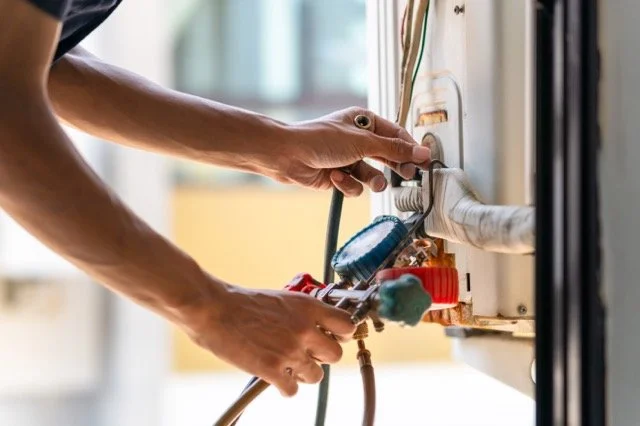
If we suspect liquid slugging or a refrigerant issue, we connect our manifold gauges and check the system pressures. Low suction pressure, high head pressure, or abnormal subcooling/superheat readings tell us there's a refrigerant problem. We'll trace the issue to a leak, a restriction, or an overcharge and fix it.
For more on how refrigerant problems cause performance issues, see our post on frozen AC coils.
Cost Reality: Repair vs. Replacement
Let's talk money. What does it actually cost to fix a shaking AC unit in Southeast Michigan, and when does it make more sense to replace the whole system?
Common Repair Costs
Re-leveling the pad: $150-$300. This includes shimming the pad or installing a new composite base and re-securing the unit.
Replacing compressor mounts: $200-$400. Parts are $50-$100, labor is 1-2 hours.
Replacing the fan blade: $100-$200. The blade itself is $50-$150, labor is minimal.
Replacing the fan motor: $300-$600. Motors cost $150-$400 depending on the brand and horsepower, plus 1-2 hours of labor.
Fixing loose electrical connections: $100-$200. Usually part of a standard service call.
Repairing refrigerant leaks and recharging: $400-$1,200 depending on the leak location and refrigerant type. R-410A is still relatively affordable; R-22 (Freon) is expensive and being phased out.
When Vibration Signals End-of-Life
If your AC unit is 15+ years old and the compressor mounts, fan motor, and refrigerant system all need work, you're looking at $1,500-$2,500 in repairs. At that point, replacement makes more sense.
Here's the math we walk homeowners through. A new 3-ton, 16 SEER air conditioner installed in Metro Detroit costs $3,500-$5,500 depending on the brand (Carrier, Lennox, Trane, Rheem, Bryant, Goodman, Amana, York, RUUD). If your current unit is old, inefficient, and needs major repairs, spending half the cost of a new system on an old one doesn't make financial sense—especially when the new system will be more efficient, more reliable, and come with a 10-year parts warranty.
We don't upsell. If your unit is 8 years old and just needs a new fan motor, we'll tell you to fix it. If it's 18 years old and needs a compressor, we'll tell you to replace it. We've been doing this for 35+ years under Premier Builder Inc., and our reputation is built on honest diagnostics. That's why we have an A+ BBB rating and hundreds of five-star reviews.
ROI Considerations for Older Units
Energy efficiency matters. A 15-year-old AC unit probably runs at 10-12 SEER. A new 16 SEER unit uses 30-40% less electricity. In a Michigan summer, that's $200-$400 in annual savings. Over 10 years, the new unit pays for itself in energy savings alone.
Add in the cost of repeated repairs on an old unit—$500 here, $800 there—and replacement often makes financial sense even if the old unit is technically repairable.
Ready to Get Started?
NEXT Heating & Cooling has been keeping Michigan homes comfortable for over 35 years. Get honest diagnostics and fair pricing from NATE-certified technicians who show up on time. If your outdoor AC unit is shaking or vibrating, we'll diagnose the problem and give you real options—not a sales pitch.
Schedule Your ServiceFrequently Asked Questions
Yes. Every air conditioner has a compressor and fan motor that create vibration during normal operation. You should feel a steady, low-frequency hum when you put your hand on the unit. If the vibration is rhythmic, loud, or causes the unit to visibly shake or rattle, that's not normal and indicates a mechanical problem.
Some issues—like tightening loose mounting bolts or removing debris from the fan—are DIY-friendly if you're comfortable working with basic tools. Always turn off power at the disconnect first. However, problems like failing compressor mounts, refrigerant issues, or motor bearing failure require a licensed HVAC technician. Attempting those repairs without proper training and tools can damage the system or create safety hazards.
Yes. Excessive vibration loosens electrical connections, cracks refrigerant lines, wears out motor bearings, and accelerates compressor failure. What starts as a minor annoyance can turn into a $2,000-$4,000 repair if ignored. If your unit is shaking more than it used to, get it checked before the damage spreads.
It depends on the cause. If the pad is slightly unlevel, you might run it for months or even a season before something fails. If the compressor mounts are shot or the compressor is liquid-slugging, you could destroy the compressor in hours or days. If you're hearing metal-on-metal sounds or the vibration is severe, shut the unit down and call a technician immediately.
The Next Care Plan includes two annual tune-ups (spring AC check, fall furnace check) where we inspect your outdoor unit for vibration, loose hardware, debris, and other issues before they become problems. If we find something during a tune-up, you get priority scheduling and 10% off repairs. The plan costs $5/month and has already saved hundreds of Michigan homeowners from expensive emergency repairs.
Vibration issues are more about installation quality, maintenance, and age than brand. That said, we see slightly fewer vibration complaints with units that have better compressor isolation systems—typically higher-end models from Carrier, Lennox, and Trane. Budget brands like Goodman and Amana can vibrate more if the compressor mounts are lower quality, but proper installation and maintenance make a bigger difference than brand name.
Yes. If the vibration is severe—especially if you hear grinding, clanging, or hammering sounds—shut the system down at the thermostat and the outdoor disconnect. Running a badly vibrating unit can cause catastrophic damage to the compressor, refrigerant lines, and electrical components. Call a technician and describe the symptoms. We offer 24-hour emergency service across Southeast Michigan if you need immediate help.