

AC Capacitor Failure in Warren MI: Symptoms, Repair Cost
Your AC clicks a few times, hums loudly, then nothing. The compressor won't start. The fan blade sits motionless. It's 87 degrees outside in Warren, and your thermostat is calling for cooling, but the outdoor unit just sits there buzzing like a trapped hornet.
Nine times out of ten, that's a failed capacitor. It's one of the most common AC repairs we handle at NEXT Heating & Cooling during Michigan summers — and one of the most straightforward to fix if you catch it early. But if you keep trying to run the system with a bad capacitor, you can burn out the compressor, which turns a $200 repair into a $3,500 disaster.
This guide covers exactly what a capacitor does, the warning signs Warren homeowners need to watch for, real repair costs based on our service data, and how fast we can get your AC back online. We've been diagnosing capacitor failures in Macomb County homes for over 35 years, and we'll walk you through this like we're standing in your driveway explaining it in person.
What a Capacitor Actually Does in Your AC System
A capacitor is a small cylindrical component inside your outdoor AC unit that stores electrical energy and releases it in powerful bursts to start motors and keep them running. Think of it like a battery, but instead of providing steady power, it delivers quick jolts of voltage exactly when motors need them.
Your AC system typically has two types of capacitors:
Start Capacitor: Provides the initial voltage jolt (400-500 volts) needed to overcome inertia and get the compressor motor spinning. Once the motor reaches operating speed, the start capacitor disconnects. Without it, the compressor can't start — you'll hear clicking or humming, but nothing happens.
Run Capacitor: Stays engaged while the system operates, providing continuous voltage support to keep the compressor and fan motors running efficiently. When a run capacitor fails, the motor can start but then overheats, cycles off prematurely, or runs inefficiently, driving up your electric bill.
Many modern AC units use a dual capacitor — a single component that handles both start and run functions. Carrier, Lennox, Trane, and Bryant systems installed in the last 15 years typically use dual capacitors rated between 35-80 microfarads (µF) for the compressor and 5-10 µF for the fan motor.
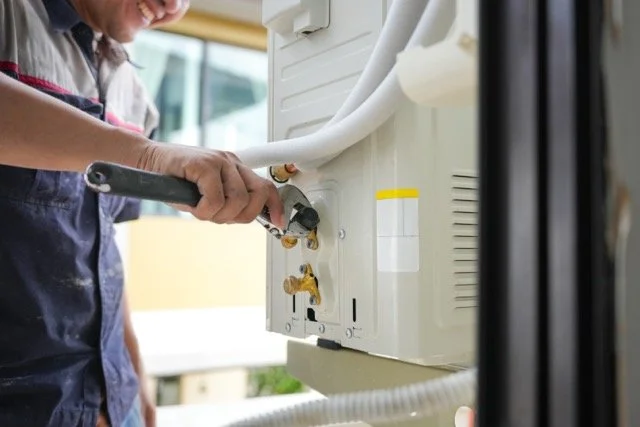
Capacitors are located inside the access panel of your outdoor condenser unit, usually mounted near the compressor or on the control board. They're cylindrical, about the size of a Red Bull can, with wire terminals on top. Even when the power is off, capacitors can hold a lethal charge — this is not a DIY repair.
7 Warning Signs Your AC Capacitor Is Failing
Capacitors don't fail instantly. They degrade over time, and the symptoms escalate. Here's what Warren homeowners typically notice, in the order they usually appear:
1. AC Won't Start or Takes Multiple Attempts
You hear the thermostat click, the contactor engages with a metallic clunk, but the compressor doesn't start. The outdoor unit might click on and off repeatedly as the system tries unsuccessfully to fire up the compressor. This is the classic sign of a failed start capacitor — the motor doesn't have enough voltage to overcome starting resistance.
2. Humming Sound From the Outdoor Unit
The compressor hums loudly but doesn't start. The motor is trying to spin, but without the capacitor's voltage boost, it just sits there vibrating and making noise. If you hear this, turn the system off immediately — the compressor is drawing locked-rotor amperage (LRA), which can overheat windings and cause permanent motor damage within minutes.
3. AC Shuts Off Randomly After 5-15 Minutes
The system starts normally, cools for a few minutes, then shuts down. This usually indicates a failing run capacitor. The motor starts (because the start capacitor is still functional), but without run capacitor support, the motor overheats and the thermal overload switch trips, shutting down the system. It cools off, resets, starts again, and the cycle repeats.
4. Higher Electric Bills With No Usage Change
A weak run capacitor forces the compressor motor to work harder, drawing more amperage to maintain operation. We've measured current draw increases of 15-25% on systems with degraded capacitors. Over a Michigan cooling season, that can add $50-$100 to your electric bill before you even realize there's a problem.
5. Warm Air From Vents Despite Thermostat Calling for Cooling
The indoor blower runs (you feel airflow), but the air isn't cold. This happens when the compressor can't start due to capacitor failure, so the system circulates unconditioned air. If you go outside and the condenser fan isn't spinning or the compressor isn't running, check the capacitor first.
6. Clicking Sounds From the Outdoor Unit
Rapid clicking (every 2-3 seconds) indicates the contactor is engaging and disengaging repeatedly. The control board is trying to start the compressor, the contactor closes to send power, but the compressor can't start without capacitor support, so the safety circuit opens the contactor again. This cycle continues until you shut the system down.
7. Burning Smell or Visible Damage to Capacitor
If you open the access panel (power off, discharge the capacitor safely), a failed capacitor often shows visible signs: bulging sides, rust or corrosion on terminals, oil leaking from the casing, or a burnt smell. Capacitors contain dielectric fluid that can leak when the internal components fail. If you see or smell this, the capacitor is toast.
Michigan-Specific Note: Power surges from summer thunderstorms are a leading cause of sudden capacitor failure in Warren and across Macomb County. If your AC stops working after a storm, the capacitor is the first component we check.
What Causes Capacitor Failure in Warren Homes
Capacitors are wear components — they're designed to last 10-20 years under normal conditions, but several factors accelerate failure in Southeast Michigan:
Heat Exposure
Capacitors are mounted inside the outdoor condenser unit, directly exposed to summer heat. When ambient temperatures exceed 90°F (which happens regularly in Michigan July and August), the internal temperature inside the condenser can reach 120-130°F. Heat degrades the dielectric fluid inside the capacitor, reducing its ability to hold a charge. Systems installed in direct sunlight or on black asphalt pads fail faster than those in shaded locations.
Age and Duty Cycle
Every time your AC cycles on, the start capacitor discharges. A typical Warren home might see 8-12 cycles per day during cooling season. Over 15 years, that's 15,000+ charge/discharge cycles. The internal components (aluminum foil, paper, and dielectric fluid) gradually break down. Most capacitors we replace in Macomb County are 12-18 years old — right at the end of their expected service life.
Voltage Spikes and Power Surges
Lightning strikes, transformer switching, and grid fluctuations send voltage spikes through your electrical system. Capacitors are particularly vulnerable because they're designed to handle specific voltage ranges (typically 370-440 volts AC). A surge above that threshold can puncture the internal dielectric, causing immediate failure. We see a spike in capacitor replacements after major storms roll through Warren and Sterling Heights.
Compressor Overwork From Dirty Coils
When the outdoor coil is clogged with cottonwood seeds (a Michigan spring nightmare), dirt, or grass clippings, the compressor has to work harder to achieve the same cooling output. This increases run time and heat generation, both of which stress the capacitor. If you've skipped a few years of coil cleaning, you're shortening capacitor life.
We cover the importance of regular coil maintenance in our guide to why your AC runs but doesn't cool — it's directly connected to capacitor longevity.
Real Repair Costs for Warren Homeowners
Capacitor replacement is one of the most affordable AC repairs. Here's what Warren homeowners actually pay based on our 2024-2026 service data:
Start Capacitor Replacement: $150-$250
Includes the capacitor (typically $15-$30 wholesale), service call, diagnosis, installation, and system testing. Start capacitors are less common in modern systems but still found in older Goodman, Rheem, and York units.
Run Capacitor Replacement: $150-$300
Run capacitors are slightly more expensive ($20-$40 wholesale) because they're rated for continuous duty and higher microfarad values. Price varies based on capacity rating and whether it's an OEM part or aftermarket equivalent.
Dual Capacitor Replacement: $200-$450
Most common repair. Dual capacitors cost $30-$60 wholesale depending on brand and specifications. Carrier, Lennox, and Trane OEM capacitors are at the higher end. Installation takes 30-45 minutes including safety discharge, wiring verification, and voltage testing.
What Affects the Price?
- OEM vs. Aftermarket: Original equipment manufacturer parts cost 20-30% more but match factory specifications exactly. Aftermarket capacitors (Turbo, Mars, Titan) are reliable and carry the same warranties but cost less.
- Emergency Service: After-hours, weekend, or holiday service typically adds $75-$150 to the base price. If your AC fails on a Saturday afternoon in July, you'll pay more for immediate response.
- Accessibility: If your condenser is in a tight space (behind bushes, under a deck, in a narrow side yard), the repair takes longer and may cost slightly more.
- Additional Repairs: If the capacitor failed due to a related issue (bad contactor, compressor starting to fail, wiring damage), we'll identify it during diagnosis. Addressing those issues adds cost but prevents future breakdowns.
Cost Reality: A capacitor replacement is $150-$450. Ignoring the problem and running the AC with a failed capacitor can burn out the compressor, which costs $2,500-$4,500 to replace — or requires a full system replacement. The math is simple: fix it now.
For more context on AC repair costs in Metro Detroit, see our breakdown of what AC installation actually costs — it helps homeowners understand when repair makes sense versus replacement.
Timeline: How Fast Can This Get Fixed?
Capacitor replacement is fast. Here's the realistic timeline from the moment you call NEXT Heating & Cooling:
Scheduling: Same Day or Next Day
During peak cooling season (June-August), we prioritize no-cooling calls. If you call before noon on a weekday, we can usually get a technician to your Warren home the same day. Afternoon calls typically get next-day service unless you opt for emergency after-hours response.
Diagnosis: 15-30 Minutes
Our NATE-certified technicians arrive with multimeters and capacitor testers. We measure microfarad capacity, check for shorts or opens, test voltage under load, and verify the compressor isn't drawing excessive amperage. Most capacitor failures are obvious — the meter reads zero or far below the rated capacity stamped on the component.
Repair: 30-60 Minutes
Once we confirm the capacitor is bad, replacement takes 30-45 minutes:
- Power off the system at the disconnect and breaker
- Discharge the old capacitor safely (critical safety step)
- Document wire connections (terminals are labeled C, HERM, FAN)
- Remove the old capacitor from the mounting bracket
- Install the new capacitor with correct wire routing
- Secure the mounting bracket and close the access panel
- Restore power and test system startup
- Measure compressor and fan amperage to verify normal operation
- Monitor the system through 2-3 full cycles
Total Time: 1-2 Hours From Arrival to Cold Air
Most Warren homeowners have cold air blowing within 90 minutes of our truck pulling into the driveway. If we discover additional issues during diagnosis (bad contactor, weak compressor, refrigerant leak), we'll explain the options before proceeding.
We stock the most common capacitor sizes on every truck (35µF, 45µF, 55µF, 60µF dual capacitors), so we rarely need to order parts. For unusual sizes or OEM-specific components, we can source them within 24 hours.
If you're facing an emergency AC repair situation, we offer 24/7 response across Macomb County — because a failed capacitor at 11 PM on a 90-degree night isn't something you should have to wait until Monday to fix.
Can You Run Your AC With a Bad Capacitor?
Short answer: No. Do not attempt to run your AC with a failed capacitor. Here's why:
Compressor Damage Risk
When a start capacitor fails, the compressor tries to start but can't overcome the mechanical resistance. It sits there drawing locked-rotor amperage — typically 5-8 times the normal running current. This generates extreme heat in the motor windings. Within 2-3 minutes, you can overheat the windings enough to cause insulation breakdown, which leads to a grounded compressor (total failure).
A capacitor costs $200. A compressor replacement costs $2,500-$4,500 including labor and refrigerant. Running the system "just to see if it works" can turn a cheap repair into a catastrophically expensive one.
Electrical System Stress
Locked-rotor current can trip breakers, damage contactors, and overheat wiring. We've seen cases where homeowners kept resetting the breaker trying to force the AC to start, which eventually melted wire insulation inside the disconnect box. That's a fire hazard and an expensive electrical repair on top of the HVAC issue.
Increased Wear on Other Components
A weak run capacitor forces the compressor to work harder, which increases operating temperature and pressure. This stresses the compressor bearings, refrigerant system, and fan motor. You might get the system to limp along for a few weeks, but you're accelerating wear on every component downstream.
When to Shut Down Immediately: If you hear humming from the outdoor unit, smell burning, or notice the breaker tripping repeatedly, turn off the AC at the thermostat and the outdoor disconnect. Call a licensed HVAC contractor before attempting to restart. These are signs of imminent compressor failure.

How to Prevent Capacitor Failure
You can't eliminate capacitor failure — they're wear components with a finite lifespan — but you can maximize their longevity and catch problems before they escalate:
Annual Maintenance Visits
During a professional tune-up, technicians measure capacitor microfarad values and compare them to the rated capacity stamped on the component. A capacitor rated at 45µF that measures 38µF is nearing failure. Catching it during a spring maintenance visit means you can replace it on your schedule, not at 9 PM on the hottest day of the year.
Our Next Care Plan includes two annual visits (spring AC tune-up, fall furnace tune-up) for $5/month. We test capacitors, measure amperage, clean coils, and catch small problems before they become expensive emergencies. Over the 35+ years we've been serving Southeast Michigan, we've found that homeowners on maintenance plans experience 60-70% fewer emergency breakdowns.
Keep the Outdoor Coil Clean
A clean coil reduces compressor run time and heat generation, both of which extend capacitor life. Spray the coil with a garden hose (top to bottom, inside to outside) every 4-6 weeks during cooling season. Avoid pressure washers — they can bend fins. For heavy buildup, schedule professional coil cleaning as part of your annual maintenance.
Install Surge Protection
Whole-home surge protectors (installed at the main panel) and HVAC-specific surge arrestors (installed at the outdoor disconnect) protect capacitors from voltage spikes. They cost $200-$500 installed but can prevent $2,000+ in storm-related HVAC damage. In Michigan, where summer thunderstorms are routine, surge protection is a smart investment.
Provide Shade for the Outdoor Unit
If your condenser sits in direct sunlight on a south or west-facing wall, consider planting shrubs (3-4 feet away for airflow) or installing a louvered shade structure. Reducing ambient temperature by 10-15°F can extend capacitor life by several years. Just make sure you maintain 24 inches of clearance on all sides for proper airflow.
Replace Aging Systems Proactively
If your AC is 15-20 years old and you're replacing the capacitor for the second or third time, it's a signal that other components (compressor, fan motor, contactor) are nearing end-of-life. At that point, investing in a new high-efficiency system often makes more financial sense than continuing to repair an aging unit. We walk through this decision-making process in our guide on when to replace your AC unit.
For Warren homeowners considering system replacement, our heating and cooling services include load calculations, efficiency analysis, and honest recommendations based on your home's needs — not commission-based upselling.
Need AC Capacitor Repair in Warren?
NEXT Heating & Cooling has been diagnosing and repairing AC systems in Macomb County for over 35 years. Our NATE-certified technicians provide honest diagnostics, fair pricing, and same-day service when you need it most. No upselling. No surprises. Just reliable HVAC service from a Metro Detroit contractor you can trust.
Schedule Your RepairFrequently Asked Questions About AC Capacitor Failure
Most Warren homeowners pay $150-$450 for capacitor replacement, depending on whether it's a start capacitor ($150-$250), run capacitor ($150-$300), or dual capacitor ($200-$450). This includes the part, service call, diagnosis, installation, and testing. Emergency after-hours service typically adds $75-$150.
Diagnosis takes 15-30 minutes. The actual replacement takes 30-45 minutes. From the time our technician arrives at your Warren home to the time you have cold air, expect 1-2 hours. We stock common capacitor sizes on every truck, so we rarely need to order parts.
No. Capacitors store lethal voltage (300-500 volts) even when the power is off. Improper discharge can cause fatal electric shock. Additionally, installing the wrong capacitor size or wiring it incorrectly can damage the compressor or create a fire hazard. This repair requires a licensed HVAC technician with proper tools and training.
Running an AC with a failed start capacitor can burn out the compressor motor within minutes due to locked-rotor amperage and overheating. A weak run capacitor forces the motor to work harder, increasing energy consumption and accelerating wear on bearings and other components. A $200 capacitor repair can become a $2,500-$4,500 compressor replacement if ignored.
Most capacitors last 10-20 years under normal conditions. In Southeast Michigan, factors like summer heat exposure, power surges from thunderstorms, and duty cycle affect lifespan. We typically see capacitor failures in systems that are 12-18 years old. Regular maintenance helps identify weak capacitors before they fail completely.
Heat exposure is the leading cause — capacitors mounted inside outdoor units experience temperatures of 120-130°F during Michigan summers. Other causes include age (charge/discharge cycles degrade internal components), voltage spikes from lightning or grid fluctuations, and compressor overwork from dirty coils or restricted airflow.
Yes. During peak cooling season (June-August), we prioritize no-cooling calls and typically provide same-day service for calls received before noon on weekdays. We also offer 24/7 emergency service for after-hours, weekend, and holiday breakdowns. Visit our about page to learn more about our service commitment to Macomb County homeowners.