

How Often to Change Your Furnace Filter in Michigan

The filter in your furnace is not decorative. It protects your blower motor, keeps dust out of your ductwork, and maintains airflow across your heat exchanger. When it clogs, your furnace works harder, uses more gas, and risks expensive breakdowns.
Most filter manufacturers print "replace every 90 days" on the packaging. That schedule might work in Arizona or Florida. It does not work in Michigan. Our heating season runs seven months. Homes stay sealed tight from October through April. Dust, pet dander, and construction debris accumulate faster here than in climates where windows stay open year-round.
We have been providing heating and cooling services in Metro Detroit for over 35 years. We see the same pattern every winter: homeowners follow the 90-day rule, then wonder why their furnace short-cycles or their energy bills spike. The filter is the first thing we check during service calls, and it is clogged more often than not.
This guide explains when to actually replace your furnace filter based on real conditions in Southeast Michigan homes. No generic advice. Just the schedule that keeps your system running efficiently through polar vortex events and lake-effect cold snaps.
Why Michigan Homes Need Different Filter Schedules
Michigan furnaces run longer and harder than systems in most other states. Our heating season stretches from early October through late April, sometimes into May. That is seven months of daily operation, often cycling 8-12 times per day during January and February cold spells.
Compare that to a home in Tennessee or North Carolina, where the furnace might run three months total. The filter in a Sterling Heights ranch accumulates more debris in one Michigan winter than a southern furnace sees in two years.
Lake-effect weather patterns bring moisture that settles dust. Construction activity across Macomb County and Oakland County kicks up fine particulates that drift into homes through gaps around doors, windows, and attic access points. Even newer homes with good sealing collect dust faster than you would expect because the HVAC system is pulling air through every crack and penetration in the building envelope.
Pet ownership changes everything. Dogs and cats shed constantly. Dander is microscopic and stays airborne for hours before settling. A single medium-sized dog generates enough dander to clog a standard pleated filter in 30-45 days during heating season. Two dogs or a couple of cats? You are looking at monthly replacements.
Homes with forced-air systems recirculate the same air 20-30 times per day. Every pass through the return duct pulls a percentage of airborne particles into the filter. The longer your furnace runs, the faster the filter loads up. This is why regular DIY maintenance matters so much in our climate.
The Real Filter Replacement Schedule for Southeast Michigan
Forget the generic 90-day rule. Here is the actual replacement schedule based on home conditions we see across Troy, Warren, St. Clair Shores, and surrounding communities:
Standard Homes (No Pets, Average Dust)
Replace every 60-90 days during heating season (October-April). You can stretch to 90 days if your home is newer, sealed well, and located away from construction or heavy traffic. Older homes with more air leakage should stick to 60 days.
Check the filter at 45 days. If it looks dark gray or brown, swap it early. If it still looks relatively clean, you can wait another couple of weeks.
Homes with Pets
One dog or cat: replace every 30-45 days. Two or more pets: replace every 30 days, no exceptions. Pet dander clogs filters faster than any other common household contaminant. The fine particles pack into the pleats and restrict airflow even when the filter does not look visibly dirty.
We have seen blower motors fail in homes where the owners insisted their filter "still looked fine" after two months. When we pulled the filter and held it to the light, nothing passed through. The surface looked acceptable, but the interior pleats were completely packed.
Homes with Allergies or Asthma
Replace every 30 days year-round. Higher-efficiency filters (MERV 11-13) trap more particles but also clog faster. Monthly replacement keeps airflow strong and indoor air quality high. This is especially important during spring pollen season and fall ragweed season, when outdoor allergens infiltrate through opened doors and windows.
Vacation Homes or Minimal Use
If your furnace only runs occasionally, you can extend replacement to every six months. The filter is not processing much air, so debris accumulation stays minimal. Still worth checking every couple of months, especially if the home sits near a lake where humidity can cause mold growth on the filter media.
New Construction or Remodeling
Replace monthly for the first year after construction or major remodeling. Drywall dust, sawdust, insulation fibers, and other construction debris will destroy a filter in weeks. We have seen brand-new furnaces clog completely within 30 days of a home finishing construction because the builder did not change the filter frequently enough during the build process.
After the first year, switch to the standard schedule based on your household conditions.
Pro Tip: Write the installation date on the filter frame with a permanent marker. This eliminates guesswork and helps you track your actual replacement intervals. Most homeowners think they change filters more often than they actually do.
How to Check If Your Filter Needs Replacement
You do not need to wait for a scheduled replacement date if the filter is clogged. Here is how to check:
Turn off your furnace. Flip the switch on the furnace cabinet or turn off the breaker. You do not want the blower running while you have the filter out.
Locate the filter slot. Most furnaces have the filter in the return air duct or inside the furnace cabinet. If you have a side-return system, the filter might be in a wall-mounted grille. Check your furnace manual if you are not sure.
Pull the filter out carefully. Note which direction the arrows point. The arrow indicates airflow direction and must point toward the furnace when you reinstall.
Hold the filter up to a light source. A ceiling light or window works. Can you see light passing through the pleats? If the filter blocks most of the light, it is clogged and needs replacement immediately.
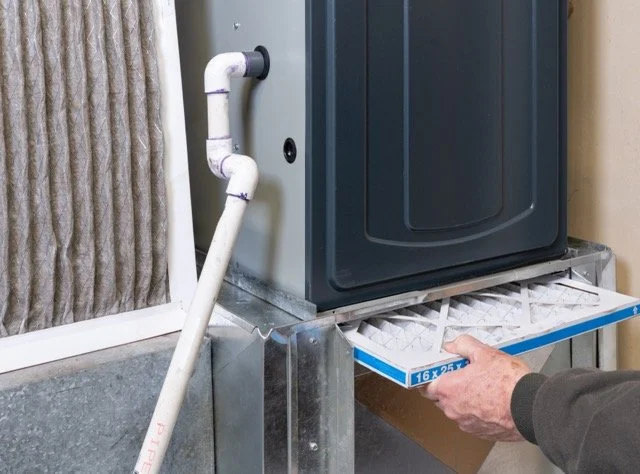
Check for visible dirt accumulation. The filter surface should be white or light gray when new. If it is dark gray, brown, or black, replace it. If you see dust buildup around the edges or gaps where air has bypassed the filter, you have a sizing problem or installation issue that needs fixing.
Feel for airflow reduction. Stand near a return air grille while the furnace runs. If airflow feels weak compared to what you remember when the filter was new, the filter is likely clogged. You can also check the supply registers. Reduced airflow at the registers often indicates a dirty filter or ductwork problems.
If you are noticing your thermostat not reaching the set temperature, a clogged filter is one of the most common causes. Restricted airflow prevents your furnace from delivering enough heated air to satisfy the thermostat.
What Happens When You Don't Change Your Filter
A clogged filter does not just reduce airflow. It creates a cascade of problems that cost real money to fix.
Reduced Efficiency and Higher Energy Bills
A dirty filter forces your blower motor to work harder to pull air through the clogged media. The motor draws more electricity. The furnace runs longer cycles to heat the home because airflow across the heat exchanger is restricted. You use more gas and more electricity to achieve the same comfort level.
The U.S. Department of Energy estimates that a clogged filter can increase energy consumption by 15-30% during heating season. On a $200 monthly gas bill, that is $30-60 wasted per month. Over a Michigan winter, you could spend $150-300 extra just because you did not swap a $15 filter.
Heat Exchanger Stress and Cracking Risk
Restricted airflow causes heat to build up inside the furnace cabinet. The heat exchanger gets hotter than designed. Metal expands and contracts with each heating cycle. Over time, this thermal stress creates cracks in the heat exchanger.
A cracked heat exchanger is a safety hazard. Combustion gases, including carbon monoxide, can leak into your home's air supply. Most HVAC contractors will not repair a cracked heat exchanger. The furnace gets red-tagged and you are looking at a replacement. In Southeast Michigan, that is $3,500-$7,000 depending on the unit and installation complexity.
We have seen multiple cases where homeowners ignored filter changes for a year or more, then faced a complete furnace replacement because the heat exchanger failed. A $15 filter could have prevented a $5,000 repair bill.
Blower Motor Failure
The blower motor is designed to move a specific volume of air against a certain resistance. A clogged filter increases that resistance dramatically. The motor draws more amperage, heats up, and wears out faster.
Blower motor replacement in a residential furnace costs $400-$800 in parts and labor. Most motors fail prematurely because of dirty filters, not age. If you are experiencing furnace short-cycling, the blower motor might be overheating due to restricted airflow.
Ductwork Contamination
When a filter clogs completely, air finds the path of least resistance. It bypasses the filter through gaps around the frame or pulls dust directly through the clogged media. That dust ends up in your ductwork, on your supply registers, and recirculating through your home.
Duct cleaning costs $400-$800 for an average home in Macomb County. If you have ever wondered what bad air ducts smell like, accumulated dust and debris create musty odors that indicate contamination.
Choosing the Right Filter for Your Furnace
Not all filters are created equal. The filter you choose affects airflow, filtration efficiency, and replacement frequency.
MERV Ratings Explained
MERV stands for Minimum Efficiency Reporting Value. It measures how effectively a filter captures particles of different sizes. The scale runs from MERV 1 (basic fiberglass) to MERV 16 (hospital-grade HEPA).
Higher MERV ratings trap smaller particles but also restrict airflow more. Your furnace blower is designed to handle a certain level of resistance. Installing a filter that is too restrictive can cause the same problems as a clogged filter: reduced airflow, overheating, and premature component failure.
MERV 8: The Standard for Most Homes
MERV 8 filters capture dust, pollen, mold spores, and pet dander. They provide good filtration without significantly restricting airflow. Most residential furnaces are designed to handle MERV 8 filters without issues.
This is the sweet spot for homes without specific air quality concerns. Brands like Filtrete, Nordic Pure, and Honeywell all make reliable MERV 8 filters. Expect to pay $15-25 for a quality pleated filter.
MERV 11: Better Filtration for Allergy Sufferers
MERV 11 filters capture smaller particles, including some bacteria and smoke. They are a good choice for homes with allergies, asthma, or respiratory sensitivities.
The tradeoff is slightly higher airflow restriction. Check your furnace manual to confirm your blower can handle MERV 11. Most modern furnaces (installed in the last 10-15 years) have no problem. Older units with single-speed blowers might struggle.
MERV 11 filters clog faster than MERV 8, so expect to replace them every 30-45 days during heating season.
MERV 13: High Efficiency, High Maintenance
MERV 13 filters capture very fine particles, including viruses and combustion particles. They are excellent for homes with severe allergies or immune-compromised residents.
These filters create significant airflow restriction. Do not install MERV 13 unless your HVAC contractor confirms your system can handle it. Many residential furnaces cannot. You risk overheating the heat exchanger and burning out the blower motor.
MERV 13 filters require monthly replacement during heating season, sometimes more often. They cost $25-40 each.
Pleated vs. Fiberglass
Fiberglass filters are cheap ($1-3) and provide minimal filtration. They catch large particles like lint and dust bunnies but do almost nothing for air quality. They are designed to protect the blower motor, not your lungs.
Pleated filters use folded media to increase surface area. More surface area means better filtration and longer service life before clogging. Spend the extra $10-15 for a pleated filter. Your furnace and your respiratory system will thank you.
Filter Size Matters
Filters are sized by width, height, and depth. Common sizes include 16x25x1, 20x25x1, and 16x20x1. The size is usually printed on the filter frame.
Installing the wrong size creates gaps that allow air to bypass the filter. Dust flows around the filter instead of through it. Your ductwork gets dirty and your indoor air quality suffers.
Measure your filter slot if you are not sure of the size. Most home improvement stores and HVAC suppliers stock common sizes. If you have an odd size, order online or ask your HVAC contractor to supply filters during service visits.
Next Care Plan members get seasonal filter reminders and discounted filter delivery. Our $5/month HVAC maintenance plan includes two annual tune-ups (fall furnace check, spring AC check) and priority scheduling when you need service.
Signs Your Furnace Has Other Problems Beyond the Filter
Sometimes a dirty filter is a symptom, not the root cause. If you are changing filters on schedule but still experiencing problems, your furnace might have deeper issues.
Short Cycling
If your furnace runs for 3-5 minutes, shuts off, then restarts a few minutes later, that is short cycling. A clogged filter can cause this by restricting airflow and triggering the high-limit switch. But if the problem continues after installing a fresh filter, you likely have a thermostat issue, oversized furnace, or failing flame sensor.
Uneven Heating
Cold spots in certain rooms usually indicate ductwork problems, not filter issues. Leaky ducts, undersized return grilles, or closed dampers restrict airflow to specific zones. A clean filter will not fix that. You need a duct inspection and possibly duct sealing or balancing.
Strange Noises
Rattling, banging, or squealing noises point to mechanical problems. Loose blower wheels, failing bearings, or cracked heat exchangers all create distinct sounds. A dirty filter might contribute to blower motor strain, but the noise itself indicates component failure that requires professional diagnosis.
When to Call a Technician
If you have replaced the filter and still notice reduced airflow, uneven heating, or unusual sounds, call a licensed HVAC contractor. These symptoms indicate problems that homeowners cannot safely diagnose or repair.
Our NATE-certified technicians perform thorough diagnostics before recommending repairs. We explain what is wrong, show you the failed component, and give you options. No pressure, no upselling unnecessary equipment.
If you are facing a furnace breakdown in the middle of a Michigan winter, we offer 24/7 emergency service across Macomb, Oakland, and St. Clair counties. Our emergency furnace repair guide walks through what to do when your heat fails at 2 AM.
Ready to Get Started?
NEXT Heating & Cooling has been keeping Michigan homes comfortable for over 35 years. Get honest diagnostics and fair pricing from NATE-certified technicians who show up on time.
Schedule Your ServiceFrequently Asked Questions
Not unless it is specifically labeled as washable or reusable. Standard pleated filters are designed for single use. Washing them damages the media and reduces filtration efficiency. Washable filters exist, but they require thorough cleaning and complete drying before reinstallation. Most homeowners find disposable filters more convenient and cost-effective.
MERV 8 works for most homes without specific air quality concerns. MERV 11 is better if you have allergies, asthma, or pets. Do not jump to MERV 13 or higher unless your HVAC contractor confirms your system can handle the increased airflow restriction. Higher MERV ratings require more frequent replacement and can damage furnaces not designed for them.
Yes. A clogged filter restricts airflow, which causes heat buildup in the furnace cabinet. This can crack the heat exchanger, burn out the blower motor, or trigger safety shutoffs. We have seen furnaces fail completely because the filter was not changed for a year or more. Regular filter replacement is the cheapest insurance policy for your heating system.
Check the existing filter. The size is usually printed on the cardboard frame (for example, 16x25x1 or 20x20x1). If the printing is faded or missing, measure the filter slot with a tape measure. Measure width, height, and depth. Round to the nearest whole inch. Most filters are 1 inch thick, but some systems use 4-inch or 5-inch media filters.
No. Installing a filter with too high a MERV rating creates excessive airflow restriction. The blower motor works harder, draws more electricity, and can overheat. The heat exchanger does not get enough airflow and can crack. Stick with the MERV rating recommended in your furnace manual or ask your HVAC contractor what your system can safely handle.
Yes. Every filter has an arrow printed on the frame indicating airflow direction. The arrow must point toward the furnace (in the direction of airflow). Installing a filter backwards reduces filtration efficiency and can damage the filter media. Always check the arrow before sliding the filter into the slot.
Whole-home air cleaners (electronic air cleaners or media cabinets) provide better filtration than standard 1-inch filters. They are worth considering if you have severe allergies, asthma, or respiratory conditions. Media cabinets use 4-inch or 5-inch filters that last 6-12 months. Electronic cleaners require periodic cleaning but never need replacement. Expect to invest $800-1,500 for installation. Your HVAC contractor can assess whether your ductwork and furnace can accommodate a whole-home system.