

Rheem Furnace Repair in Southeast Michigan | NEXT HVAC
Rheem builds solid furnaces. We see them in homes across Sterling Heights, Rochester Hills, and Grosse Pointe Farms every day. When they break down, it's rarely dramatic. Most Rheem furnaces give you warning signs: a clicking igniter that won't light, a blower motor that sounds louder than it should, or a flame sensor covered in enough residue to shut the burners down mid-cycle.
We've been repairing Rheem furnaces in Southeast Michigan for over 35 years under Premier Builder Inc. The brand's modular design makes repairs straightforward when you know what you're looking at. Rheem uses standardized control boards, pressure switches, and ignition systems across most of their residential gas furnace lineup, which means parts availability is good and diagnostic protocols are consistent.
This guide covers the Rheem-specific problems we diagnose most often in Metro Detroit, what those error codes flashing on your control board actually mean, and when repair makes more financial sense than replacement. If you need furnace and AC installation services, we'll explain that too, but most Rheem furnaces under 15 years old are worth fixing.
How Rheem Furnaces Work: The Basics
Rheem residential gas furnaces operate on a straightforward combustion cycle. When your thermostat calls for heat, the control board initiates a startup sequence: the induced draft blower motor spins up to create negative pressure in the heat exchanger, pulling combustion gases safely out through the vent pipe. Once the pressure switch confirms proper airflow, the hot surface igniter glows red-hot for about 30 seconds.
The gas valve opens, sending natural gas or propane to the burners. The igniter lights the gas. The flame sensor, a thin metal rod positioned in the burner flame, confirms ignition within five seconds. If it doesn't detect flame, the control board shuts the gas valve immediately as a safety measure. This is why furnace smells like burning when turned on issues sometimes point to delayed ignition or debris on the burners.
Once the burners fire, the heat exchanger warms up. When the heat exchanger reaches around 120-130°F, the blower motor kicks on, pushing heated air through your ductwork. The blower continues running until the thermostat is satisfied or the heat exchanger cools below the fan-off temperature limit. Rheem's two-stage and modulating furnaces add complexity, running at lower capacities most of the time to improve efficiency and reduce temperature swings.
Michigan winters stress these components. When outdoor temperatures drop below 10°F during a polar vortex, your furnace runs longer cycles. Condensation forms inside the heat exchanger on high-efficiency models (90%+ AFUE), which is normal, but that acidic condensate can corrode the heat exchanger over 15-20 years if the condensate drain clogs.
Common Rheem Furnace Problems We Fix in Metro Detroit
Most Rheem furnace repairs in Southeast Michigan fall into a few predictable categories. These are the issues our NATE-certified HVAC technicians diagnose most frequently in homes across Macomb and Oakland counties.
Flame Sensor Failure
The flame sensor is a $20 part that causes 40% of no-heat service calls. It sits in the burner flame, generating a tiny electrical current (microamps) when heated. If the sensor rod is coated in carbon buildup or corrosion, it can't conduct current properly. The control board interprets this as no flame detected and shuts the gas valve after three failed ignition attempts.
You'll see the igniter glow, the burners light for 3-5 seconds, then shut off. The cycle repeats. Cleaning the flame sensor with fine-grit sandpaper or steel wool restores conductivity in about five minutes. We carry replacements on every truck because older sensors sometimes crack at the ceramic insulator.
Pressure Switch Problems
Rheem furnaces use pressure switches to confirm the induced draft blower is pulling sufficient airflow before allowing ignition. A stuck-open or stuck-closed pressure switch prevents the furnace from starting. Common causes: a clogged condensate drain line backing water into the pressure switch tubing, a cracked inducer housing leaking air, or a failed pressure switch diaphragm.
We see more pressure switch issues in homes with finished basements where the condensate drain runs a long horizontal distance before reaching a floor drain or condensate pump. If the drain line freezes or clogs with algae, water backs up and blocks the pressure switch tubing. Similar to AC frozen coil issues, drainage problems cause cascading failures.
Igniter Burnout
Hot surface igniters last 3-7 years depending on how many cycles your furnace runs. They're fragile silicon carbide or silicon nitride elements that crack from thermal expansion and contraction. When an igniter fails, it either won't glow at all or glows weakly without reaching the 1800°F needed to ignite gas.
Rheem uses a few different igniter models depending on furnace series. We stock the most common ones: the 62-22868-xx series and the universal replacement igniters that fit multiple Rheem, Ruud, and Weatherking models. Replacement takes 15 minutes once we confirm the igniter is the problem and not a control board voltage issue.
Blower Motor and Capacitor Failure
Blower motors fail less often than igniters or flame sensors, but when they do, you'll know it. Symptoms include no airflow even though the furnace fires, a loud humming noise from the blower compartment, or a burning smell from an overheating motor winding.
The blower motor capacitor fails more frequently than the motor itself. The capacitor provides the voltage boost needed to start the motor spinning. A weak or failed capacitor causes the motor to hum but not spin, or to start slowly and overheat. Capacitors are inexpensive ($30-60) and quick to replace. Blower motors run $300-600 for the part depending on horsepower and whether it's a variable-speed ECM motor.
Michigan-Specific Issue: Homes built in the 1960s-1980s across Warren, Sterling Heights, and Clinton Township often have undersized ductwork. When a blower motor pushes against high static pressure from restrictive ducts, it works harder and fails sooner. We measure static pressure during every diagnostic to catch this before it kills a new motor.
Control Board Failures
Control boards are the brain of your furnace. They sequence the startup, monitor safety switches, and shut the system down if something goes wrong. Rheem control boards fail from power surges, moisture intrusion, or component wear after 10-15 years.
A failed control board displays erratic behavior: the furnace might start and stop randomly, ignore thermostat calls, or flash error codes that don't match the actual problem. Control boards cost $200-500 depending on the model. We always check for underlying issues (a shorted blower motor, a bad transformer, a corroded wire connection) before replacing a board, because those same issues can kill the new board.
Rheem Furnace Error Codes Decoded
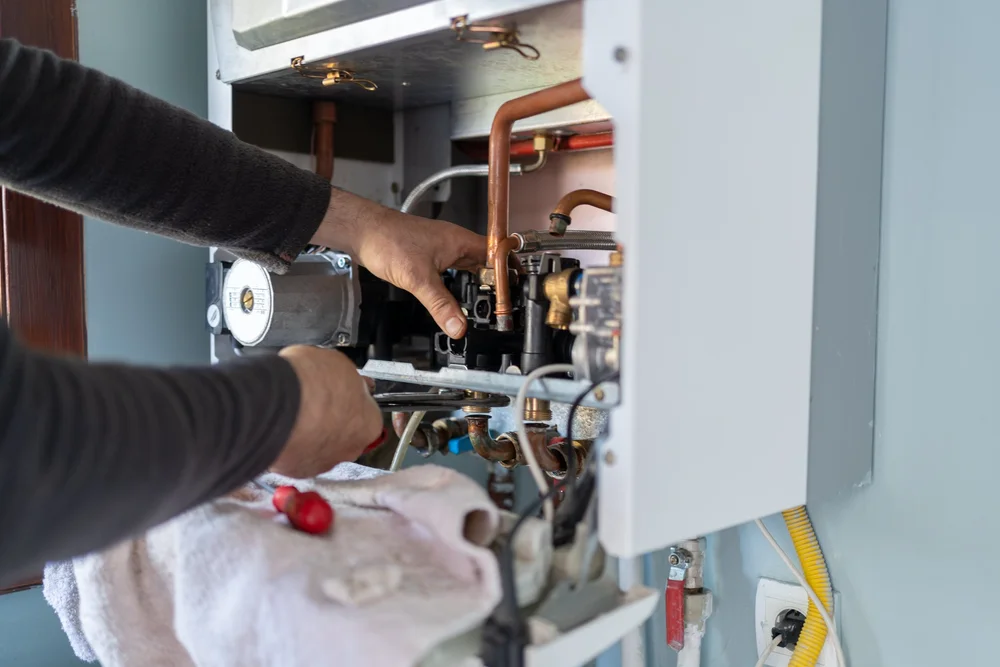
Rheem furnaces flash LED codes on the control board to indicate what's wrong. The number of flashes corresponds to a specific fault. You'll need to open the blower compartment door and watch the LED on the control board. Count the flashes, note the pause, then count again to confirm the pattern.
Here are the most common Rheem error codes and what they mean:
- 1 Flash: Normal operation. No fault detected.
- 2 Flashes: Pressure switch stuck closed. Check for a blocked vent, failed inducer motor, or pressure switch tubing issue.
- 3 Flashes: Pressure switch stuck open. The inducer is running but the pressure switch isn't closing. Common causes: clogged condensate drain, cracked inducer housing, failed pressure switch.
- 4 Flashes: Open high-limit switch. The furnace overheated and the safety limit tripped. Causes: dirty filter, blocked return air, failed blower motor, or a cracked heat exchanger allowing flames to overheat the limit switch.
- 6 Flashes: Flame detected when no flame should be present (flame rollout or stuck gas valve). This is a serious safety issue. Shut the furnace off and call for service immediately.
- 7 Flashes: Flame sensor failure. The burners light but the flame sensor doesn't detect flame, so the control board shuts the gas valve. Clean or replace the flame sensor.
- 8 Flashes: Control board detected a grounding issue or internal fault. Could be a bad board, a shorted wire, or a failed component sending incorrect voltage.
If you're seeing error codes and need immediate help, our emergency HVAC service in Macomb County is available 24/7 during Michigan winters. We don't charge extra for after-hours diagnostics, just honest labor and parts.
When to Repair vs. Replace Your Rheem Furnace
The decision between repairing and replacing a Rheem furnace comes down to age, efficiency, and cost. Here's the framework we use when talking to homeowners in Rochester Hills, Troy, and Bloomfield Hills.
Age of the Furnace
Rheem furnaces last 15-20 years with proper maintenance. If your furnace is under 10 years old, repair almost always makes sense unless the heat exchanger is cracked (rare on newer units). Between 10-15 years, it depends on the repair cost and the furnace's efficiency. Over 15 years, you're weighing repair costs against the remaining lifespan and the energy savings from a new high-efficiency model.
A furnace installed in 2010 likely has an AFUE (Annual Fuel Utilization Efficiency) rating of 80-92%. New Rheem furnaces hit 96-98% AFUE. On a $1,200 annual gas bill, upgrading from an 80% furnace to a 96% furnace saves about $240/year. That payback matters when you're deciding whether to invest $800 in repairs on a 14-year-old furnace.
Cost of the Repair
We use a simple rule: if the repair cost exceeds 50% of a new furnace's cost and the furnace is over 12 years old, replacement makes more financial sense. A $1,500 repair on a 14-year-old furnace is harder to justify than a $400 flame sensor and pressure switch replacement on the same unit.
Heat exchanger cracks are the exception. Heat exchanger replacement costs $1,200-2,000 in labor and parts because it requires disassembling the entire furnace. At that price point, most homeowners choose replacement unless the furnace is under warranty (Rheem offers a 10-year limited warranty on heat exchangers for registered units).
Frequency of Repairs
If you've had three or more service calls in the past two years, the furnace is telling you something. Repeated failures indicate wear across multiple components. You might fix the igniter today, then the blower motor next month, then the gas valve in January. At some point, you're paying for a furnace rebuild one part at a time.
This is where our $5/month HVAC maintenance plan helps. Regular tune-ups catch small issues before they cascade into expensive failures. We clean flame sensors, check pressure switch tubing, measure blower motor amperage, and test igniter resistance during every visit. Preventive maintenance extends furnace lifespan and reduces emergency repair calls.
Real Example: We recently serviced a 2008 Rheem furnace in Shelby Township. The homeowner had replaced the igniter twice and the pressure switch once in the past 18 months. During our diagnostic, we found the heat exchanger had a hairline crack and the blower motor was drawing 20% over rated amperage. Total repair cost: $2,400. A new 96% AFUE Rheem furnace installed: $4,200. They chose replacement and will save about $200/year on gas bills.
What Rheem Furnace Repair Costs in Southeast Michigan
Repair costs depend on the failed component, labor time, and whether we're working during regular hours or on an emergency call. Here are typical price ranges for common Rheem furnace repairs in Metro Detroit as of 2026. These include parts, labor, and diagnostic fees.
- Flame Sensor Cleaning/Replacement: $150-250. Quick fix, high success rate.
- Hot Surface Igniter Replacement: $200-350. Includes testing voltage to the igniter and confirming proper grounding.
- Pressure Switch Replacement: $180-320. We also check condensate drain lines and inducer motor operation.
- Blower Motor Capacitor: $120-200. Simple replacement, but we test the motor's condition while we're there.
- Blower Motor Replacement: $450-900. Variable-speed ECM motors cost more than single-speed PSC motors.
- Control Board Replacement: $400-750. Includes verifying all wiring connections and testing safety switches.
- Gas Valve Replacement: $350-600. Requires gas line shutdown, leak testing, and combustion analysis afterward.
- Inducer Motor Replacement: $450-750. Labor-intensive because the inducer sits inside the burner box.
- Heat Exchanger Replacement: $1,200-2,000. Rarely cost-effective unless the furnace is under warranty.
These prices reflect fair market rates for licensed, insured HVAC contractors in Southeast Michigan. We don't charge diagnostic fees separately if you proceed with the repair. If you're comparing quotes, make sure you're comparing the same scope of work. Some contractors quote parts-only prices, then add labor and trip charges later. We give you the total upfront.
For context, AC installation costs in Mount Clemens run significantly higher than furnace repairs, which is why we emphasize preventive maintenance to extend equipment life.
Why Choose NEXT Heating & Cooling for Rheem Furnace Repair
We've been repairing Rheem furnaces in Southeast Michigan since Premier Builder Inc. started in 1991. Our technicians carry Rheem parts on every service truck because we see enough Rheem installations across Macomb and Oakland counties to stock the high-failure components: igniters, flame sensors, pressure switches, and blower capacitors.
We're not a commissioned sales company. Our techs diagnose the problem, explain what's wrong in plain language, and give you options. If your furnace needs a $200 flame sensor, we're not going to pitch you a $5,000 replacement. If the furnace is 16 years old and needs a $1,400 heat exchanger, we'll explain why replacement makes more sense and what that costs. You decide.
NEXT Heating & Cooling holds a Michigan Mechanical Contractor License, maintains BBB A+ accreditation, and employs NATE-certified technicians who know the difference between a Rheem RGPJ series control board and an RGFD series board without looking it up. We show up on time, explain the problem clearly, and clean up when we're done.
Our service area covers all of Macomb, Oakland, and St. Clair counties. Whether you're in Lake Orion, St. Clair Shores, or Detroit, we're the reliable HVAC contractor in Metro Detroit your neighbors call when their Rheem furnace stops working at 9 PM on a Tuesday in January.
Need Rheem Furnace Repair?
NEXT Heating & Cooling has been keeping Michigan homes warm for over 35 years. Our NATE-certified technicians diagnose Rheem furnace problems fast and fix them right the first time. No upselling, no runaround, just honest service.
Schedule Your RepairFrequently Asked Questions About Rheem Furnace Repair
Rheem furnaces last 15-20 years in Southeast Michigan with regular maintenance. Harsh winters and frequent cycling can reduce lifespan if the furnace is undersized or poorly maintained. Homes with dirty filters, blocked returns, or neglected tune-ups see failures closer to the 12-15 year mark. Our affordable HVAC maintenance plan includes seasonal inspections that catch problems early and extend equipment life.
If the igniter glows orange or red but the burners don't light, the gas valve isn't opening. Common causes: a failed gas valve, a tripped manual gas shutoff, low gas pressure from the utility, or a control board that's not sending voltage to the gas valve. Less common: a clogged burner orifice or a pressure switch that's not closing properly. We test voltage at the gas valve terminals and gas pressure at the manifold to isolate the problem.
Yes, if you're comfortable working around gas appliances. Turn off power at the breaker and gas at the manual shutoff valve. Remove the burner assembly cover and locate the flame sensor rod (thin metal rod near the burners). Unscrew it, clean the rod gently with fine-grit sandpaper or steel wool until it's shiny, then reinstall. Don't use harsh chemicals or abrasive pads that could damage the rod. If cleaning doesn't fix the problem, the sensor might be cracked or the control board could have a grounding issue.
Diagnostic service calls typically run $100-150 in Southeast Michigan. At NEXT Heating & Cooling, we waive the diagnostic fee if you proceed with the repair. Emergency after-hours calls may include a trip charge, but we don't mark up parts or inflate labor rates at night. Total repair costs depend on the failed component, ranging from $150 for a flame sensor to $900 for a blower motor. We give you the total price before starting work.
Rheem and Ruud are the same company. Ruud is Rheem's sister brand, using identical components, control boards, and heat exchangers. The only difference is the logo on the cabinet. Parts are interchangeable between Rheem and Ruud models from the same production year. We stock parts that fit both brands because we see them equally often in Metro Detroit homes.
It depends on the repair cost and the furnace's efficiency. If the repair is under $600 and the furnace has been reliable, repair makes sense. If you're looking at $1,000+ in repairs on a 12-year-old 80% AFUE furnace, replacement might save you money long-term through lower gas bills. A new 96% AFUE Rheem furnace saves $200-300/year on a typical Michigan heating bill. We'll walk you through the math and let you decide. Similar logic applies to central air replacement decisions.
Short cycling happens when the furnace overheats and the high-limit switch trips, shutting the burners off. Common causes: a clogged air filter restricting airflow, a failed blower motor or capacitor, closed supply registers in too many rooms, or undersized ductwork creating high static pressure. Less common: a cracked heat exchanger causing flame rollout. We measure temperature rise across the heat exchanger and static pressure in the ductwork to diagnose the root cause. This issue shares similarities with frequent furnace cycling problems we see across all brands.